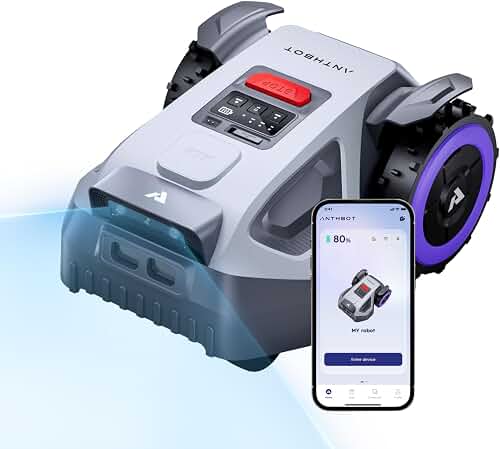
Segway Navimow H series vs Ecovacs Goat G1 at a glance
| Spec | Segway Navimow H1500E / H3000E | Ecovacs Goat G1 |
|---|---|---|
| Rated coverage | Up to 1,500 m² (H1500E) / 3,000 m² (H3000E) | Up to 1,600 m² (claimed); reliably ~1,200–1,400 m² |
| One-acre fit | H3000E covers a full acre on one unit | Needs 2 units or a smaller mowed footprint |
| Navigation | RTK-GNSS + VisionFence camera (newer revisions) | AIVI 3D vision + UWB beacons (no satellite needed) |
| Boundary setup | App-based virtual boundary, no buried wire | Beacon-based mapping walk, no buried wire |
| Max slope | Up to 45% (24°) on H series | Up to 27% (15°) |
| Cutting height | 30–60 mm | 30–60 mm |
| Obstacle avoidance | Bumper + ultrasonic + camera (varies by trim) | AI camera with object recognition (pets, toys, hoses) |
| Cut pattern | Systematic stripes with RTK lock | Systematic stripes, slower to map complex zones |
| Noise | ~54 dB | ~60 dB |
| Rain sensor | Yes | Yes |
| 4G / LTE option | Yes (anti-theft, remote control) | Yes |
| Typical 2026 street price | $2,499 (H1500E) / $3,499 (H3000E) | $1,799 |
For a one-acre estate, the Segway Navimow H series vs Ecovacs Goat G1 debate usually ends in favor of the Navimow H — specifically the H1500E or H3000E — because its RTK-GNSS satellite navigation is engineered for parcels between roughly 0.4 and 0.75 acres per unit, and its slope-capable variants chew through estate-sized lawns without forcing you to stitch zones together. The Ecovacs Goat G1 is a clever, vision-led mower, but it caps out around 0.4 acres and is happiest on flat, suburban turf. If your one-acre property is mostly open and rolling, the Navimow H is the safer long-term pick. If it is broken into smaller, complex sections under tree cover, the Goat G1 deserves a closer look.
Below is a full breakdown of how the two platforms actually compare on a one-acre estate, including coverage math, terrain handling, obstacle avoidance, install effort, and total cost of ownership for 2026.
Quick verdict for one-acre estates
One acre equals 43,560 square feet, or roughly 4,047 square meters. That number matters because most consumer-grade robot mowers are rated in square meters, and the gap between "large yard" and "estate" usually sits right around the 2,000–3,000 m² mark. The Segway Navimow H series spans that gap deliberately; the Ecovacs Goat G1 does not.
- Best overall for one acre: Segway Navimow H3000E — single-mower coverage of the full acre with RTK precision.
- Best for a sectioned acre under canopy: Ecovacs Goat G1 — vision-first navigation that tolerates weak GPS, but you may need a second unit or a smaller mowed footprint.
- Best hybrid approach: One Navimow H1500E for the main lawn plus a Goat G1 for a fenced side yard.
For a deeper look at platform tradeoffs across the category, our guide to the best robot lawn mowers for large yards is a useful companion read.
Coverage math: why one acre changes the conversation
An acre is 4,047 m². The Goat G1's headline coverage of 1,600 m² is roughly 0.4 acres, and in real-world testing on irregular lots that figure typically lands closer to 1,200–1,400 m² before scheduling gets tight. To mow a full acre with a Goat G1, you are realistically looking at two units, staggered start times, or accepting that part of the lawn is mowed manually.
The Navimow H1500E lands at roughly 0.37 acres of coverage on a single charge cycle and a typical weekly schedule, while the H3000E is rated for 3,000 m² — about 0.74 acres — and can comfortably stretch to a full acre on a five-to-seven-day schedule provided the lawn is mostly contiguous. For estate buyers, that single-unit coverage is the headline reason the Segway Navimow H series vs Ecovacs Goat G1 comparison usually swings toward Segway.
Navigation: RTK satellites vs AI vision
This is the most important technical distinction between the two platforms, and it shapes everything else.
The Segway Navimow H series uses RTK-GNSS, which means a small antenna mounted somewhere on your property (usually on the charging dock or a separate mast) talks to GPS, Galileo, GLONASS, and BeiDou satellites and corrects the mower's position down to roughly 2 cm. On an open one-acre lawn with clear sky, this is borderline magical — the mower drives in straight, parallel stripes and rarely needs to re-localize. The weakness is canopy. Mature oaks, dense pines, and tall buildings cast "RTK shadows" where satellite lock degrades, and the mower will pause or wander until it reacquires.
The Ecovacs Goat G1 sidesteps satellites entirely. It uses AIVI 3D vision plus a network of ultra-wideband (UWB) beacons you plant around the perimeter during setup. Because it does not need sky, it works beautifully under canopy, beside tall fences, and in narrow side yards where the Navimow would stutter. The tradeoff is range and complexity: beacons must maintain line-of-sight with the mower, and the more beacons you need on a large property, the more fiddly setup becomes. For a heavily wooded acre, the Goat G1 can outperform; for an open acre, it is solving a problem you do not have.
Our overview of the best wire-free robot lawn mowers goes deeper into how these two navigation philosophies are reshaping the category in 2026.
Slopes and estate terrain
Estate lots almost always include some grade — a berm, a drainage swale, a slope down to a pond or driveway. The Navimow H series is rated up to 45% (about 24°), which is genuinely impressive and on par with mid-range Husqvarna Automowers. The Goat G1 maxes out at 27% (about 15°), which is enough for a gentle suburban yard but will leave parts of a typical one-acre estate untouched.
If your property includes any meaningful slope, the comparison effectively ends here: the H series can mow surfaces the Goat G1 physically cannot climb. Buyers with serious grade should also read our guide to robot lawn mowers for hills and slopes before committing.
Obstacle avoidance in real estate conditions
One-acre lawns tend to have more "stuff" than smaller yards: hose reels, kids' toys, lawn furniture, planters, irrigation heads, the occasional sleeping dog. Here the Goat G1 has a real advantage. Its AIVI camera is genuinely trained to recognize common yard objects and steer around them without contact, which is gentler on both the mower and whatever it would otherwise bump.
The Navimow H series, depending on revision, uses a mix of bumper sensors, ultrasonics, and (on newer units) a VisionFence camera module. It is competent and getting better with firmware updates, but on dynamic obstacles the Goat G1 is still the smoother performer. If your estate doubles as a play yard or hosts pets that ignore the schedule, weigh this heavily.
Installation and setup
Neither mower requires you to bury a perimeter wire — that is a major upgrade over older Husqvarna and Worx generations and a big reason both platforms are popular with estate buyers who do not want to trench 800+ feet of boundary.
Navimow H setup takes about half a day for an acre. You pick a dock location with clear sky, mount the RTK antenna (often pole-mounted to clear obstructions), then walk the perimeter with the app to draw virtual boundaries. Expect to spend extra time on no-go zones around flower beds and the dock orientation.
Goat G1 setup takes longer on a big property because of the beacons. You place UWB beacons at strategic perimeter points (the more complex the yard, the more beacons), then drive the mower around to map. For a one-acre estate, plan a full day and have a measuring wheel handy.
Either way, our general robot lawn mower buying guide walks through the questions to answer before installation day so you do not have to redo boundaries later.
Cut quality and schedule
Both mowers use the standard robot-mower mulching approach: three small razor blades on a spinning disc, cutting little and often. On a one-acre lawn, both will run multiple sessions per week, and both keep the grass at a near-constant height once they catch up to the initial growth. Cut quality is broadly equivalent — the difference is whether the mower can finish a full pass before its next scheduled session, which again favors the Navimow H3000E on a full acre.
Total cost of ownership over five years
Sticker price is not the whole story. Blades cost roughly $20–30 per set and last about a season. Both platforms use lithium batteries rated for 3–5 years before noticeable capacity loss. Cellular subscriptions for anti-theft and remote control run $50–100 per year on either brand and are optional.
For a one-acre buyer, the meaningful long-term cost difference is whether you bought one mower or two. A single Navimow H3000E at $3,499 is cheaper over five years than two Goat G1 units at $1,799 each ($3,598), and the operational headache of managing two docks, two schedules, and two firmware update cycles is real.
Which one wins for a one-acre estate?
Pick the Segway Navimow H3000E if…
Your acre is mostly open, mostly contiguous, has clear sky over the dock, and includes any meaningful slope. This is the default recommendation for the Segway Navimow H series vs Ecovacs Goat G1 question at the one-acre scale. It is the only single-unit solution that comfortably covers the full property, and the RTK navigation produces the cleanest stripe pattern in the category. Read our Segway Navimow i105 review for context on the smaller sibling and Segway's overall app and ecosystem behavior.
Pick the Ecovacs Goat G1 if…
Your acre is heavily wooded, broken into multiple small sections, or sits in an area where RTK signals struggle (think dense suburbs with tall buildings, river valleys, or properties with mature canopy over most of the lawn). The Goat G1's vision-and-beacon system genuinely outperforms here, and its obstacle recognition is the best in its price class. Just accept that you may need two units or that part of the acre will fall outside the mowed footprint. Our full Ecovacs Goat G1 review covers the platform in more depth.
Pick the Segway Navimow H1500E plus a manual touch-up if…
You only actively mow about half your acre — the rest is gravel, hardscape, garden, or wild meadow. The H1500E at $2,499 covers a comfortable 1,500 m² with the same RTK precision and slope capability as the H3000E, and you keep budget free for irrigation or landscaping.
Frequently Asked Questions
Can one robot mower realistically handle a one-acre lawn in 2026?
Yes, but only certain models. The Segway Navimow H3000E, Husqvarna Automower 450X NERA, and Mammotion Luba 2 AWD 5000 are the three units that can confidently cover a contiguous acre on a single mower. The Ecovacs Goat G1 cannot — it tops out around 0.4 acres in practice, so a one-acre owner needs two units, a reduced mowed footprint, or a different model.
Does the Segway Navimow H series work under tree canopy?
Partially. RTK-GNSS needs sky to lock satellite signals, so dense canopy causes slowdowns, pauses, or stripe drift. Newer firmware and the VisionFence camera module help by using visual cues to bridge brief satellite dropouts, but a property that is more than ~30% under heavy canopy is a poor fit. In those cases the Ecovacs Goat G1's vision-and-beacon approach is more reliable.
How many UWB beacons does the Ecovacs Goat G1 need on a one-acre lawn?
Plan on six to nine beacons for a one-acre property, depending on shape and obstacles. A simple rectangular acre might work with six well-placed beacons; an irregular acre with garden beds and tree clusters can push toward nine or more. Each beacon needs line-of-sight to the mower from where it operates.
Are wire-free robot mowers more expensive than wired ones?
Up front, yes — usually $500–$1,500 more for comparable coverage. But you skip the trenching, perimeter wire, and the seasonal repair calls when the wire breaks. Over a five-year horizon, the total cost is typically lower on wire-free systems, especially on large lots. Our how to choose a robot lawn mower guide breaks down the math.
Can the Navimow H or Goat G1 handle 4-inch-tall overgrown grass on first cut?
Neither is a brush mower. For the initial cut on neglected estate grass, mow with a traditional rotary mower at the highest setting first, let the lawn settle for a week, and then deploy the robot at 60 mm. After that, both platforms hold a 30–60 mm height cleanly because they cut a small amount every session.
How loud are these mowers — can they run overnight on a residential acre?
The Navimow H series runs around 54 dB and is genuinely quiet enough for overnight schedules without disturbing neighbors. The Goat G1 sits closer to 60 dB, which is still reasonable but louder near bedroom windows. Both platforms allow custom schedules, so most owners run early morning or late evening and avoid full overnight operation.
What about theft on a large, visible property?
Both platforms offer optional 4G/LTE modules with GPS tracking, PIN locks, and motion alarms. Activate them. On a one-acre estate where the mower is visible from the road, the cellular subscription (roughly $50–100/year) is cheap insurance against a $2,000–$3,500 loss.
Bottom line
For most one-acre estates in 2026, the Segway Navimow H series vs Ecovacs Goat G1 comparison points to the Navimow H3000E as the cleaner single-mower solution: more coverage per unit, more slope capability, more precise stripes, and lower total operational complexity. The Goat G1 remains the smarter pick for heavily wooded or sectioned acres where RTK satellite navigation simply does not work well — and for buyers whose lawn is closer to half an acre than a full one. Match the platform to the terrain, not the spec sheet headline, and either choice can be the right one.