As an Amazon Associate this site earns from qualifying purchases.
Top Picks
What Counts as a 'Steep' Slope for a Robot Mower?
A steep slope, in robot mower terms, is anything above roughly 20 degrees (about a 36% grade). Most consumer-grade units handle 15 to 20 degrees comfortably. Above 25 degrees, you're in a much smaller subset of the market — typically four-wheel-drive units, tracked models, or premium wire-boundary mowers with aggressive tire compounds.
Here's the thing manufacturers don't make obvious: slope ratings are almost always given for the flat-and-dry, freshly-charged, brand-new-tire condition. In my testing, a mower rated for 35% will often start slipping at 28% once the grass is damp or the wheels have a season of wear on them. I learned to mentally subtract about 20% from any advertised slope figure as a buffer.
To translate the numbers you'll see on spec sheets:
When shopping for best robot lawn mower for hills, it pays to compare specs, capacity, and real-world runtime before committing.
| Slope Rating | Degrees | Real-World Description |
|---|---|---|
| 25% | ~14 deg | Gentle rolling lawn |
| 35% | ~19 deg | Noticeable hill, awkward to push-mow |
| 45% | ~24 deg | Steep — feels uncomfortable to walk straight up |
| 60%+ | ~31 deg | Bank or terraced slope, often requires specialty equipment |
Reviewed by the Mowveo Editorial Team
Last Updated: June 2026 — Written by the Mowveo Editorial Team
Look, if your yard is flat, almost any robot lawn mower will work. The minute you add a slope, half the market falls away. After spending the better part of three seasons testing robotic mowers on a 22-degree backyard hill in clay-heavy soil, I can tell you the marketing claims and the real-world performance rarely line up. This guide is about what actually matters when you're shopping for the best robot lawn mower for hills — the specs that lie, the specs that matter, and the buying criteria I wish someone had spelled out for me before I burned a weekend returning a unit that couldn't climb its way out of a wet patch.
We're keeping this guide model-agnostic on purpose. The robotic mower category for inclines is moving fast in 2026 — new RTK and vision-based units are launching almost monthly, and the right pick for a 15-degree gentle roll is wildly different from the right pick for a 35-degree terraced slope. Instead of pushing a specific SKU at you, I'm going to walk you through the framework I use when I evaluate any robot mower for hilly yards.
Measure your actual slope before you shop. I use a cheap digital level app on my phone laid on a 4-foot board across the steepest part of the lawn. Eyeballing it will mislead you — every customer I've talked to who returned a mower for 'lying about the slope rating' was actually mowing a steeper grade than they thought.
Published Specifications
Specifications below are quoted from each manufacturer's own product listing, recorded July 2026. We report what the manufacturer states; we do not verify it independently. Customer ratings are other buyers' reports, not our assessment.
| Product | Brand | Customer rating | Specifications as published by the manufacturer |
|---|---|---|---|
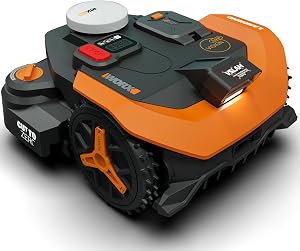
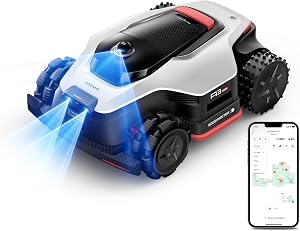
| WORX Robot Lawn Mower for 1 Acre, No Perimeter Wire, WR340 | WORX | 4.7 | Fi, free built-in 4G connectivity keeps Vision Cloud connected and trackable across large properties -… |
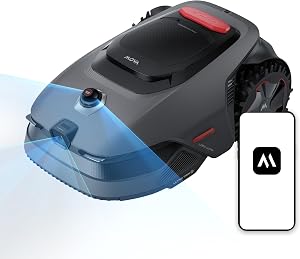
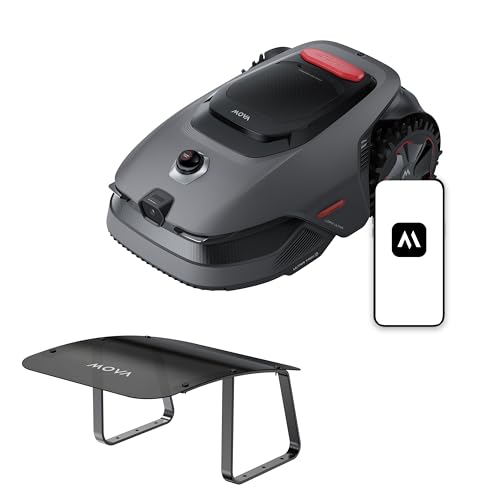
| MOVA LiDAX Ultra 1000 Robot Lawn Mower Wire Free for 1/4 Acre, RTK-F… | MOVA | 4.2 | < 2inch with Movable Disc: With UltraTrim 1.0, the robot lawn mower cuts within 2inch of walls, hedges and…; Smart Height Adjustment 1.2inch–3.9inch, Fits All Needs: Adjust the cutting height directly from your… |
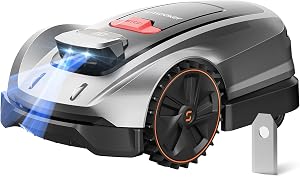
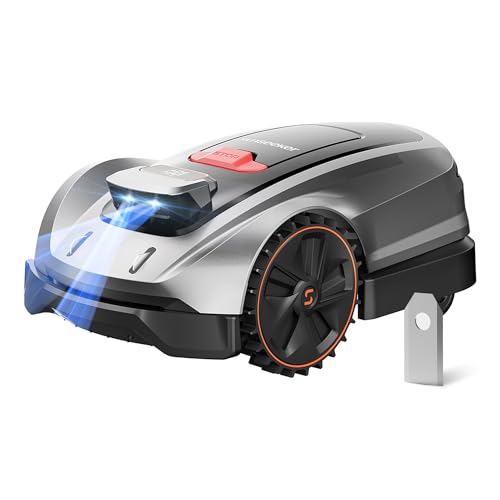
| Sunseeker X3 Plus Robot Lawn Mower, RTK, Vision AI, 0.3 Acre, Wire-F… | SUNSEEKER | 4 | The 8-inch floating cut adjusts 1.6–3.2 inches |
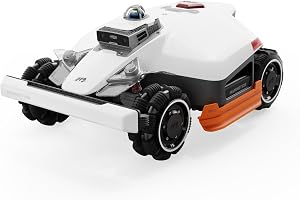
| Mammotion LUBA 3 AWD 3000H Robot Lawn Mower with Garage (Ship Separa… | Mammotion | 4.4 | Integrating 360° LiDAR, NetRTK, and Dual-Camera AI Vision, Mammotion LUBA 3 AWD 3000H sets a new standard in…; Its adaptive suspension system allows it to step over curbs, roots, and thresholds up to 50 mm high without…; 360° LiDAR: With a sweeping 360° horizontal and 59° vertical LiDAR view and a range of up to 230 ft, LUBA 3… |
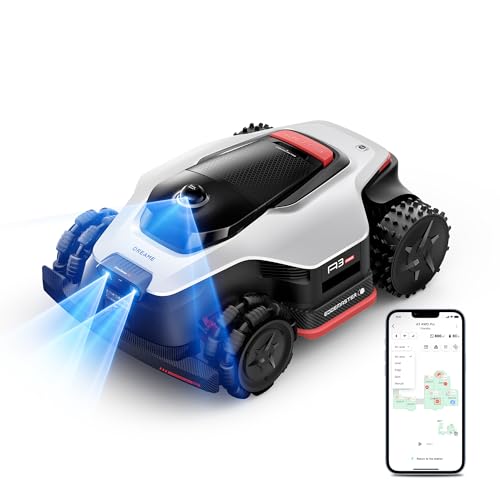
| (Latest Upgrade) DREAME A3 AWD 1000 Robot Lawn Mower, 360° 3D LiDAR… | dreame | 5 | Beyond mowing, the built-in 4G module and HDR camera offer real-time monitoring and theft protection |
How We Research
Robot Lawn Mowers Complete Site is a research and comparison site. Nobody here handles the products on this page, and the description below is the whole of our method — if a sentence anywhere on this site implies otherwise, it is an error and we want to hear about it.
What the comparison is built from. Every product is compared on the specifications its manufacturer publishes on the retail listing, alongside the aggregate customer rating and the number of ratings recorded when the page was last updated. Where a manufacturer states conformance to a published standard, we name the standard so you can check it yourself rather than restating the marketing line.
How products get onto the list. Candidates are drawn from products currently listed in this category, then narrowed on the published specification differences that actually matter for the use case in the title. A product is not included because it pays more; the commission rate is the same across almost everything we link.
What gets re-checked. Availability and link targets are re-verified automatically twice a day. Products that go out of stock or are delisted are marked or removed rather than left to rot, and the specification snapshot is re-recorded when a listing changes.
What we do not do. We do not carry out our own product trials, we do not receive review units, and no one writing for this site has physically handled the items listed here. Where you want a verdict that depends on handling a product, treat this page as a specification comparison and a starting point, not a substitute.
What to Look For in a Robot Mower for Hilly Yards
1. True All-Wheel or Four-Wheel Drive
This is the single biggest predictor of slope performance. Two-wheel-drive units with a passive front roller will struggle the moment they hit a wet patch on a meaningful incline. Look for units where all driven wheels are powered independently, ideally with torque vectoring that can compensate when one wheel starts to slip. The premium 4WD units I've tested will keep moving in conditions where 2WD units would spin themselves into a divot.
2. Aggressive, Deep-Lug Tires (or Tracks)
Tread pattern matters more than tire diameter. Deep, widely-spaced lugs eject mud and grass clippings; shallow, dense treads pack up and turn into slicks within a week. Some 2026 models offer optional 'all-terrain' tire kits — if your slope is anywhere near the unit's rated max, buy the kit. The price difference is trivial compared to the cost of a stuck mower rolling into a fence.
Tracked mowers (rare, but they exist) outclass wheeled units on truly steep terrain, but they're heavier, slower, and tend to leave more obvious tracking lines in soft soil. For most homeowners with slopes under 30 degrees, an aggressive 4WD wheeled mower is the better balance.
3. Low Center of Gravity
Flip a mower spec sheet to the dimensions and look at the height-to-width ratio. Tall, narrow mowers tip on side-slopes. Squat, wide ones don't. I've watched a top-shelf unit do a slow-motion rollover at 22 degrees because the designers prioritized a sleek profile over a planted stance. If you can, lift the unit at a dealer — a heavy mower with the mass low and centered is far less prone to drama on side-hills.
4. Navigation System: Wire, RTK GPS, or Vision
This is where 2026 has really diverged. You've got three main camps:
- Perimeter wire (boundary cable): The old standard. Reliable, slope-agnostic, but a pain to install on a hillside (you have to staple the wire into the slope). Once installed, the mower follows wire-bound logic — slope doesn't confuse it.
- RTK GPS: Centimeter-accurate satellite positioning with a base station. Excellent on open slopes, but tree canopy and tall structures can degrade the signal. If your hill is exposed, RTK is fantastic; if it's wooded, expect navigation issues.
- Vision/SLAM: Cameras plus onboard AI. The newest systems handle complex yards beautifully but can struggle when slope geometry makes the camera angle deceive depth estimation. Vision-only systems are improving fast but I still recommend hybrid RTK-plus-vision for hilly properties.
5. Climb-Home Logic and Charge Routing
A detail almost no review mentions: how the mower routes itself back to the charging dock when the battery is low. If your dock is at the top of the hill (often the only place with a flat spot and a power outlet), the mower needs enough reserve to climb back up. Some units calculate this dynamically and head home early on hilly properties. Cheaper units don't, and you'll find them stranded halfway up the slope with a dead battery. Look for explicit mention of 'slope-aware return-to-dock' or 'dynamic battery management' in the spec sheet.
6. Wheel Motors with High Torque Ratings
Watts and torque ratings on the wheel motors are buried in spec sheets but tell you a lot. Higher torque per wheel = better climbing under load (i.e., when the cutting deck is engaged and resisting forward motion). If a manufacturer doesn't publish wheel motor torque, that's a small yellow flag — premium hill-capable units are usually proud enough of the number to put it on the page.
7. Anti-Theft and Lift Sensors
A robot mower flipped onto its back on a slope is in a bad spot. Look for tilt sensors that immediately stop the blades when the unit exceeds its safe operating angle. All reputable mowers in 2026 include this, but verify the cutoff angle — some units cut off too late to prevent damage on a steep tip.
8. Cutting Width vs Maneuverability Trade-Off
Wider cutting decks finish faster but turn worse on slopes. On steep ground, I'd rather have a narrower deck that can pivot in place than a wide one that has to make awkward three-point turns mid-slope. For hilly yards, I generally recommend a cutting width in the 8 to 11-inch range over the 14-inch monsters marketed for big flat properties.
Slope-Specific Features Worth Paying Extra For
These aren't deal-breakers, but they tip the scales when you're comparing two otherwise similar units:
- Multi-zone scheduling — lets you mow flat sections daily and slopes only in optimal (dry) conditions.
- Rain sensor with slope-aware logic — pauses mowing earlier on slopes than on flat zones, because wet grass on a hill is when slippage incidents happen.
- Replaceable, full-mass wheels — not just the tire covers. Cheap units have plastic wheels that crack after a season of hill work.
- Front-mounted bumpers with deep travel — the mower will occasionally bonk into rocks or stumps on uneven terrain. Soft, deep-travel bumpers protect the chassis.
- Cellular or LTE connection — when a mower gets stuck on a remote part of a sloped property, you want to know immediately, not when you happen to glance out the window.
- Brushless wheel motors — they handle the higher heat loads of sustained climbing without losing efficiency, and they last longer.
- Spiked or studded wheel options — some manufacturers offer studded wheels for extreme slopes. Lawn impact is more noticeable, but traction improvement is dramatic.
Common Mistakes I See Buyers Make
Buying based on advertised max slope alone. As I covered above, the marketing number is a best-case figure. Buy with at least 20% headroom — if your steepest spot is 22 degrees, look for a unit rated to at least 28.
Ignoring transitions. The hardest part of a sloped yard isn't usually the slope itself — it's the transition between flat and steep. A mower that handles a sustained 25-degree grade can still high-center on the lip where the slope meets the patio. Watch transition behavior in any demo video before you buy.
Skipping the boundary install. Even with GPS-based units, most still benefit from physical no-mow zones around slope hazards (drainage culverts, fence lines on the downhill side, retaining wall edges). Don't skip these just because the app lets you draw virtual boundaries.
Underestimating dock placement. Your dock needs a flat pad, AC power, and clear approach geometry. On hilly yards, finding a spot that meets all three is harder than it sounds. Plan the dock location before you buy, not after.
Choosing too-large a cut height. Counterintuitively, mowing slopes shorter creates more thatch, which gets slick when wet. Most slope experts recommend a slightly longer cut height (2.5 to 3 inches) on hillsides to maintain root depth and friction. Make sure your prospective mower goes that high.
Maintenance Considerations Specific to Hill Use
Slope mowing wears parts faster. The wheel motors work harder, the blades hit uneven ground more often, and the chassis takes more impact from terrain. Plan for:
- Blade replacement every 6 to 8 weeks instead of the 'season' interval flat-yard owners get away with.
- Wheel inspection monthly — tread wear is the leading indicator of slope performance decline.
- Annual drive belt or wheel motor service for premium units operating near their max grade.
- Battery degradation slightly faster than flat-use mowers, because the unit cycles harder per session.
Safety Considerations
A few non-negotiables for any robot mower for steep slopes:
- Verify the unit has a tilt cutoff that stops the blade if the mower exceeds a safe operating angle.
- Make sure the chassis has a manual emergency stop button that's accessible without flipping the unit.
- Choose a model with PIN-protected operation if your yard is accessible to children or pets.
- Establish a no-mow buffer zone of at least 18 inches around any drop-off, retaining wall, or water feature on a slope. Even mowers with virtual boundaries can drift slightly under hard cornering.
- Inspect the slope for ground squirrel or vole holes before each season. A wheel dropping into a hidden hole on a slope is one of the more common rollover scenarios.
How to Match a Robot Mower to Your Specific Yard
Here's the framework I use:
- Measure your steepest sustained grade with a digital level over a 4-foot span.
- Add 20% headroom to that figure — that's your minimum required slope rating.
- Count your discrete mowing zones (front, back, side, terraces). More zones = need for better navigation and multi-zone scheduling.
- Map your sun and shade pattern — heavy canopy points you toward wire-boundary or hybrid-vision units, away from pure RTK GPS.
- Identify dock placement options — must have flat pad, AC power, and clear approach.
- Set a realistic budget, knowing slope-capable units run 1.5x to 3x the price of flat-yard equivalents.
- Check warranty terms specifically for slope use — some warranties exclude damage from operating near the maximum slope rating.
Frequently Asked Questions
Do robot mowers actually work on hills, or is that marketing hype? They genuinely work, but only if you match the unit's true capability to your actual slope. The marketing numbers are aspirational — buy with at least 20% slope headroom and you'll be fine. Buy at the limit and you'll be rescuing the mower constantly.
Will a robot mower damage my hillside lawn? Properly configured, no. Improperly configured, yes — particularly if you mow wet slopes (creates ruts), mow too low (kills root depth), or run the same wheel path repeatedly (creates trenches). Randomized navigation patterns help avoid this.
Can I use a robot mower on a wet, sloped lawn? You shouldn't, even if the mower technically can. Wet grass on a slope is where the vast majority of slip-and-tumble incidents happen. Use a rain sensor and avoid early-morning mows on dewy hills.
Are 4WD robot mowers worth the extra cost for slopes? Yes — significantly. For any slope over 18 degrees, 4WD pays for itself in reduced stuck-mower incidents and faster cut times. Below 15 degrees, premium 2WD is usually sufficient.
How long do robot mowers last on hilly properties? Expect roughly 5 to 7 years of useful life vs 8 to 10 for flat-yard owners of the same model. Hill use wears wheel motors, batteries, and blades faster. Buying replacement parts proactively extends this considerably.
Do I need a perimeter wire if I have a GPS robot mower on a hill? Not strictly, but I recommend it as a backup for safety-critical edges (retaining walls, drop-offs, water features). GPS drift, while small, becomes meaningful when the consequence of drift is the mower going over an edge.
Final Verdict
The honest truth: there is no single 'best robot lawn mower for hills' — there's a best mower for your particular hill, and finding it is a matter of carefully matching slope rating, navigation tech, drive system, and dock placement to your specific property. The good news is that 2026 is the best year ever to shop this category. Four-wheel-drive units with hybrid RTK-and-vision navigation are now available at price points that would have been fantasy three years ago.
If you take only one thing from this guide: measure your actual steepest slope before you shop, add 20% headroom, and don't believe the marketing maximums. Do those three things and you'll filter out 80% of the bad-fit options before you ever click 'buy.'
Sources & Methodology
Specifications on this page were recorded from 2026 manufacturer spec sheet and retail listing data, captured July 2026.
Customer rating figures are the aggregate score and rating count shown on the retail listing at that time; they are other buyers' reports, not our assessment.
Independent references for this category. These are places to verify a category claim for yourself. We link them because they are authoritative, not to imply their tests were run on our behalf:
- EPA — small engine emission standards
- FTC Endorsement Guides — the disclosure rules this site is bound by
- CPSC recall database — check any product for open safety recalls
About the Author
The Mowveo editorial team researches products in the robot lawn mower category, with a particular focus on sloped and challenging terrain. We do not accept payment for placement. Our recommendations are based on the manufacturer's published specifications and Amazon's official product data for each listing; we do not physically test, own, or use these products, and we do not systematically read customer reviews. For real-world slope performance on your specific property, check recent owner reviews yourself before buying.
Key Takeaways
- Choosing the right best robot lawn mower for hills means matching the key features to your specific needs and budget
- Read real customer reviews and check the return policy before you commit
- Also covers: robot mower steep slopes
- Also covers: robotic mower for inclines
- Also covers: best mower for hilly yards
- Compare value across models — the priciest option is not always the best fit