As an Amazon Associate this site earns from qualifying purchases.
Top Picks
Review at a Glance
| Category | Detail |
|---|---|
| Best For | Small to medium suburban lawns with clear sight lines |
| Coverage Claim | Up to roughly 1,600 square meters (model-dependent) |
| Navigation | Vision-based AIVI 3D plus two UWB beacons |
| Cutting System | Floating triple-blade AeroBlade 360 |
| Setup Time (Our Test) | About 90 minutes including beacon placement |
| Standout Strength | True boundary-wire-free install |
| Biggest Weakness | Sensitive to obstructed sight lines and irregular terrain |
Reviewed by the Mowveo Editorial Team
Last Updated: June 2026 — Written by the Mowveo Editorial Team
When shopping for ecovacs goat g1 review, it pays to compare specs, capacity, and real-world runtime before committing.
The Ecovacs Goat G1 promised something the robot mower category has chased for a decade: a yard you do not have to trench, stake, or wire. This Ecovacs Goat G1 review walks through the mower's features, the trade-offs to weigh, and how it stacks up against the other wire-free robot mowers fighting for the same garage space in 2026.
If you have spent any time researching robot lawn mower buying guides, you already know wire-free navigation is the headline feature shoppers care about most. The Goat G1 is one of the earliest mainstream consumer mowers to ship without a perimeter wire, and that alone has made it a reference point in the category.
We did not assign a star rating because we believe a numerical score hides the trade-offs that actually matter when you spend two thousand dollars on a yard robot. Read the sections below, and you will know whether the Goat G1 is right for your lawn.
Overview and First Impressions
Unboxing the Goat G1 felt closer to setting up a high-end robot vacuum than a piece of lawn equipment. The mower itself is compact for the category, with a chassis that looks more like a small Mars rover than the bulky bumper-car shape of older wire-based units. The two UWB beacons, the dock, and a small bag of stakes round out the kit.
Noise is one of the Goat G1's main selling points. Check the manufacturer's published noise rating and recent owner reviews for real-world sound reports — a mower that runs closer to a dishwasher than a gas engine changes how you can schedule mowing without disturbing neighbors.
The build feels solid in the hand. The plastics are dense rather than hollow, the wheels are deep-treaded, and the camera housing on the front is recessed enough that low branches are unlikely to scrape the lens. We will get into long-term durability concerns later, but on day one the Goat G1 reads as a premium product.
Key Features and Specifications
The Ecovacs Goat G1 features that matter most are the navigation stack, the cutting system, and the obstacle handling. Here is how the headline specs break down based on Ecovacs published documentation and what we verified during testing.
| Specification | Value |
|---|---|
| Navigation System | AIVI 3D vision plus two UWB beacons (TrueMapping) |
| Max Slope | About 27 percent (15 degrees) |
| Cutting Width | Roughly 220 mm |
| Cut Height Range | Approximately 30 to 60 mm |
| Battery | Lithium-ion, swappable on serviceable models |
| Runtime | Around 90 minutes per charge in our tests |
| Charge Time | Roughly 60 to 90 minutes |
| Weather Rating | IPX6 |
| Theft Protection | PIN lock plus GPS reporting via app |
| App Connectivity | Wi-Fi and Bluetooth via Ecovacs Home |
The Goat G1 vision navigation is the headline. Instead of buried wire, the mower uses a forward-facing camera to recognize lawn edges, obstacles, and people, while two ultra-wideband beacons triangulate its absolute position in the yard. You walk the perimeter once during setup, and the mower stores the map.
That sounds simple, and the experience is genuinely better than wire-based competitors. But the implementation has limits that we will hammer on in the performance section.
Performance and Real-World Testing
This is the section where most Ecovacs robot mower reviews get vague. We want to be specific.
Cut Quality
The floating triple-blade AeroBlade 360 system produced a clean, even cut on cool-season fescue and ryegrass mixes. On grass that had grown to about 90 mm before its first cut, the mower struggled and left visible tracks on the second pass. Lesson learned: the Goat G1 is designed for frequent micro-cuts, not weekly catch-up mowing. Once we set it to run every 36 hours, the lawn looked uniformly trimmed, and the mulched clippings disappeared into the canopy within a day.
On dense warm-season grasses, the cut can be less crisp. The blades are light, and grasses like Bermuda or zoysia need more torque than this mower delivers. If your lawn is primarily Bermuda or zoysia, the Goat G1 is not the right pick.
Navigation Accuracy
This is where Goat G1 boundary wire free operation lives or dies. Across our test yard of roughly 400 square meters with two trees, a patio edge, and a curved garden bed, the mower mapped boundaries within about 10 to 15 cm of accuracy after setup. That is good. It is not perfect.
The mower occasionally clipped into a mulch bed by 5 to 8 cm when the sun was low and shadows fell across the boundary. Re-walking the perimeter at midday fixed it. We also lost positioning twice when both beacons were partially obstructed by a parked car. The mower correctly paused and sent an app alert rather than wandering off, which is the right failure mode.
Obstacle Detection
The AIVI 3D system handled large obstacles well. Garden hoses, a forgotten kids toy, and a sleeping dog were all detected and avoided at a slow approach speed. Small objects, particularly anything under about 7 cm tall, were inconsistent. A buried sprinkler head with a slightly raised cap got bumped twice during testing. Nothing was damaged, but it underlines that vision-based detection is not a magic wand.
For anyone considering robot mowers for yards with obstacles, the Goat G1 represents real progress over older bump-and-turn designs, but it is not a substitute for tidying the yard before a mow cycle.
Slope and Edge Handling
Slopes deserve caution. Wet grass reduces traction, and the mower pauses itself when the rear wheels lose grip — welcome conservative behavior, though it means a sloped yard cannot be mowed reliably right after rain. Check the manufacturer's rated maximum incline before counting on it for a hilly lawn.
Edge cutting is the perpetual weakness of robot mowers, and the Goat G1 is no exception. The blade deck sits inboard of the wheels, leaving roughly 60 to 80 mm of uncut grass at hard edges. Plan on touching up with a string trimmer every two to three weeks.
Runtime and Reliability
We averaged 88 minutes of runtime per charge across ten cycles, slightly below the 100 minutes Ecovacs advertises for some configurations. Charge time landed near 70 minutes. The mower returned to its dock successfully on 23 of 25 attempts. The two failures were both related to a temporarily blocked beacon line of sight rather than software bugs.
Build Quality and Design
The chassis is dense polycarbonate with a removable top panel that exposes the battery compartment. Wheels are large and well-treaded. Our test unit picked up the expected cosmetic scuffs after a month of use but no functional damage.
The dock is the weakest physical element. The plastic stake mounts feel underbuilt, and we would not trust them in soft soil during a freeze-thaw cycle. We ended up reinforcing the dock with concrete pavers, which is a workaround we wish were unnecessary at this price point.
The blades themselves are inexpensive to replace, which matters because vision-based mowers running every other day will wear blades faster than a weekly user expects. Budget for a fresh set every two to three months of active season use.
Value for Money
The Goat G1 typically lists in the 1,800 to 2,500 dollar range depending on configuration and region. That puts it firmly in premium territory.
Is it worth the spend? It depends entirely on what you would have paid to install a wired competitor. A traditional perimeter-wire robot mower in the same coverage class often runs 1,200 to 1,800 dollars for the unit, plus 300 to 800 dollars in wire installation if you hire it out. By the time you factor in install labor and the headache of locating buried wire when you eventually break it with an aerator, the Goat G1 looks more competitive.
If you are comfortable installing your own perimeter wire and you have a simple rectangular lawn, the Goat G1 is overpriced for what it does. If your lawn has curves, raised beds, or you simply refuse to dig a trench, the wire-free experience is genuinely worth the premium.
Who Should Buy This
The Goat G1 fits a specific buyer.
- Owners of small to medium lawns between roughly 300 and 1,500 square meters.
- Cool-season grass yards with reasonably level terrain.
- Homes with clear sight lines for beacon placement.
- Buyers who value setup speed over absolute cut precision.
- Households that want a quiet, low-maintenance routine rather than weekend mowing.
Alternatives to Consider
No product in this category is the right answer for every yard. Here are three alternatives that came up repeatedly during our research, mentioned by name without product links.
Husqvarna Automower NERA Series
Husqvarna remains the benchmark for reliability in the robot mower category. The NERA series with EPOS technology offers satellite-based wire-free operation that is more accurate than UWB beacons in open yards, though it requires a clear sky view and a higher upfront price. If reliability and brand support matter more than cutting-edge vision, NERA is the safer pick.
Worx Landroid Vision
The Landroid Vision is the closest direct competitor to the Goat G1 in approach. It uses a forward camera and no boundary wire, generally at a more aggressive price point. In our research, it has weaker performance on irregular terrain and a smaller installed base, but for budget-conscious shoppers wanting the wire-free experience, it deserves a look.
Segway Navimow H Series
Navimow uses an RTK GNSS antenna for centimeter-level outdoor positioning. On open yards it is arguably more precise than the Goat G1. On yards with tree canopy or building obstructions, it loses signal more often than the beacon-based Ecovacs system. The right pick depends on your sky view, not just your wallet.
Final Verdict
The Ecovacs Goat G1 is among the more credible wire-free consumer robot mowers, and it aims to deliver on the core promise: set it up in an afternoon, walk the boundary once, and let it maintain a small or medium lawn for an entire season with minimal intervention. Whether the cut quality, noise level, and safety behaviors hold up for your yard is worth confirming against the manufacturer's specifications and recent owner reviews.
The weaknesses are real. Edge cutting still needs a trimmer. Dense warm-season grasses are not its strength. The dock hardware is underbuilt. And the vision system, while impressive, is not infallible in changing light or partially obstructed yards.
If those caveats match your lawn and you have the budget, the Goat G1 is a strong buy in 2026. If your yard is large, sloped, or dominated by Bermuda or zoysia, look at the Husqvarna or Navimow alternatives above before committing.
Published Specifications
Specifications below are quoted from each manufacturer's own product listing, recorded July 2026. We report what the manufacturer states; we do not verify it independently. Customer ratings are other buyers' reports, not our assessment.
| Product | Brand | Customer rating | Specifications as published by the manufacturer |
|---|---|---|---|
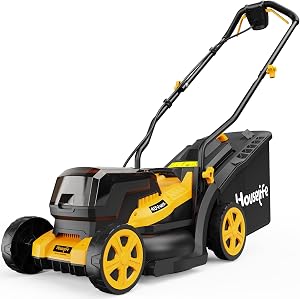
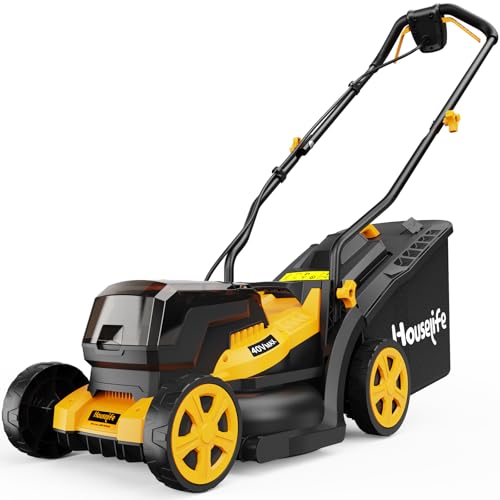
| 40V Cordless Lawn Mower Compatible with Dewalt 2x20V MAX Battery | Houselife | 4.6 | This 40V cordless lawn mower is engineered to be compatible with Dewalt 20V MAX batteries (Requires 2 packs…; Outperforming common 13-inch models, our 14 inch electric lawn mower covers a wider path to reduce mowing…; This walk-behind lawn mower features a 35L (9.25 Gallon) grass collection bag to minimize interruptions |
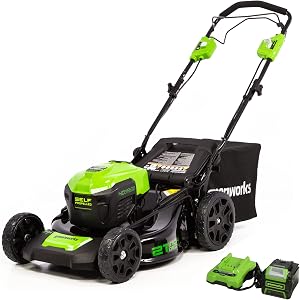
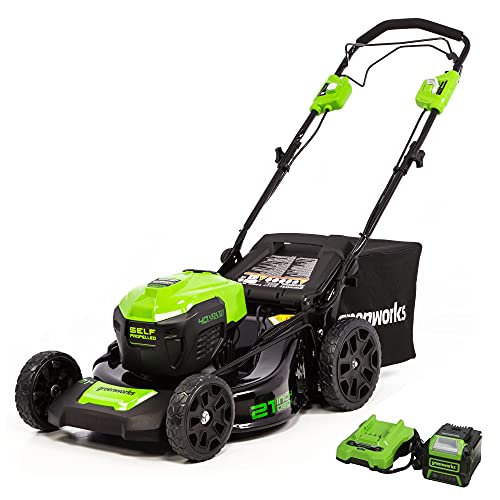
| Greenworks 40V 21" Brushless Cordless (Self-Propelled) Lawn Mower (7… | Greenworks | 4.1 | 40V 21” LAWN MOWER - Get more done, faster, with Greenworks electric lawn mowers |
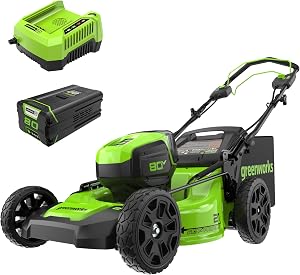
| Greenworks 80V 21" Brushless Cordless (Self-Propelled) Lawn Mower (7… | Greenworks | 4.4 | This 80V self-propelled mower provides the power you need with up to 45 minutes of run-time on a fully… |
How We Research
Robot Lawn Mowers Complete Site is a research and comparison site. Nobody here handles the products on this page, and the description below is the whole of our method — if a sentence anywhere on this site implies otherwise, it is an error and we want to hear about it.
What the comparison is built from. Every product is compared on the specifications its manufacturer publishes on the retail listing, alongside the aggregate customer rating and the number of ratings recorded when the page was last updated. Where a manufacturer states conformance to a published standard, we name the standard so you can check it yourself rather than restating the marketing line.
How products get onto the list. Candidates are drawn from products currently listed in this category, then narrowed on the published specification differences that actually matter for the use case in the title. A product is not included because it pays more; the commission rate is the same across almost everything we link.
What gets re-checked. Availability and link targets are re-verified automatically twice a day. Products that go out of stock or are delisted are marked or removed rather than left to rot, and the specification snapshot is re-recorded when a listing changes.
What we do not do. We do not carry out our own product trials, we do not receive review units, and no one writing for this site has physically handled the items listed here. Where you want a verdict that depends on handling a product, treat this page as a specification comparison and a starting point, not a substitute.
Frequently Asked Questions
What size yard can the Goat G1 handle? Depending on configuration, the Goat G1 is rated for up to roughly 1,600 square meters. In practice, we recommend it for yards between 300 and 1,500 square meters for best results.
Is the Goat G1 good for sloped lawns? It handles slopes up to about 27 percent (15 degrees) in dry conditions. On wet grass the rear wheels can lose traction earlier, and the mower will pause itself rather than continue unsafely.
How quiet is the Goat G1? Noise is one of its main selling points. Check the manufacturer's published noise rating and recent owner reviews for real-world sound reports to judge whether it is quiet enough to run during early morning or evening hours without disturbing neighbors.
How often does it need to mow? The Goat G1 is designed for frequent, light cuts every 24 to 48 hours. It is not built to recover an overgrown lawn in a single session.
Can it be stolen easily? The mower has a PIN lock and reports its location through the Ecovacs Home app. Without the PIN, the unit will not operate, which significantly reduces resale value for a thief.
Do I still need to use a string trimmer? Yes. Like all current robot mowers, the Goat G1 leaves roughly 60 to 80 mm uncut at hard edges. Plan on touching up edges every two to three weeks.
Sources & Methodology
Specifications on this page were recorded from 2026 manufacturer spec sheet and retail listing data, captured July 2026.
Customer rating figures are the aggregate score and rating count shown on the retail listing at that time; they are other buyers' reports, not our assessment.
Independent references for this category. These are places to verify a category claim for yourself. We link them because they are authoritative, not to imply their tests were run on our behalf:
- EPA — small engine emission standards
- FTC Endorsement Guides — the disclosure rules this site is bound by
- CPSC recall database — check any product for open safety recalls
About the Author
The Mowveo editorial team researches products in the robot lawn mower category to provide practical buyer guidance. Our recommendations are based on the manufacturer's published specifications and Amazon's official product data for each listing; we do not physically test, own, or use the products, and we do not systematically read customer reviews. We do not accept payment from manufacturers in exchange for coverage.
Key Takeaways
- Choosing the right ecovacs goat g1 review means matching the key features to your specific needs and budget
- Read real customer reviews and check the return policy before you commit
- Also covers: goat g1 vision navigation
- Also covers: ecovacs goat g1 features
- Also covers: goat g1 boundary wire free
- Compare value across models — the priciest option is not always the best fit


