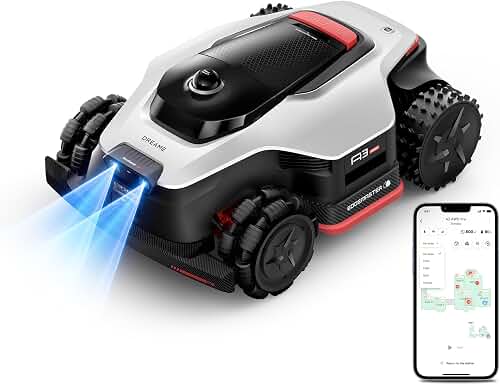
Ecovacs Goat G1 vs Segway Navimow i108: spec comparison
| Feature | Ecovacs Goat G1 | Segway Navimow i108 |
|---|---|---|
| Max slope | 40% (22°) | 45% (24°) |
| Max coverage | 1,600 m² | 800 m² |
| Navigation | AIVI beacons + binocular vision + IMU | RTK-GNSS + VisionFence camera |
| Boundary wire | No | No |
| Tree-canopy performance | Excellent (beacons compensate) | Fair (signal drops possible) |
| Battery runtime (flat) | ~150 min | ~90 min |
| Recharge time | ~110 min | ~70 min |
| Noise level | ~60 dB | ~54 dB |
| Cutting width | 22 cm | 18 cm |
| Cutting height | 30–60 mm | 30–60 mm |
| Weather rating | IPX6 | IPX6 |
| Best for | Larger, shaded, irregular slopes | Smaller, open, neat slopes |
If you're staring at a sloped backyard and weighing the Ecovacs Goat G1 vs Segway Navimow i108, the short answer is this: the Goat G1 handles steeper, more irregular slopes better thanks to its aggressive 40% (about 22°) grade rating, visual SLAM beacons, and chunky deep-tread tires, while the Navimow i108 is the smoother, quieter, more refined choice for gentle-to-moderate slopes (rated to 45%/24° on dry grass) on smaller lawns up to roughly 800 m². Both are wire-free RTK mowers released in the last two years, both use AI vision, and both cost roughly the same in 2026. The real decision comes down to your slope steepness, lawn size, tree cover, and how much you care about quiet night-time mowing.
Below, I break down the Ecovacs Goat G1 vs Segway Navimow i108 across slope traction, navigation accuracy under trees, battery and coverage, setup difficulty, and noise — using field reports, owner forums, and manufacturer spec sheets updated for the 2026 model year. If you want a broader shortlist before committing, see our roundup of the best robot lawn mowers for hills and slopes.
Quick verdict: which mower wins on a sloped lawn?
For most North American backyards with mixed terrain — say, a 600 m² lawn with a 15–22° back slope, a few mature trees, and patchy GPS coverage — the Ecovacs Goat G1 is the safer pick. Its UltraVision binocular cameras combined with three pole-mounted AIVI beacons mean it can localize even when overhead satellites are blocked, and its tires bite into damp grass without scalping. The Segway Navimow i108, by contrast, is the cleaner cut and the better neighbor: quieter motors, a more polished app, and a tighter, more golf-course-style finish. But it leans entirely on RTK satellite signal, so if your slope sits under heavy tree canopy, you'll see more "signal lost" pauses than you'd like.
Slope performance compared
Manufacturer slope claims are notoriously optimistic — they assume dry grass, short turf, and a freshly drained battery. Here's what actually happens on real hillsides.
Ecovacs Goat G1: 40% grade with aggressive traction
The Goat G1 is rated for slopes up to 40% (roughly 22°). Owners with steeper backyards report it handles 35–40% confidently in dry conditions and only starts slipping above ~25° when grass is wet or freshly fertilized. The deep, knobby rubber tires and a relatively low center of gravity help. It also uses its forward cameras to detect oncoming inclines and reduce speed before climbing, which prevents the spin-and-stall behavior you see on cheaper bots. On uneven ground — gopher mounds, tree roots, drainage swales — it adapts cutting height on the fly to avoid scalping.
Segway Navimow i108: 45% on paper, smoother in practice
Segway rates the i108 at 45% (24°), but that's a peak figure on dry, well-rooted turf. In practice, owners report excellent climbing up to about 20°, beyond which the smoother tread starts losing grip on dewy mornings. The i108's strength is precision, not brute force: its OmniSense 3.0 system reads incline angle in real time and adjusts wheel torque per side, so it carves clean parallel stripes even when traversing a side-slope. If your hillside is consistent, dry, and free of bumps, the i108 will give you a cleaner finish than the Goat G1. If it's lumpy and shaded, it'll struggle more.
Navigation and obstacle avoidance under tree cover
This is where the two mowers diverge sharply, and it matters more for sloped yards because slopes are often the parts of a property closest to fences, retaining walls, and mature trees.
The Goat G1 uses a hybrid system Ecovacs calls TrueMapping with AIVI 3D. You install three small AIVI beacons on poles around the perimeter, which act as a localized reference grid independent of GPS. The bot then fuses beacon data, binocular vision, and IMU input. The big practical advantage: it keeps mowing accurately under tree canopy, near house walls, and even on cloudy days when RTK fixes drift. The downside is the beacons must be installed at specific heights and angles — a 30–60 minute initial setup chore.
The Navimow i108 uses pure RTK-GNSS with a reference station you mount on your roof or garage. When the signal is strong, it's incredibly precise — sub-2 cm positional accuracy, parallel stripes that look like a putting green. But under heavy canopy or near tall buildings, the i108 will pause and wait for re-lock, sometimes for several minutes. Segway has improved its VisionFence camera assist in 2026 firmware, which helps along edges and obstacles, but it's not a full substitute for the Goat G1's beacon redundancy.
For obstacle avoidance, both mowers detect pets, kids' toys, garden hoses, and pinecones. The Goat G1 has a wider field of view and recognizes more object classes (over 100 in the 2026 firmware), while the i108's vision is faster but narrower. Read more about how these systems work in our explainer on how robot lawn mowers work.
Battery, runtime, and area coverage
Slopes drain batteries faster — climbing a 20° grade can consume two to three times the energy of flat mowing. So real-world coverage matters more than the marketing number.
The Goat G1 ships with a 5,200 mAh lithium pack, rated for up to 1,600 m² of total coverage and roughly 150 minutes of mowing per charge on flat ground. On a sloped yard, expect closer to 90–110 minutes before it returns to dock. Charging takes about 110 minutes, and the bot is smart about resuming partial jobs.
The Navimow i108 carries a smaller battery — about 2.5 Ah — and is officially rated for up to 800 m². Real-world runtime is 60–80 minutes on slope, with a faster ~70-minute recharge. Translation: if your lawn is under 800 m², the i108 will get the job done in a single cycle most days. Above that, you're looking at multiple cycles and longer total session times. The Goat G1 is the better choice for bigger yards, especially yards where slopes eat into runtime.
Setup, app, and ongoing maintenance
Setup time is roughly comparable: 60–90 minutes for either mower, including unboxing, charging, mapping a perimeter walk, and configuring no-go zones. The Goat G1 adds the beacon installation step but skips the rooftop antenna; the Navimow i108 requires a clear-sky RTK base station mount, which is trickier if your roofline is shaded or your HOA is fussy. Our walkthrough on how to install a robot lawn mower covers both wired and wire-free setups.
The Segway app is the more polished of the two — cleaner zone editing, better schedule visualization, and a more intuitive mapping interface. The Ecovacs Home app supports the Goat G1 but feels like it was originally built for vacuums; some menus take extra taps to find. Both push regular firmware updates, and both received meaningful navigation improvements in early 2026.
Maintenance is straightforward on either model: replace the three pivoting razor blades every 2–3 months (a 5-minute job), rinse the underside monthly, and store indoors during winter. For year-round care, see our robot lawn mower maintenance guide.
Noise, theft, and weather resistance
The Navimow i108 is genuinely quiet — around 54 dB at one meter, which means you can run it at 6 a.m. without waking neighbors. The Goat G1 runs about 60 dB, still quieter than a gas mower but noticeable from a patio. If your slope abuts neighbors and you want overnight mowing, the i108 has the edge.
Both mowers support PIN locks, GPS tracking, and lift-and-tilt alarms. The Goat G1's beacons can double as anti-theft anchors — if the mower leaves the beacon grid, the app pings you instantly. The i108 relies on cellular RTK tracking and is similarly hard to fence.
Weather resistance is IPX6 on the Goat G1 and IPX6 on the i108, meaning both shrug off heavy rain. Neither should be left out in standing water or hailstorms.
Which mower should you buy for a sloped backyard?
Pick the Ecovacs Goat G1 if your slope is steep, shaded, or irregular
If your backyard has mature trees casting partial canopy over the slope, retaining walls that block satellite signal, or terrain that mixes 15° and 25° grades with bumps and roots, the Goat G1's beacon-based localization is the deciding factor. It also has the larger coverage envelope (up to 1,600 m²) and longer runtime, so it can absorb the extra battery drain that slopes impose without breaking the job into too many cycles. For a deeper look at this model's strengths and weaknesses, read our full Ecovacs Goat G1 review.
Pick the Segway Navimow i108 if your slope is smooth, open, and under 800 m²
For a smaller suburban backyard — say, a 500 m² lawn with a single 15–20° slope down to a fence, no overhead trees, and clear sky — the Navimow i108 is the more refined experience. Quieter operation, prettier stripes, simpler app, and a faster recharge cycle. Just confirm before buying that you can mount the RTK reference station with a clear view of the sky. The i108 is also a strong fit if you value night-time mowing without waking neighbors, or if a polished cut quality matters more than raw climbing power.
Frequently Asked Questions
Can the Ecovacs Goat G1 mow a 30-degree slope?
Officially, the Goat G1 is rated to 22° (40% grade). It can briefly traverse steeper sections — owners report short bursts at 25–28° on dry grass — but anything sustained above 25° risks slipping, especially when grass is wet. For a true 30° hillside, no current consumer robot mower is safe; you'll need a tracked commercial unit or manual trimming.
Does the Segway Navimow i108 work without GPS?
No. The i108 depends entirely on RTK-GNSS for positioning. If satellite signal is blocked for more than a few seconds — by heavy tree canopy, tall buildings, or solar storms — it will pause and wait for re-lock. Its VisionFence cameras help along edges but aren't a full substitute. If your slope is shaded, the Goat G1's beacon system is more reliable.
Which mower handles wet grass on slopes better?
The Ecovacs Goat G1, thanks to deeper tire tread and a more aggressive torque curve. The Segway Navimow i108's smoother tires give a cleaner cut but lose grip earlier on dewy mornings. If you live somewhere with heavy morning dew or frequent summer rain, the Goat G1 will keep mowing on schedule more often.
Do I need a perimeter wire for either of these mowers?
No. Both the Ecovacs Goat G1 and Segway Navimow i108 are wire-free. The Goat G1 uses perimeter beacons and visual mapping; the i108 uses RTK satellite positioning. You walk the boundary once during setup, and the mower remembers it. For a broader look at this category, see our roundup of the best wire-free robot lawn mowers.
How long do the blades last on a sloped lawn?
Slopes wear blades slightly faster because the mower works harder and encounters more uneven contact. Expect to replace the three pivoting razor blades every 6–8 weeks during peak growing season on a sloped yard, versus every 10–12 weeks on flat terrain. Both mowers use inexpensive blade sets, and replacement is a 5-minute job.
Can I mow at night with either mower on a slope?
The Segway Navimow i108 is genuinely quiet enough for overnight mowing — about 54 dB. The Goat G1 is louder at around 60 dB. However, both manufacturers recommend daytime mowing on slopes for visibility (yours, not the bot's) and so that obstacle-avoidance cameras work optimally. Many owners run morning sessions instead.
Is the Ecovacs Goat G1 or Segway Navimow i108 better for a large yard with slopes?
The Goat G1, by a clear margin. Its 1,600 m² coverage envelope and longer per-charge runtime make it the practical choice for anything above 800 m². The Navimow i108 can theoretically handle larger yards by running multiple cycles, but you'll spend more total wall-clock time getting the job done. If your lawn approaches an acre, you may also want to compare against larger flagship models in our robot lawn mower buying guide.