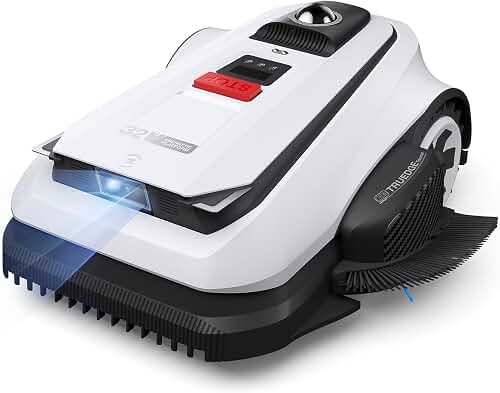
Spec-by-spec comparison
| Feature | Ecovacs Goat O500 | Worx Landroid S WR130E |
|---|---|---|
| Recommended lawn size | Up to ~500 m² | Up to ~300 m² |
| Navigation | Wire-free: vision + GNSS assist | Boundary wire required |
| Mapping | App-guided automatic map, multi-zone | Wire defines area; no on-screen map |
| Obstacle avoidance | Vision-based active avoidance | Bump sensors; optional ACS ultrasonic add-on |
| Edge cutting | Dedicated edge mode along mapped boundary | "Cut to Edge" via offset wire routing |
| App control | Ecovacs Home, Wi-Fi + optional 4G | Landroid app, Wi-Fi only |
| Anti-theft | GPS tracking, alarm, PIN | PIN + alarm (no GPS on S tier) |
| Max slope | Up to ~45% on drive wheels | Around 20° |
| Noise class | ~60 dB | ~62 dB |
| Typical install time | 1-2 hours, no digging | 3-6 hours including wire |
| Best for | Multiple disconnected zones, complex shapes | One simple rectangular lawn |
For tiny city lots under 500 m², the Ecovacs Goat O500 vs Worx Landroid S WR130E choice comes down to one question: do you want a wire-free, vision-guided mower that maps a patchwork courtyard automatically, or a proven boundary-wire model that quietly mows a tidy terrace garden? The Goat O500 is the smarter pick for awkward, fragmented urban yards. The Landroid S WR130E is the cheaper, simpler workhorse for one rectangular plot. Below we compare both head-to-head for compact city use in 2026, including obstacle handling, edge cutting, app control, install effort, and what each costs to keep running for five years.
Why these two mowers end up on the same shortlist
Buyers shopping for a compact urban lawn keep landing on the same pair. The Ecovacs Goat O500 is the small-yard sibling in Ecovacs's Goat family — a fully wire-free robot built around visual SLAM and GNSS positioning, aimed at lawns up to roughly 500 m². The Worx Landroid S WR130E sits in the budget end of the boundary-wire world, designed for lawns up to roughly 300 m². Both have small footprints, both are quiet enough for terraced housing, and both usually land within a couple of hundred euros of each other at street prices. Underneath, however, they represent two completely different generations of robotic mowing.
If your "lawn" is really three thin strips around a paved courtyard, a wedge by the front steps, and an L-shape behind a shed, the Ecovacs Goat O500 vs Worx Landroid S WR130E decision tilts toward whichever mower needs the least manual setup. We'll get to that in a moment.
Setup and install on a tiny city lot
This is where the gap between the two is biggest. The Goat O500 doesn't need a perimeter wire. You walk it around the boundary once with the app, drop a few pins for no-go zones, and it builds a working map in well under an hour. For a typical 150-300 m² courtyard with flower beds and a paved path, most owners are mowing the same afternoon they unbox the robot. There are no buried cables, nothing to snag on tree roots, and no fragile junction at the charging base to repair when a hedgehog chews through it in spring.
The Landroid S WR130E is a classic perimeter-wire mower. It ships with the wire, pegs, and connectors, and you trench or peg the cable around every flower bed, tree well, and paving edge. On a tiny city lot full of obstacles, this can take a full Saturday afternoon. The upside is reliability — once the wire is down and the base is plugged in, the mower simply follows the loop and rarely gets confused. There's no Wi-Fi handshake, no GPS lock to wait for, no firmware update before first run.
If you rent, or if you suspect you'll re-landscape in a year or two, the Goat O500 wins. If you own and your lawn is a single straightforward rectangle that won't change shape, the Landroid is a perfectly sensible long-term answer.
How they handle real urban obstacles
City lots throw weird things at robot mowers: garden hoses left out, kids' toys, low planter walls, the recycling bin moved into the wrong spot on Wednesday. The Goat O500's forward-facing camera and AI obstacle library are designed for exactly this. It identifies and steers around most stationary obstacles, including thin objects like cables and toy cars, and it remembers persistent obstacles in its map so it doesn't keep bumping into them.
The Landroid S WR130E in its base form relies on a physical bump-and-turn approach. It will gently nudge your barbecue cover, decide it's a wall, and reverse. That is fine for shrubs and chair legs but can be a nuisance with delicate planters or lightweight outdoor furniture. Worx sells the "ACS" ultrasonic anti-collision sensor as an add-on for many Landroids, but at the S tier it's an extra cost that closes some of the price gap with the Goat.
Edge cutting on walled urban gardens
Most small city lots are walled or fenced on at least three sides. Edge performance matters far more here than on a large open lawn, because every uncut centimetre against a wall is visible from the kitchen window.
Neither mower has a side-mounted edge blade like premium models, but they tackle the edge differently. The Goat O500 runs a deliberate edge pass along the mapped boundary and uses its wheel offset to bring the cutting disc close to the wall. The Landroid S WR130E offers Worx's "Cut to Edge" feature, which routes the mower along the boundary wire. If you install the wire close enough to the wall — without crossing it — Cut to Edge gets you within roughly 4-5 cm. That's a strip you'll still need to trim a few times a season with a small cordless trimmer, but it's manageable.
App, scheduling, and security
Both apps are mature in 2026. Ecovacs Home is the more feature-rich, with multi-zone scheduling, a live mowing map, rain-delay logic that uses local weather data, and remote control over 4G if you buy the optional cellular module. The Goat O500 includes GPS tracking and an audible alarm if it leaves the mapped area — useful in a front-garden install where it's visible from the street.
The Landroid app handles the basics — schedule, manual start, error notifications — and includes Worx's "AIA" cutting algorithm that varies pass direction so the lawn doesn't develop stripes. Anti-theft is limited to PIN and alarm; there is no GPS recovery on the S model. For a back-garden install behind a locked gate, that's fine. For a front lawn directly on the pavement, the Goat O500's tracking is a real advantage.
Noise, neighbours, and lawn quality
Both robots are quiet enough to run during the day in a row of terraced houses without anyone complaining. The Goat O500 is a touch quieter on grass, partly because its blade disc spins slightly slower and partly because the chassis damps vibration well. On clean Bermuda or fescue you'll get a finer, more even cut from the Landroid — Worx's small-blade-disc design is genuinely good — but the Goat catches up after two or three passes because its mapping ensures no area is missed.
For a tiny lot mowed two or three times a week, both produce a "carpet" finish within about ten days. The difference is more about consistency on awkward shapes than on raw cutting quality.
Price and value in 2026
The Worx Landroid S WR130E is the cheaper purchase — often 30-40% less than the Goat O500 at street prices in 2026. That gap narrows once you add the ACS ultrasonic sensor, the Find My Landroid GPS module, and the extra wire pegs most small lots need. By the time a Landroid S is fully kitted for a complex courtyard, the price difference can shrink to a couple of hundred euros.
The Goat O500 is more expensive up front but ships feature-complete. There's no module to add, no wire to replace every few years, and resale value of a wire-free unit is currently stronger because the technology is newer and demand is rising.
Our picks for tiny city lots
Best overall for complex urban gardens: Ecovacs Goat O500
If your "lawn" is really three small grass islands separated by paving, gravel, or a path, the Goat O500 is worth the extra money. Wire-free setup means you can install it in an afternoon, move flower beds next season without re-trenching cable, and let it manage multiple zones from one base. The vision avoidance handles the random clutter of city living — kids' bikes, hose reels, planters — better than any wired Landroid at this price. It is also the right call for any front-garden install where theft is a concern, thanks to its GPS tracking and louder alarm.
Best budget pick for a single small rectangle: Worx Landroid S WR130E
If you have one straightforward back garden under 300 m², no complex obstacles, and you're comfortable spending a Saturday laying boundary wire once, the Landroid S WR130E is excellent value. Cut quality is genuinely strong, the app is reliable, and Worx parts and blades are easy to source for years. Skip the ACS add-on unless you have delicate furniture in the mow zone, and run "Cut to Edge" weekly to minimise hand trimming.
If you're not sure which side of the line you fall on
Measure your lawn, count the obstacles taller than 10 cm, and count the disconnected grass zones. If you have more than five obstacles or more than one zone, lean Goat. If it is a single shape with under five obstacles, lean Landroid. Our broader best robot lawn mowers for small yards roundup walks through more options if neither of these feels right, and our guide to wire-free robot lawn mowers covers alternatives to the Goat if you want to stay cable-free at a different price point.
For background on why boundary wires are still common in 2026, see how robot lawn mowers work, and if you are brand-new to robotic mowing, our robot lawn mower buying guide covers terminology, install costs, and what to expect in the first season.
Frequently Asked Questions
Is the Ecovacs Goat O500 worth the extra money over the Worx Landroid S WR130E for a 200 m² courtyard?
For a 200 m² courtyard with multiple flower beds, paved paths, or disconnected grass islands, yes — the Goat O500's wire-free mapping saves a full day of installation and avoids cable damage from roots and digging tools later on. For a single open rectangle of 200 m² with clean edges, the Landroid S WR130E delivers about 80% of the result at a noticeably lower price.
Can the Worx Landroid S WR130E handle a front-garden install on a city street?
It can mow the area fine, but it lacks GPS recovery on the S model. If the front garden is visible from the pavement and unfenced, the Goat O500's GPS tracking and louder anti-theft alarm are a meaningful safety upgrade. At minimum, bolt the Landroid base to a paving slab and keep the PIN enabled.
Does the Ecovacs Goat O500 work without Wi-Fi or 4G on a tiny city lot?
Initial mapping requires Wi-Fi via the app. After the map is built, scheduled cuts will run without an internet connection, but you'll lose remote control, rain-delay updates, and GPS theft alerts. For a fully offline install, the Landroid S WR130E is actually the better fit because it doesn't depend on any cloud features.
How close to the wall do these mowers actually cut on a small terraced garden?
Both leave roughly 4-6 cm of uncut grass against a vertical wall in normal operation. The Goat O500 gets slightly tighter on its dedicated edge pass because the wheels can ride right up to the wall. The Landroid S WR130E depends on how close you ran the boundary wire — install it 10 cm from the wall and Cut to Edge will trim very neatly.
Will either mower cope with the slopes in a sunken city garden?
The Goat O500 is rated for steeper slopes (around 45% on its drive wheels) than the Landroid S WR130E (around 20°). Sunken gardens with a short steep ramp between levels are usually fine for the Goat. The Landroid may refuse to climb a wet ramp, which means a manual carry between zones during damp weather.
Can both mowers be locked out of certain zones, like a vegetable patch?
Yes, but differently. The Goat O500 lets you draw no-go zones directly in the app over its map and edit them at any time. The Landroid S WR130E excludes zones by routing the boundary wire around them, which is permanent until you re-lay the wire. For a vegetable patch that moves each year, the Goat is much more practical.
Which mower needs less ongoing maintenance over five years?
The Goat O500 has fewer wear items because there's no boundary wire to repair, but its camera lens and sensor array need occasional cleaning. The Landroid S WR130E will almost certainly need a wire repair or two over five years — usually at a joint or where a spade has cut it. Blade replacement is similar on both: small pivoting razor blades, swapped every 6-10 weeks during the mowing season.