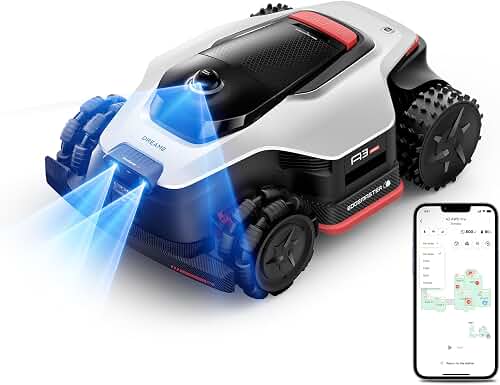
Quick Answer for Lakefront Owners
If you own a lakefront cottage or lake home, choosing the best robot mower waterfront lake shoreline coverage requires more than picking any popular model. You need a mower that handles damp ground near the water's edge, steep banks running down to the shore, irregular boundaries around docks and seawalls, and the unpredictable obstacles waterfront yards collect — gardening tools, kayak racks, hose reels, and the occasional driftwood. The best 2026 options pair GPS or virtual boundary technology with strong slope ratings and IPX-rated weather sealing so they can mow right up to a shoreline without rolling in, getting stuck in soggy turf, or stalling on the bank.
Why Waterfront Mowing Is Different
Lakefront lawns share a handful of headaches that suburban yards simply don't. The ground holds moisture longer because the water table sits inches below the surface. Banks pitching down to the water often exceed 30 percent grade. Boundaries are irregular and rarely match the geometric shapes a typical perimeter wire wants to follow. And the consequence of a wrong turn isn't a flowerbed nibble — it's a $2,000 robot at the bottom of the lake.
That changes how you should evaluate features. Battery runtime matters less than turning precision. Cutting speed matters less than how reliably the mower respects a virtual fence three feet back from the seawall. And the manufacturer's published slope rating is a starting point, not a guarantee, because wet shoreline grass behaves very differently than the dry test lawns used to publish those numbers.
Boundary Technology: Wire, GPS, or RTK?
The single biggest decision for a waterfront property is how the mower knows where the lawn ends and the lake begins.
Traditional Perimeter Wire
Older robotic mowers from brands like Husqvarna, Worx, and Robomow rely on a buried boundary wire. For a shoreline, you'd run the wire roughly three to five feet inland from the waterline. This works, but it has real drawbacks at the lake: shoreline erosion shifts the wire's relationship to the water year over year, ice heave can snap the wire in northern climates, and trenching a wire around a rocky shoreline is genuinely miserable work. If you go this route, plan to re-stake or rebury the wire each spring.
GPS Virtual Boundaries
Mid-tier 2026 mowers use satellite GPS to follow virtual boundaries you draw in an app. This is dramatically easier to install on a waterfront property because you simply walk the mower along the shoreline once with a setup wand, and the app records the geofence. The catch is consumer-grade GPS drift — typically two to four meters — which is far too imprecise for a shoreline boundary unless the mower also uses RTK correction.
RTK GPS (The Lakefront Winner)
RTK (Real-Time Kinematic) GPS pairs the mower with a reference antenna mounted on your home or a fence post, achieving centimeter-level accuracy. Models from Segway Navimow, Mammotion, EcoFlow, and Worx Vision now offer RTK in the prosumer price band. For shoreline mowing, RTK is the only virtual-boundary technology accurate enough to mow within a foot of a seawall reliably. Just make sure your reference antenna has clear sky view — dense lakeside tree canopy can degrade the signal.
For a deeper comparison of these boundary systems, see our guide to the best wire-free robot lawn mowers.
Slope Capability for Shoreline Banks
Almost every waterfront property has a slope problem somewhere. Even a gentle ten-foot drop from the lawn to a sandy beach can exceed the slope rating of entry-level mowers. Manufacturers express slope capability as a percentage — a 35% slope is roughly 19 degrees, and a 45% slope is about 24 degrees.
Match the spec to your terrain, but build in a safety margin. A mower rated for 35% will struggle on a 35% slope when the grass is wet, dewy, or freshly cut. For shoreline work, look for at least a 40% rating, and prefer 45% or higher if your bank is steep enough that you'd hesitate to push a walk-behind mower down it.
Drive wheels matter as much as the rating. Knobby off-road tires, all-wheel drive, and high ground clearance separate the mowers that handle damp lake banks from the ones that spin out and trigger a "lifted" error every third pass. Our guide to robot mowers for hills and slopes covers which specific models actually deliver on their slope ratings.
Weather and Water Resistance Ratings
Waterfront mowers face two distinct moisture challenges: rain and morning dew on the chassis, and the constant high humidity that promotes corrosion and electronics failure over years of seasonal use.
Look for an IPX5 rating at minimum, which means the mower can withstand direct water jets without damage. IPX6 or higher is better if you intend to leave the mower outside in its dock through summer storms. Equally important is the dock itself — some manufacturers ship docks with exposed charging contacts that pit and corrode within a season in lake air. Stainless or gold-plated contacts last dramatically longer.
Battery chemistry matters too. Lithium-iron-phosphate (LiFePO4) batteries handle humid storage and temperature swings far better than older lithium-ion packs, and they're now standard on most 2026 models.
Safety Features That Matter Near Water
Three safety features are non-negotiable for shoreline mowing:
Lift and tilt sensors immediately stop the blades if the mower tilts past a threshold. On a slick lake bank, a tilt sensor can mean the difference between the mower stopping safely and tumbling.
Multi-zone no-go areas let you carve out the dock area, the swim ladder, the boat ramp, and the kayak rack — not just the shoreline itself. Cheap mowers only support a single perimeter; better ones support dozens of no-go polygons.
Theft tracking and PIN locks matter at the lake because waterfront properties are often unoccupied during the week. Look for built-in 4G/cellular tracking, alarms, and remote disable. A mower visible from a public beach is a target.
The best waterfront robot mower for safety pairs all three of these with a strong AI obstacle camera, so it sees and stops for the random objects — fishing rods, beach toys, sunbathing pets — that perimeter wires and GPS fences can't anticipate.
Setup Tips for Lakefront Properties
Even the best robot mower waterfront lake shoreline setup will fail if it's installed carelessly. A few field-tested practices:
- Walk the boundary at sunrise. Morning dew reveals where water pools and where the bank is softer than it looks. Set your virtual boundary back to the firm edge, not the visible grass edge.
- Install the charging dock uphill from the lake, ideally on a small concrete pad. Docks placed at the lowest point of the yard will eventually flood or sit in standing water after heavy rain.
- Use a generous standoff from the shoreline — three feet for RTK mowers, five feet for GPS-only mowers, and at least four feet for wire-guided mowers to account for spring wire shift. Trim the last strip with a string trimmer once a month.
- Schedule mowing for mid-morning, after the dew burns off but before afternoon thunderstorms typical of summer lake weather. Wet shoreline grass is where slope failures happen.
- Winterize aggressively. Even mowers rated for outdoor storage shouldn't sit through a lakeside winter — ice, snow load, and rodents seeking shelter all take a toll. Bring the mower, dock, and reference antenna inside for the season.
What to Avoid
A few categories of mowers consistently disappoint at the lake. Entry-level Worx Landroid S-series and Gardena Sileno Minimo models are built for small, flat suburban yards and lack both the slope rating and the boundary precision for shoreline work. Older Husqvarna Automower 315X-class units are reliable but rely on perimeter wire that's a nightmare to install along an irregular shoreline. And the cheapest no-name Amazon imports often advertise GPS without RTK, meaning their two-to-four meter drift can put the mower in the lake on the wrong pass.
If you're choosing your first robot mower for any property type, our general buying guide walks through the decision tree from the top down.
Putting It All Together
The ideal lakefront robot mower in 2026 combines RTK GPS boundaries, a 40%+ slope rating, IPX5 or better weather sealing, AI obstacle detection, multi-zone no-go support, and cellular theft tracking. Brands building toward this spec include Segway Navimow's H-series, Mammotion's Luba 2 AWD line, EcoFlow's Blade, and Husqvarna's NERA series with EPOS satellite navigation. Expect to spend $2,000 to $4,500 for a model that actually delivers all of these features in one package — less than that and you're cutting a corner that the lake will eventually find.
If your shoreline is short and your bank is gentle, you can spend less and still get good results. If you're maintaining several hundred feet of lakefront with steep banks, the upper end of that price range pays for itself in one season versus the cost of replacing a drowned mower.
Frequently Asked Questions
Can a robot mower fall into the lake?
Yes, if it's poorly configured. A mower without lift and tilt sensors, or one with imprecise GPS drift, absolutely can drive itself into the water on a sloped shoreline. RTK GPS mowers with proper tilt sensors and a conservative virtual boundary are the safest configuration. Always set your no-mow boundary at least three feet inland from the actual waterline, and trim the gap with a string trimmer.
What slope rating do I need for a lakeside bank?
For most residential lake properties, look for at least 40% (about 22 degrees) of rated slope capability. If your bank is steeper than that, you'll need a tracked or all-wheel-drive model rated for 50% or more, like the Mammotion Luba 2 AWD or Husqvarna Automower 535 AWD. Always derate the manufacturer's spec by about 10% to account for wet shoreline grass.
Do I need RTK GPS or is regular GPS enough?
For waterfront mowing, RTK is strongly recommended. Standard consumer GPS drifts two to four meters — enough to put your mower in the lake on a windy day with poor satellite reception. RTK reduces drift to under five centimeters, which is the precision you need to mow within a foot of a seawall reliably.
How do I handle a rocky shoreline with no clean grass edge?
Use a virtual boundary that follows the natural transition from turf to rock, leaving a small buffer. Many newer mowers let you draw curved no-go zones in the app rather than forcing a straight line. If you have a wire-guided mower instead, a low retaining edge or paver border makes wire installation much easier and longer-lasting.
Will lake humidity damage my robot mower over time?It can, especially the charging dock contacts and the wheel motor bearings. Choose a model with IPX5 or higher rating and sealed bearings. Cover the dock during heavy storms, wipe down the chassis weekly during peak season, and store the mower indoors during the off-season. With basic care, a quality mower lasts 7-10 years even in humid lakefront conditions.Can one robot mower handle both my lakeside lawn and a separate front yard?
Yes, most RTK and modern wire-guided mowers support multiple zones. The mower can be transported between zones manually, or for adjacent zones, you can set up a passage. For physically separated areas (front yard plus lakefront), most owners find it simpler to carry the mower between zones once or twice a week rather than installing two docks.
Is a wire-free mower really worth the premium for a waterfront property?
For shoreline mowing specifically, yes. Wire installation along an irregular, rocky, or eroding shoreline is genuinely difficult, and the wire will need maintenance every spring. RTK virtual boundaries eliminate that entire category of problem and let you adjust the no-go zone instantly in the app as your shoreline changes. The $500-$1,000 premium for RTK pays back in install time and long-term maintenance, especially if you can compare it against our full buying guide before deciding.