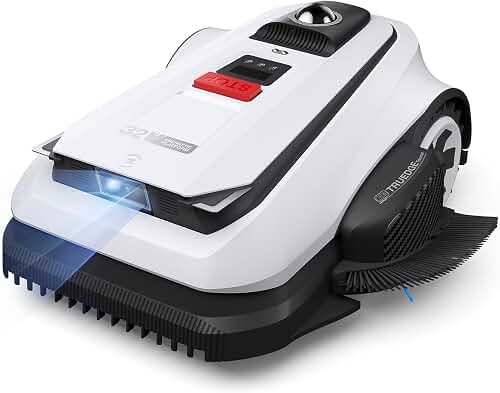
To install robot lawn mower fenced yard multiple zones setups in 2026, you need to plan how the robot enters each enclosed area, lay a continuous boundary wire (or map a wire-free perimeter), and configure zone schedules so every pocket of grass gets cut without the robot stalling at a closed gate. Most modern mowers handle two to four separate zones through narrow passages between fences, but fenced yards introduce three real obstacles: blocked GPS signal, tight gate corridors, and isolated grass islands. This guide walks through the entire installation, from wire layout and dock placement to gate hardware and scheduling logic, so your mower covers every zone reliably without manual carrying between cuts.
Planning Your Multi-Zone Fenced Yard Before You Buy
Before you unbox anything, sketch the yard on paper or in a satellite-view screenshot. Mark every fence line, gate, slope, tree, garden bed, and the nearest outdoor outlet (the charging dock needs power within roughly 30 ft, or 10 m). Then count your zones: a zone is any grass area separated from another by a hard barrier the robot cannot drive over. A front lawn connected to a back lawn through a 32 in (81 cm) side gate is two zones with one corridor. A back lawn split by a raised patio is two zones that may need a hand-carry between them unless a corridor exists.
The narrowest gate or passage in your yard sets the upper limit on robot size. Measure the tightest pinch point in inches; budget mowers like the Worx Landroid M need about 24 in (60 cm) of clearance, while large-yard models like the Husqvarna 450X push closer to 30 in (75 cm). If your side gate is under 24 in, you will need a robot with a slim chassis, or you will need to operate two separate robots, one per zone.
Slope also matters per zone. A robot rated for 35% incline can struggle in a fenced backyard with a 40% berm even if the front lawn is dead flat. Pick a mower whose worst-case slope rating exceeds your steepest zone, not your average zone. For broader buying logic across yard shapes and sizes, our robot lawn mower buying guide walks through every spec that matters before you commit.
Mapping the Boundary Wire (or Wire-Free Perimeter)
Wired robots, including most Husqvarna Automower, Worx Landroid, and Gardena Sileno models, rely on a single continuous loop of perimeter wire that carries a low-voltage signal the mower senses through its bumper coils. For a fenced yard you have two layout choices: run the wire inside the fence line at a consistent 12 in (30 cm) offset, or anchor the wire directly against the fence base. Anchoring against the fence is cleaner visually but leaves an uncut strip the robot cannot reach, so you will need a string trimmer for that border. Offsetting 12 in inward gives the robot full coverage but consumes a strip of usable yard.
For multi-zone yards, the perimeter wire is still one continuous loop, but you create "guide wires" that branch from the loop into each separate zone through the gate corridor. A guide wire helps the robot find the dock from anywhere in any zone and acts as a track through narrow passages where the perimeter wire alone would confuse the navigation. Most mid-range robots support 2 to 3 guide wires; premium units allow up to 5.
Wire-free robots, including the Segway Navimow, Ecovacs Goat, and Mammotion Luba 2, use RTK-GPS, vision, or LIDAR to map zones instead of wire. These shine in multi-zone fenced yards because you can simply walk each zone with a remote during setup and the robot builds a virtual perimeter. The trade-off is GPS reliability: tall fences, eaves, and tree canopy block satellite signal, so you may need to mount the RTK reference antenna higher than the fence top. Our roundup of the best wire-free robot lawn mowers compares signal performance in obstructed yards.
Connecting Zones Through Gates and Passages
A passage is the corridor your robot uses to move from one zone to the next. The robot needs three things to traverse it: enough physical clearance (chassis width plus 2 in / 5 cm of margin per side), a continuous boundary wire or virtual track guiding it through, and a gate that is reliably open during mowing hours.
For physical clearance, install a low concrete-paver path or stamped strip through the gate threshold so the wheels do not catch on uneven ground. A 1 in (2.5 cm) lip will stop most robots. For wire layout, route the perimeter wire down one side of the corridor, around the second zone, and back up the other side of the same corridor with at least 4 in (10 cm) of separation between the two wire runs; closer than that, the magnetic fields cancel and the robot reads the passage as blocked.
For gate scheduling, most homeowners just leave the gate open during the daily mow window. If pets, kids, or HOA rules prevent that, you have three options: a smart gate with timed opening (around $150 to $400 in 2026), splitting the install into two separate single-zone robots, or scheduling cuts only when you can manually open the gate. Wire-free RTK robots handle this slightly better because you can call them via app to a specific zone after you have opened the gate yourself.
Choosing Between Wired, GPS-RTK, and Vision-Based Robots
Each navigation type has clear strengths in a fenced multi-zone yard.
Wired (perimeter loop) robots are the most reliable in fenced yards because they ignore satellite signal entirely. Tall wood fences, metal panels, and dense tree cover have zero effect on a buried wire loop. The downside is installation labor: expect 4 to 8 hours of trenching, staking, or surface-pinning for a typical 1/4 acre (1,000 m²) multi-zone yard. They also struggle with detached zones, since the wire must be continuous.
RTK-GPS robots install in about 1 to 2 hours because you walk the perimeter once with the remote, but they require a clear sky view. A 6 ft (1.8 m) wood fence creates a "signal shadow" of 3 to 6 ft (1 to 2 m) along the fence base where positioning drifts. Mount the RTK antenna at the highest point of the yard, ideally above the tallest fence, and place the dock in the most open zone.
Vision and LIDAR robots like the Ecovacs Goat G1 use cameras and beacons to triangulate position, sidestepping the GPS-shadow problem entirely. They handle fenced yards beautifully but cost more and need clean, unobstructed beacon line-of-sight to each zone. For deeper architectural comparisons see our piece on how robot lawn mowers work.
Step-by-Step Installation Process
The following sequence works for both wired and wire-free systems with minor adjustments noted.
Step 1: Prepare the Lawn
Mow the existing grass to roughly 2 in (5 cm) so the robot's wheels and sensors are not buried on first run. Remove fallen branches, stones, pet toys, and any wire ties from old fencing. Fill in any depressions deeper than 1.5 in (4 cm), since the robot will scalp them. A prepped lawn dramatically reduces first-week errors.
Step 2: Install the Charging Dock
Place the dock in the most accessible zone, ideally the largest one, on a flat patch with at least 10 ft (3 m) of straight wire approach and 3 ft (1 m) of clearance on each side. Run a weatherproof extension cord to your nearest outdoor outlet, or hire an electrician for a permanent outlet. Anchor the dock with the included stakes; a wobbling dock causes failed self-docking errors.
Step 3: Lay the Perimeter (or Map the Boundary)
For wired robots, unspool the boundary wire around each zone in a continuous loop, branching through the gate corridors. Use plastic staking pins every 24 to 36 in (60 to 90 cm) on grass and every 12 in (30 cm) on slopes or curves. After 4 to 6 weeks, the wire sinks into the turf and disappears completely.
For wire-free, hold the remote and walk the perimeter of zone one at a slow steady pace, then stop, drive the robot to zone two, and repeat. Save each zone with a clear name in the app.
Step 4: Set Up Guide Wires or Virtual Routes
Guide wires for wired robots branch from the boundary loop into the heart of each zone, ending at a stake near the back wall. They give the robot a homing track and shorten return-to-dock time by 30 to 50 percent. For wire-free, designate a "transit path" between zones in the app so the robot follows the same corridor each time.
Step 5: Test the Boundary
Trigger a full perimeter test from the controller. The robot should drive the entire loop, including through every gate corridor, without stopping or alarming. If it stalls at a corridor, the wire spacing is too tight or the gate is too narrow.
Configuring Multi-Zone Schedules
Once installation works mechanically, scheduling makes or breaks the experience. Modern robots let you set per-zone cutting frequency, time windows, and percentage of total cutting time. A typical 4-zone fenced yard might use: zone 1 (front, largest) 40% of cut time on Mon/Wed/Fri mornings, zone 2 (back) 35% Tue/Thu/Sat, zone 3 (side strip) 15% Sunday only, zone 4 (rear corner pocket) 10% on Sunday afternoon.
Stagger zone cuts so the robot finishes one zone, returns to dock, charges, and then starts the next zone fresh. Avoid scheduling all zones in one continuous block; the robot will run flat, dock mid-zone, and create stripe patterns of uneven growth. For larger or steeper layouts our best robot lawn mowers for large yards roundup highlights units with longer runtime and bigger zone-count caps.
Common Installation Mistakes in Fenced Yards
Three errors account for most failed setups. First, running boundary wire too close to the fence base, which lets the robot scrape against pickets and gouge the chassis; always keep at least 6 in (15 cm) of buffer. Second, putting the dock in a tight corner zone, which forces the robot to traverse gates twice every cycle and burns 20 to 30 percent of battery on transit alone. Third, ignoring slope ratings inside fenced backyards where retaining walls or berms create hidden inclines.
Whatever robot you pick, walk the yard once with the manufacturer's app open and the safety-stop button accessible during the first three full mow cycles. Most installation problems reveal themselves in the first week, and fixing them then takes minutes rather than hours later.
Frequently Asked Questions
Can I install a robot lawn mower in a fenced yard with multiple zones if the gate is closed most of the day?
Yes, with two approaches. Schedule mowing only during a daily window when you can leave the gate open (most owners use early morning), or buy a smart gate opener that triggers on a timer. If neither works, the practical fix is two separate single-zone robots, one per side of the fence, which often costs less than a premium multi-zone unit anyway.
How narrow can a gate be for a multi-zone robot lawn mower install?
The absolute minimum is the robot's chassis width plus 2 in (5 cm) per side for tracking margin. Compact units like the Gardena Sileno City fit through 22 in (56 cm); mid-size models need 24 to 26 in (60 to 66 cm); large mowers like the Husqvarna 450X need 30 in (75 cm) or more. Always measure with the gate fully open and account for any post or hinge protrusion.
Will tall wooden fences block RTK-GPS signal for a wire-free robot mower?
They reduce it. A 6 ft (1.8 m) solid wood fence creates a positioning shadow of 3 to 6 ft (1 to 2 m) along the base where accuracy drops from 1 in to 4 to 8 in. Mounting the RTK reference antenna above the fence top (typically on a roof, garage peak, or pole) restores full accuracy. Vision-based mowers like the Ecovacs Goat G1 do not have this problem.
Do I need a separate boundary wire for each zone or one continuous loop?
One continuous loop. The wire must form a single closed circuit around all mowable areas, branching through each gate corridor and back. Adding a second independent loop will cancel signals and confuse the robot. Guide wires are different and additional: they branch from the main loop into the center of distant zones as homing tracks.
How long does it take to install a robot lawn mower in a fenced multi-zone yard?
Plan on 4 to 8 hours for a wired install on a 1/4 acre (1,000 m²) yard with 2 to 3 zones, including dock setup, wire laying, guide wires, and a full test cycle. Wire-free RTK installs take 1 to 2 hours but add 30 to 60 minutes if you need to mount the reference antenna on a roof or pole.
Can a robot lawn mower cross a paver path or driveway between fenced zones?
Yes, if the path is flush with the lawn (no lip greater than 0.5 in / 13 mm) and the boundary wire runs across the path beneath a saw-cut slot or under a thin protective conduit. The robot drives across the path as if it were grass. Driveways wider than 16 ft (5 m) often need a dedicated cross-path guide wire to keep tracking accurate.
What is the easiest robot lawn mower to install in a fenced multi-zone yard for a first-time owner?
For most first-time owners, wire-free RTK models with app-based zone walking are dramatically faster and more forgiving than wired loops, provided the yard has reasonable sky visibility. If fences and tree cover block the sky, a compact wired model with manufacturer-supplied installation kit (Worx Landroid or Gardena Sileno City) is the most beginner-friendly path. Compare specs side by side in our how to choose a robot lawn mower guide before buying.