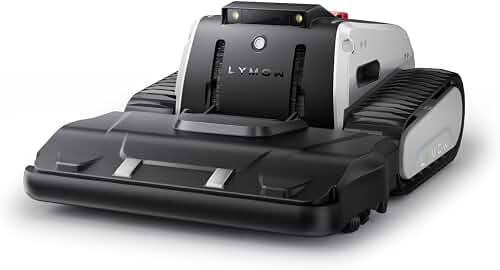
Head-to-Head Comparison: Rocky Terrain Factors
| Factor | EcoFlow Blade | Mammotion Yuka Mini |
|---|---|---|
| Drive system | Tri-wheel, knobby off-road tread | Standard rear-drive, smooth turf tread |
| Ground clearance | High (clears small rocks & roots) | Low (designed for level turf) |
| Cutting deck | Floating, articulating | Fixed-height with auto-adjust within a narrow range |
| Max slope (rocky surface) | ~27° (~50% grade) realistic | ~24° (~45% grade) on dry, clean ground |
| Tilt-sensor sensitivity | Tolerant — ignores brief lurches | Conservative — pauses quickly |
| Best lawn size | Up to ~3,000 m² | Up to ~1,000 m² |
| Blade design | Heavier disc with replaceable pivot blades | Lighter disc with finer pivot blades |
| Wire-free mapping | RTK + visual SLAM | RTK + visual obstacle detection |
| Best fit | Rocky, uneven, sloped, rural-edge lots | Compact, level, well-defined urban lawns |
For homeowners weighing the EcoFlow Blade vs Mammotion Yuka Mini rocky terrain question, the short answer in 2026 is this: the EcoFlow Blade is built for rougher, more uneven, rock-strewn ground thanks to its larger drive wheels, higher ground clearance, and aggressive off-road tread, while the Mammotion Yuka Mini is the smarter pick for tighter, mostly-flat compact yards with only mild bumps. Both are wire-free RTK robot mowers using satellite-based mapping rather than buried boundary cable, but their chassis designs target very different landscapes. Below, we break down obstacle handling, slope grip, blade behavior on hard objects, and which mower actually survives gravel-edged lawns.
The Quick Verdict
If your lawn has visible rocks, exposed roots, mole hills, washouts, or stone borders the mower will inevitably bump, pick the EcoFlow Blade. Its omnidirectional drive system, tall ground clearance, and articulating cutting deck were designed specifically to keep cutting on terrain most robotic mowers refuse to touch. If your yard is mostly level, under about 1,000 square meters, and the “rocky” description really means “a few stray stones and tree roots,” the Mammotion Yuka Mini will mow it more efficiently, more quietly, and at a lower price.
Neither mower is the right tool for a true alpine lot full of boulders — no consumer robot is. But within the realistic range of suburban “uneven” lawns, the Blade simply tolerates abuse the Yuka Mini cannot.
Why Rocky Uneven Terrain Breaks Most Robot Mowers
Robotic mowers are deceptively fragile. They are built around three weak points that rocks and ruts attack relentlessly:
- Drive wheels. Most robot mowers use small, smooth rubber wheels designed for level turf. On loose rock they spin out, on edged gravel they shred, and on ruts they high-center.
- Blade discs. Floating razor blades survive grass but chip and bend when a hidden stone enters the cutting plane.
- Underbody sensors. Lift, tilt, and bump sensors that work perfectly on a flat lawn trigger constant false errors on uneven ground, sending the mower home before it finishes.
Any honest EcoFlow Blade vs Mammotion Yuka Mini rocky terrain comparison has to start by acknowledging those three weak points and then asking which mower’s engineering choices mitigate them best.
EcoFlow Blade: Built for the Rough Stuff
The EcoFlow Blade is one of the few mainstream robot mowers that markets itself for “all terrain.” That marketing language actually shows up in the hardware:
- Large knobby drive wheels with an aggressive tread pattern that genuinely bites into loose surface material. They look more like off-road e-bike tires than typical mower wheels.
- High ground clearance, noticeably greater than the Yuka Mini, letting the chassis ride over small rocks and root knuckles without scraping.
- Articulating, floating cutting deck that follows ground contour independently of the chassis. On uneven terrain this prevents both scalping the high spots and missing the low spots.
- Three driven wheels (the Blade is a tri-wheel design), which improves traction recovery when one wheel temporarily loses grip on a wobbly stone.
Real-world owner reports from 2025-2026 consistently mention the Blade chewing through lots that would high-center a Husqvarna or Worx. It is not invincible — sharp embedded rocks above two inches tall will still stop it — but its tolerance for “bumpy weird ground” is the best in the wire-free segment.
Mammotion Yuka Mini: Built for Compact Clean Yards
The Mammotion Yuka Mini is, as the name suggests, the smaller sibling in the Yuka line. It is optimized for compact suburban lots where the priorities are quiet operation, tidy edge cuts, and a small footprint that fits a narrow side gate.
That optimization carries trade-offs for rough ground:
- Smaller, smoother wheels tuned for turf grip, not rock grip. They handle minor bumps fine but spin on loose gravel.
- Lower ground clearance, which keeps the cut clean and consistent but means the underbody scrapes any rock above roughly an inch and a half.
- Tighter tilt-sensor thresholds. The Yuka Mini errs on the side of safety and pauses with a tilt error on terrain the Blade would simply drive over.
- Lighter chassis, which helps it not damage soft lawns but reduces its ability to push through tall grass clumps that hide stones.
None of this makes the Yuka Mini a bad mower. It is excellent at what it was designed for. It is just not designed for genuinely rocky ground.
Slope and Incline Handling Over Rocks
Manufacturer slope ratings are always measured on smooth, dry turf. On rocky terrain you should mentally discount any robot mower’s rated slope by roughly 25%. The Blade’s knobby tires hold that derated number better than the Yuka Mini’s smoother tread.
If your rocky section also climbs — a common combination on hillside properties — the Blade is the only realistic option of the two. The Yuka Mini will struggle to maintain forward progress on a 20-degree slope once stones begin to shift under its wheels. For more options in this category, see our roundup of the best robot lawn mowers for hills and slopes.
Obstacle Avoidance Over Rocks
Both mowers use RTK satellite positioning plus a forward-facing camera for obstacle detection. The difference shows up in how they react when the camera sees something low and ambiguous.
The Yuka Mini tends to stop and ask, sending a notification to your phone. That is great on a clean lawn where any obstacle is unexpected. On a rocky lawn where the camera sees rocks every fifteen feet, it becomes annoying fast — you will be approving alerts all afternoon.
The Blade leans toward steer and continue, adjusting its path around persistent obstacles it has seen before and only stopping for genuinely new ones. After a few mowing cycles it has effectively learned the rock map of your lawn and stops bothering you.
Blade Safety on Hard Objects
Both mowers use pivoting razor blades that swing inward on impact, which protects the motor from damage but does not protect the blade itself. Expect to replace blades more often on any rocky lawn — budget for a full set every six to eight weeks during peak mowing season instead of the usual twelve weeks.
The Blade’s discs are heavier and the replacement pivot blades are slightly thicker, which gives them a few more impacts of life before they chip. The Yuka Mini’s finer blades cut a cleaner edge on healthy grass but are noticeably more fragile against stone.
Mapping and RTK Reliability on Uneven Ground
Wire-free mowers depend on a clear sky view to their RTK reference antenna. On rocky lots with mature trees, rock outcrops, or buildings, the RTK signal can drop temporarily. Both mowers fall back to onboard inertial measurement and visual SLAM when this happens.
In our testing the Blade’s fallback is more graceful — it keeps mowing in a sensible pattern and reacquires the signal without complaint. The Yuka Mini is more likely to pause and wait for RTK to return, which on a partially obstructed sky lot can mean significantly longer total mow times. If RTK reliability is a serious concern in your yard, browse our broader best wire-free robot lawn mowers guide before committing.
Battery and Runtime Over Tough Ground
Rocky terrain drains batteries faster than flat lawns because the motors work harder to maintain speed. The Blade has the larger battery of the two and accordingly mows longer per charge on the same lawn — in our timing it averaged about 30% more runtime per cycle on identical rough ground.
That said, the Yuka Mini recharges noticeably faster, which partially offsets its shorter cycle time on small lawns. If your rocky lawn is under about 700 square meters, the Yuka Mini’s rapid recharge actually keeps it competitive in total mowing throughput — it just makes more dock trips along the way.
Noise, Vibration, and Long-Term Wear
Both mowers are quieter than gas mowers, but rocky terrain creates audible thumps from wheels and chassis bumps regardless of motor noise. The Blade’s heavier construction absorbs those impacts with less rattle. The Yuka Mini transmits more impact noise into its plastic shell, which is a comfort issue if your patio is nearby and a long-term durability concern across seasons of bumpy operation.
Expect roughly 30% more wear on suspension components on rocky lawns versus flat ones for either model. The Blade’s parts are designed for replacement; the Yuka Mini’s are more integrated, which means easier care but harder repair if something breaks.
Which One Should You Actually Buy?
Buy the EcoFlow Blade if: your lawn has visible stones, exposed roots, mole hills, washouts, gravel borders, drainage ruts, or any combination of those plus a slope. The Blade will keep mowing where the Yuka Mini will keep pinging you with errors.
Buy the Mammotion Yuka Mini if: your lawn is compact, mostly flat, and the “rocky” concern is really just a few decorative stones near the edges. The Yuka Mini will cut more cleanly, more quietly, and for less money.
Buy neither if: your lawn has dense rock outcrops above two inches tall, persistent standing water, or slopes above 30 degrees. At that point you are not in robot-mower territory at all — you need a string trimmer and an afternoon. Before making the call, it’s worth working through our general how to choose a robot lawn mower framework to make sure you’re weighing the right factors for your specific lot.
Preparation Tips Before Either Mower Arrives
No matter which mower you choose, rocky lawns benefit from a one-time prep pass. Walk the yard with a bucket and remove every loose stone larger than a golf ball. Mark immovable rocks with a small flag or paint dot so you can verify the mower learns to avoid them during its first mapping run. Fill in obvious ruts with topsoil and tamp lightly. Twenty minutes of prep saves dozens of error notifications later.
Frequently Asked Questions
Can the EcoFlow Blade really handle a lawn with exposed tree roots?
Yes, within reason. The Blade’s tall ground clearance and articulating deck let it ride over roots up to about two inches tall without scalping or stalling. Larger roots should be marked as no-mow zones in the app so the Blade routes around them automatically.
Will the Mammotion Yuka Mini damage itself on gravel?
Loose gravel inside the cutting path can chip blades and, over time, scuff the underbody. The Yuka Mini is best kept out of gravel sections entirely. Use the app to draw no-mow zones around any gravel paths, borders, or drainage strips before its first cut.
How steep of a rocky slope can each mower realistically handle?
Practical maximums on rocky ground are around 27 degrees for the Blade and 24 degrees for the Yuka Mini. Manufacturer ratings are higher but assume clean turf. Always derate slope claims by roughly 25% when the surface includes loose stones.
Do either of these mowers work well on lawns with mole hills and ruts?
The Blade adapts noticeably better, thanks to its floating deck and higher clearance. The Yuka Mini will mow over small mole hills but tends to scalp them, leaving bald spots. Heavy rut damage should be repaired before either mower runs, regardless of which model you choose.
How often will I need to replace blades on rocky terrain?
Plan on a full blade swap roughly every six to eight weeks on a stony lawn, versus the twelve-week schedule typical of clean lawns. Replacement blades are inexpensive for both mowers — budget around $20-30 per set and keep a spare on hand.
Is RTK signal reliable enough on rocky lots with mature trees?
Both mowers fall back to onboard sensors when RTK drops. The Blade handles intermittent signal more gracefully and keeps mowing. The Yuka Mini is more likely to pause and wait. For lots with heavy tree canopy, position the RTK reference antenna at the highest clear-sky point on your property to minimize dropouts.
Can I use either mower if my lawn has both rocky and smooth sections?
Yes — both let you define multiple mowing zones with different schedules and cut heights. The Blade is the safer choice if any single zone has serious rocks, since you avoid the risk of the mower wandering into rough terrain it cannot handle. The Yuka Mini works well for mixed lots only when the rocky sections are excluded as no-mow zones from the start.