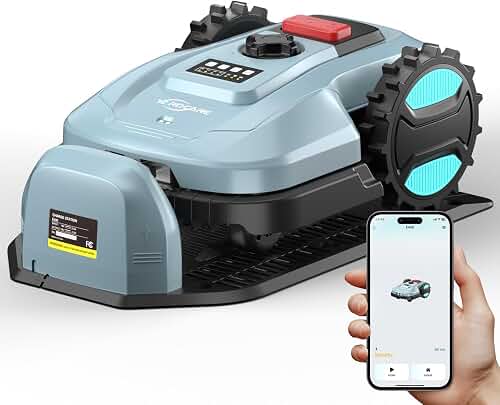
Freshly laid sod looks lush, but underneath it's barely hanging on. The grass blades are mature, but the root system is only millimeters deep for the first two to six weeks. Drop the wrong machine on it and you'll lift tiles, scalp patches, or leave wheel ruts that take a season to grow out. The best robot mowers for new construction sod thin roots are light, low-pressure, slow-moving, and have height ranges that can sit unusually high during establishment. This guide explains what to look for, when it's actually safe to start mowing, and which categories of robot mower are worth shortlisting for a brand-new lawn in 2026.
Why new construction sod is different from established turf
New construction lots come with a stack of problems that established lawns don't. The topsoil is usually shallow, often compacted by heavy equipment during the build, and frequently mixed with construction debris. On top of that, the sod itself was harvested with roughly half an inch of soil attached and is sitting on whatever base the installer rolled out. For the first 10–14 days the only thing holding the tiles down is friction and irrigation water keeping them swollen against the subsoil. New roots have to push through the seam, find moisture in the soil below, and only then will the lawn anchor. Until that happens, the surface behaves like wet carpet, and anything that tugs sideways can peel a corner.
Robot mowers solve a real problem here. A homeowner pushing a 90-pound walk-behind on week three can do more damage in 15 minutes than a robot will do all season. But the wrong robot — heavy, hard-wheeled, razor-tipped on a tight stripe pattern — can still leave marks. The right one barely registers.
How long before you can run a robot mower on new sod?
The industry rule of thumb is to wait until the sod passes the tug test: grab a corner of a tile and pull up. If it lifts cleanly, the roots haven't knitted yet. If it resists and only the blades pull free, you're ready for a first mow. For most cool-season sod in moderate weather, that's two to three weeks; for warm-season sod or hot installs, allow three to four. Robot mowers — because they cut so little at a time — should generally start one cycle after the first traditional cut, not before. Running a robot on un-rooted sod is the single fastest way to ruin an installation.
What to look for in the best robot mowers for new construction sod thin roots
If you've already read our general robot lawn mower buying guide, most of the standard advice still applies. But new sod adds five specific filters worth applying before you buy.
Total weight under 20 lb (and ideally under 15)
Weight is the single biggest variable. Heavier robots — 25 lb and up — distribute load through small wheels and concentrate pressure into thin contact patches. On freshly rooted sod, that pressure can break new root hairs, especially at turn points where the wheels twist in place. Look for sub-20-lb models for residential lots; sub-15 is even better for the first season.
Wide, low-pressure wheels or soft rubber tires
Skinny plastic wheels concentrate force. Wider, softer wheels with tread that flexes spread the load and grip without digging. Some models use studs or paddles that bite shallow; on new sod, these can occasionally tear if the roots haven't set, so favor smooth, soft-compound treads for the first eight weeks.
A cutting height that reaches 2.4 inches or higher
Mowing tall protects new roots in two ways: longer blades shade the soil, holding moisture, and a higher cut removes less leaf surface per pass, leaving photosynthesis intact so roots can keep growing. Many robot mowers cap out at 2.4 inches; on new sod you'll want every fraction available. Anything that tops out at 2 inches is too short for the establishment window.
A floating disc with pivoting razor blades, not a fixed bar
The “three little razor blades on a spinning disc” design that Husqvarna popularized and most premium brands have since copied is gentler than a fixed bar blade. The razors swing back on impact, so they slice tips rather than chopping. On weak sod, clean slices heal in hours; chopping bruises blades and invites disease. Avoid robotic mowers using rigid steel blades for the establishment season.
Random or adaptive patterns instead of stripe-cut routes
Some newer GPS-guided mowers run perfectly straight stripes. They look great on Instagram, but they pound the same wheel tracks every session. For new sod, a chaotic random pattern is actually kinder — it spreads wear across the whole surface instead of concentrating it. If you do choose a striping model, configure it to rotate patterns weekly.
Wire boundary vs. wire-free on new builds
This is where new construction yards split from established lawns. On a finished lawn, a buried perimeter wire is invisible and bulletproof. But on a brand-new lawn, you have two problems: you don't want to trench a wire through fresh sod (it disturbs the very seams you're trying to protect), and the landscape design often isn't finished — beds, paths, and trees may still be moving for months.
For new construction, GPS or RTK-guided wire-free mowers are usually the better answer. You set the boundary in an app, adjust it as the yard evolves, and never touch the turf. Our roundup of the best wire-free robot mowers covers the leading options and their accuracy in tight quarters. If you're locked into a wired model, surface-pin the wire for the first season and bury it once the lawn is fully knitted.
Categories worth shortlisting
Lightweight urban-class robots (sub-15 lb)
These are the safest first-season choice. Designed for small European gardens, they're light enough to walk on freshly rooted sod without leaving prints, and their small cutting decks (15–17 cm) mean less torque load through the wheels. Battery runtime is short, so they're best for lawns under about 4,000 sq ft. The trade-off is they take longer to finish bigger yards, but on new sod, that frequent gentle pass is exactly what you want.
Mid-weight GPS wire-free models
For lawns 4,000–15,000 sq ft, the current generation of RTK/GPS wire-free mowers offers the best balance. Most sit in the 25–35 lb range — heavier than the urban class, but wheel design has improved sharply since 2023, and many now run on wider profiles specifically to handle softer turf. Check the spec sheet for ground pressure (g/cm²) — anything under 35 g/cm² is reasonable for new sod after week six.
Premium wire-guided models with high cut heights
If you have an existing perimeter wire installation from a builder package, premium wire-guided models offer the highest cut heights (up to 2.8 inches on some units), excellent floating-disc cutting systems, and decades of mechanical refinement. They're heavier than the urban class, but their cutting action is the most forgiving available.
Setup tips that protect young roots
Before the first robot mow, follow the same prep checklist you'd use for any new installation — our guide to preparing a lawn for a robot mower covers the basics. For new sod specifically, add these steps:
- Wait for the tug test to pass everywhere, not just near the dock. Walk the whole yard and check the tiles farthest from the irrigation heads — they root last.
- Do one traditional high cut first with a sharp push mower at the highest setting. This levels the blade height so the robot's small bite isn't overwhelmed on the first pass.
- Set the robot to its highest cut for the first four mow cycles and only lower it 1/8 inch at a time over subsequent weeks.
- Run during dry conditions only. Wet new sod is much more prone to wheel rutting; configure your rain sensor aggressively for the first month.
- Skip the perimeter cut feature for the first four weeks if your model offers it — the perimeter is exactly where edges peel, and repeated wheel passes along seams accelerate that.
Common mistakes that destroy new sod
The avoidable mistakes are predictable. Owners get excited, drop the robot on day five, and then wonder why they have brown tracks two weeks later. Don't:
- Run a robot on sod less than 14 days old, even if it looks rooted.
- Schedule daily mowing during establishment — three times a week at high cut is plenty.
- Use a robot during the first week after a heavy sod-watering session, when the soil is saturated.
- Buy based on cut-quality videos shot on established lawns; they don't predict behavior on a soft surface.
- Skip the manual mow before the first robot pass. The blade height needs to be inside the robot's working range.
The bottom line
The best robot mowers for new construction sod thin roots aren't the most powerful or feature-packed — they're the lightest, the gentlest on the surface, and the most adjustable. Pick a sub-20-lb unit with a floating-disc cutter, a high maximum cut height, and either wire-free guidance or surface-pinned wire for the first season. Wait for the tug test to pass before the first run, start high and step down slowly, and you'll have a knit-in lawn by the end of summer with no rutting and no peeled tiles. For broader shopping criteria beyond the new-sod window, see our companion guide on how to choose a robot lawn mower.
Frequently Asked Questions
Can I use a robot mower on sod that was laid two weeks ago?
Only if the tug test passes across the whole yard. Two weeks is often the lower edge of safe — cool-season sod installed in spring with steady irrigation may be ready, but late-summer or warm-season installs typically need three to four weeks. When in doubt, wait an extra week and do one manual mow first.
What's the lightest robot mower for protecting thin-rooted sod?
The lightest current models hover around 11–13 lb — the urban-class units from Gardena, Worx, and Husqvarna's smallest residential range. These leave essentially no impression on rooted sod and are the safest first-season choice for lawns under 4,000 square feet.
Will a GPS robot mower work without trenching wire into new sod?
Yes — that's their main advantage on new builds. RTK-GPS and visual-SLAM mowers set their boundary via an app or a one-time walk-around with the unit itself. No trenching means no disturbed seams, which matters most in the first eight weeks while the lawn is still anchoring.
How often should a robot mower run on new construction sod?
Three short, high-cut sessions per week for the first month, then ramp to daily once the lawn passes a strong tug test everywhere and you've successfully lowered the cut height to your target. Daily mowing of weak sod removes too much leaf area and slows root growth instead of helping it.
Do robot mowers leave wheel tracks on new lawns?
They can, especially if they're heavy, run on saturated soil, or follow the same path repeatedly. Sub-20-lb robots with wide soft tires running random patterns on dry soil rarely leave visible tracks. Heavy GPS mowers running striped patterns on damp new sod almost always do.
Should I use a robot mower's edge-cutting mode on new sod?
Skip it for the first four to six weeks. Edge-cutting routines drive the wheels along the sod seams — the exact line where tiles peel up. Once the perimeter has fully knitted to the soil below, edge mode is safe to enable.
Can robot mowers damage sprinkler heads in a freshly graded yard?
Robot mowers are designed to ride over standard pop-up heads when retracted, but in a new construction yard the heads may sit fractionally proud while soil settles. Mark them with flush-mounted donuts for the first season, and avoid running the robot within 30 minutes of an irrigation cycle while heads are still up.