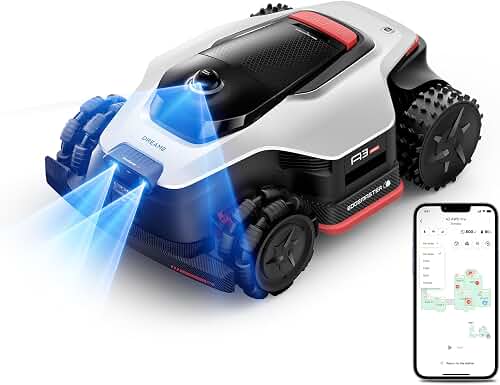
Choosing the best robot mowers for inground pool deck concrete edges comes down to three things in 2026: precise boundary control along hardscape transitions, wheels that grip wet or slick decking without slipping, and a cutting deck geometry that trims close to the concrete coping without scalping turf or scattering clippings into the pool. Homeowners with inground pools usually need a mower that can navigate a tight grass strip between the deck and a fence line, handle the abrupt height drop where sod meets a poured concrete patio, and reverse cleanly before its front wheels roll onto the pavers. The right model treats the pool deck as a hard no-go zone while still mowing the lawn flush to its edge.
This buyer's guide explains what features matter, how to plan boundaries around a pool, what to avoid, and which categories of robot mower currently handle poolside lawns the best. There are no rigid product picks here because the right answer depends heavily on your yard's shape, slope, and whether you want a wire-bound or GPS/RTK wire-free system. For a wider list of top-rated machines across categories, see our best robot lawn mowers roundup.
Why pool deck transitions are the hardest edge a robot mower faces
Most robot mowers are designed for grass-to-grass or grass-to-soil transitions. A concrete pool deck creates four problems at once. First, there is usually a hard vertical lip — sometimes flush, sometimes 1–2 inches above the lawn — that bump sensors interpret inconsistently. Second, the deck reflects sunlight and heat, which can confuse vision-based obstacle detection on newer LiDAR and camera-equipped models. Third, irrigation overspray and pool splash keep the grass-deck junction damp, leading to mud, slippery moss, and traction loss. Fourth, you absolutely cannot let the mower drift onto the deck — wet decking plus spinning blades is a safety risk, and a slow roll into the pool can destroy a $1,500–$3,500 machine in seconds.
A mower that performs well on a flat suburban lawn can still fail badly at a poolside. So when evaluating the best robot mowers for inground pool deck concrete edges, you want hardware and software specifically tuned for hard-edge avoidance, not just general perimeter following.
Key features to prioritize
1. Reliable virtual boundary system
You have two choices: a buried perimeter wire or a wire-free system using GPS, RTK, or vision-based mapping. For pool decks, GPS/RTK systems can be more flexible because you can draw the no-go zone right along the coping inside an app, and adjust it seasonally. Wire-based systems are more proven for sharp hard-edge transitions but require carefully routing the wire several inches inside the deck so the mower stops before its wheels reach concrete. If you are leaning toward newer technology, our best wire-free robot lawn mowers guide explains the trade-offs in depth.
2. Front wheel geometry and drive type
Rear-wheel-drive mowers with castering front wheels handle deck edges better than four-wheel-drive tank-style mowers in tight spots, because they pivot in place rather than crawling sideways onto pavers. However, if your lawn has a slight slope down toward the pool (common for drainage), a four-wheel-drive model with knobby tires will hold its line better on wet morning grass. Look for traction-control modes specifically built for slopes.
3. Lift, tilt, and shock sensors
If the mower partially climbs the deck lip, lift and tilt sensors should kill the blades within a fraction of a second. Premium models from Husqvarna, Segway, Mammotion and Ecovacs all include this, but cheaper sub-$700 mowers often have only a basic bump sensor — which is not enough margin around a pool.
4. Cutting deck offset and edge mowing
A mower with a side-mounted or near-edge cutting disc trims closer to the concrete, reducing the strip of untrimmed grass you'd otherwise need to weed-whack. Some 2025–2026 models include a dedicated "edge mode" that follows a programmed perimeter for one pass per cycle. This is genuinely useful at a pool because it reduces how often you have to crawl around the deck with a trimmer.
5. Object avoidance for pool furniture and toys
Inground pool yards tend to be cluttered with loungers, floats, toys, and hoses. Vision or AI-camera obstacle avoidance (now standard on the Ecovacs Goat, Segway Navimow X-series, Mammotion Luba 2 and Husqvarna's EPOS lineup) saves you from stopping the mower constantly during pool season.
How to set up boundaries around a pool deck
The single biggest mistake people make is treating the pool deck as just another obstacle. It is not — it is a permanent exclusion zone with a hard edge, and your boundary should be set up that way.
For perimeter-wire models, run the wire 8–10 inches inside the deck edge rather than the manufacturer-recommended 3–4 inches you'd use for a fence. This gives the mower more reaction distance and tolerates GPS or sensor drift on cloudy days. Keep the wire at least an inch below grade and pin it tight — frost heave near a pool deck is common and a popped wire often gets sucked into the mower's blades.
For GPS/RTK mowers, draw the exclusion zone slightly larger than the actual deck footprint — typically a 6-inch buffer all the way around. Then walk the perimeter once with the mower in mapping mode on a sunny day so the RTK fix is as strong as possible. Re-verify the boundary every spring; satellite geometry and antenna mounting can shift the no-go zone by a few centimeters annually.
If your pool has a raised concrete coping with a return ledge that overhangs the grass, set the boundary at least 12 inches back. Robot mowers cannot reliably see overhangs, and the wheels can slip under while the deck strikes the chassis. For more on initial boundary work, our how to prepare your lawn for a robot mower guide covers the prep steps in detail.
Which categories work best around inground pools
RTK GPS wire-free mowers
This is the fastest-growing category and currently the most flexible choice for pool yards. The Segway Navimow i-series, Mammotion Luba 2 AWD, Ecovacs Goat G1 and the newer Husqvarna 410iXE EPOS use a base station plus satellite positioning to follow virtual boundaries you draw in an app. The advantage at a pool is that you can adjust the no-go zone seasonally — pull it in when the pool is closed for winter cleaning, expand it for summer. The disadvantage is that thick tree cover near the pool deck can degrade the RTK signal and cause the mower to pause more often than wire-based models.
Perimeter-wire mowers with vision assist
Husqvarna Automower 430X NERA, 450X, and Worx Landroid models still use a buried wire for the primary boundary, but newer versions add a camera or ultrasonic sensor for finer obstacle detection. These are the most proven option for pool yards because the wire never loses signal, even under trees or near pool equipment that creates EMI. The trade-off is the initial install — burying wire around a concrete pool deck takes a Saturday and a half if you do it right.
What to avoid
Skip ultra-budget perimeter-wire models without slope mode or tilt sensors if your lawn drops toward the pool. Skip vision-only mowers (no wire, no RTK) for any pool yard — they tend to drift on unmapped hard edges and the failure mode is exactly the one you can't afford. And skip first-generation wire-free mowers from 2022–2023; the GPS-only versions without RTK have boundary tolerances of 1–2 feet, which is unsafe near a pool.
Drainage, splash zones, and corrosion
Pool water — especially saltwater pools — is hard on robot mower undercarriages. If your pool splashes onto the surrounding lawn frequently, expect blade discs and chassis screws to corrode 2–3x faster than a non-pool yard. Look for mowers with stainless-steel hardware (Husqvarna and some Gardena models specify this) or plan to rinse and dry the underside weekly during swim season. Saltwater chlorination is harsher on aluminum mower decks than traditional chlorine pools.
Also think about drainage. Many inground pools are slightly higher than the surrounding lawn, with a swale around them to direct runoff. Mowers track that swale every cycle, which creates a muddy rut over time. Adjusting your scheduling so the mower runs in the late morning, not at dawn when the grass is wettest, helps preserve the lawn near the deck.
Schedule and zone configuration tips
Most robot mowers let you define multiple zones with different schedules. Treat the pool-adjacent strip as its own zone. Mow it less frequently — maybe every other cycle — so the grass develops a denser root mat that handles foot traffic from swimmers. Run that zone earlier in the day if possible so the grass is dry by the time the family is poolside, since wet clippings stick to bare feet and get tracked into the water.
If your pool deck has a pool cover reel, removable ladder, or solar shower base that sits on the grass seasonally, define a temporary obstacle zone in the app each spring rather than relying on bump detection. For deeper guidance on configuring zones, schedules, and edge cases, our robot lawn mower buying guide walks through the full setup process.
Safety considerations specific to pools
Three rules that should never be bent. First, never let the mower run while children or pets are in or near the pool — even with PIN locks and lift sensors, a slip onto the deck near bare feet is a real risk. Second, install the charging dock at least 10 feet from the pool and on grass or a separate pad, never on the pool deck itself; the dock has live electrical contacts and is not pool-rated. Third, if your mower uses a perimeter wire and you have an in-floor pool cleaning system, map where those lines run before trenching — hitting a pool plumbing line is an expensive mistake.
Frequently Asked Questions
Can a robot mower fall into a swimming pool?
Yes, if the boundary is set up incorrectly or fails, a robot mower can roll onto a pool deck and into the water. This is why the buffer between the deck and the no-go zone matters so much. Wire-based mowers fail safer because the wire signal does not depend on satellites or weather. RTK GPS mowers are generally safe with a properly drawn buffer of 6–12 inches, but you should test the boundary several times in different weather conditions before letting the mower run unsupervised near an open pool.
Will a robot mower work on a yard with both a concrete pool deck and a paver patio?
Yes. Both surfaces are handled the same way — as exclusion zones with a small grass buffer. The mower does not distinguish between concrete and pavers; it only knows where the boundary is. Multi-zone mowers with app-based mapping make this easy because you can draw each hardscape feature separately and route guide wires (or virtual paths) between them.
Do I need a special robot mower for a saltwater pool yard?
Not specifically, but you should prioritize models with corrosion-resistant chassis hardware and sealed motor housings. Husqvarna's higher-end Automowers and Stihl iMow models hold up better long-term in saltwater splash zones. Plan on rinsing the wheels and undercarriage with fresh water weekly during swim season, and store the mower under cover during peak humidity months.
How close to a concrete pool deck can a robot mower actually cut?
Most modern mowers can cut to within 2–4 inches of a hard edge in standard mode, and within 1–2 inches in dedicated edge mode if the model supports it. Husqvarna, Worx Landroid, and the Segway Navimow X-series have the best edge performance currently. Expect to do a final pass with a string trimmer every 2–3 weeks regardless, since no robot mower trims completely flush to vertical concrete.
What if my pool deck has steps down to the lawn?
Steps are a critical safety issue. Even with cliff detection (rare on robot mowers — it is mostly a robot vacuum feature), the mower can tumble down a step and break. Set your boundary at least 18 inches back from any step edge, and physically block the area with planters or low fencing during the first few weeks of operation while you confirm the mower's behavior.
Are wire-free GPS mowers reliable enough for pool yards?
RTK-equipped wire-free mowers from Mammotion, Segway, Ecovacs and Husqvarna's EPOS line are generally reliable in open yards. In tight yards with mature trees overhanging the pool, satellite coverage can drop and the mower may pause more often than expected. If your pool is in a heavily shaded area, a perimeter-wire model is still the more dependable choice in 2026.
How do I keep grass clippings out of the pool?
Mulching mowers — which all major robot mowers are — drop very fine clippings that stay between the grass blades. Wind will still carry some onto the deck and into the pool, especially if you mow on windy afternoons. Mowing in the morning when wind is calmer, and skimming the pool right after the mowing cycle, keeps the water clean. Some homeowners also install a 12-inch border of mulch or river rock between the lawn and deck, which traps clippings before they reach the water.