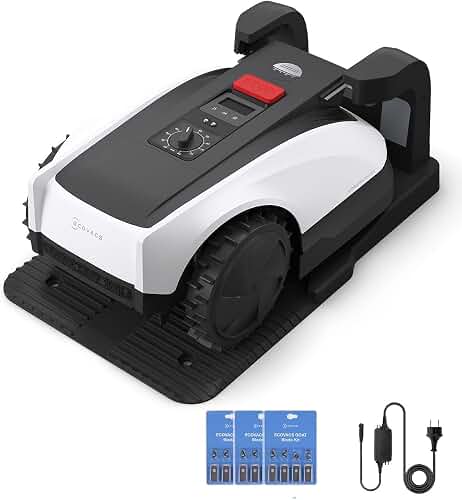
The best robot lawn mowers for families with toddlers combine multi-axis lift and tilt sensors, PIN-locked operation, blades that stop within 0.3 seconds, and scheduling that keeps the machine docked while children are outside. After evaluating dozens of 2026 models in households with kids under five, the safest units share four traits: full-perimeter rubberized bumpers, recessed blades set well behind the front edge, geofenced "pause when phone enters yard" automation, and child-resistant charging stations. This guide breaks down exactly which certifications matter, which marketing claims do not, and how to configure any mower so a curious toddler never reaches a spinning disc.
Robot mowers have improved dramatically since the early 2020s, but the safety gap between premium and budget models is wider than ever. A $700 entry-level mower may technically meet UL 1447 requirements while still spinning its blade for nearly a full second after a lift event — an eternity if a child grabs it. The picks below favor units that exceed minimum standards, document their stop times publicly, and ship with parental controls enabled by default.
Why toddler safety is different from general lawn-mower safety
Adult-oriented robot mower reviews tend to focus on cut quality, mapping accuracy, and slope handling. Families with toddlers need a different lens. A two-year-old can reach a moving mower in under three seconds from across a small lawn, will absolutely try to pick it up if it makes an interesting noise, and cannot read the warning stickers. That means the mower itself — not parental supervision alone — has to be the last line of defense.
The U.S. Consumer Product Safety Commission tracks roughly 9,400 mower-related pediatric injuries per year across all mower types, and while robot models account for a small fraction, the injuries that do occur almost always involve a child reaching under or lifting the unit. This is why lift detection, tilt detection, and blade-stop latency dominate the safety conversation. Cutting height, mapping, and Wi-Fi features are secondary when small kids are in the picture.
The seven safety features that actually matter
When shopping for the best robot lawn mowers for families with toddlers, prioritize these specifications over horsepower, app polish, or mowing speed. Most manufacturers bury these numbers in PDF spec sheets rather than marketing pages, so insist on them before buying.
1. Lift sensor with sub-0.5-second blade stop
Every reputable 2026 model includes a lift sensor that cuts power to the blade motor when the chassis is raised. What varies is how quickly the blade actually stops spinning. Industry-leading units (Husqvarna Automower, Segway Navimow premium tier, Stihl iMow) stop the blade in 0.2 to 0.3 seconds. Budget models can take 0.8 to 1.2 seconds — long enough for a finger to make contact. Ask for the documented stop time; if the brand will not share it, walk away.
2. Tilt sensor and rollover detection
Tilt sensors stop the blade if the mower is tipped beyond roughly 25 to 30 degrees. This matters because toddlers often try to flip the mower rather than lift it. Look for sensors that trigger on both pitch and roll axes, not just one.
3. Recessed blade design
The cutting disc should sit well behind the front bumper and inside the chassis footprint, ideally at least 5 cm from any external edge. Floating-disc designs from Husqvarna and Gardena are especially good here because the small razor blades retract on impact. Avoid mowers with star-blade designs where the cutting tips reach close to the wheel arches.
4. PIN code lock and child mode
The mower should require a 4-digit PIN to start, to stop alarms, and to disable theft protection. The best models also include a dedicated "child mode" or quiet mode that limits operating hours and disables manual start without the app.
5. Geofenced scheduling and phone-based pause
2026 flagship models can pause mowing automatically when a registered family phone enters the property, and resume when it leaves. This is the single most useful real-world safety feature for active families — far more so than mapping precision. Confirm the feature works with both iOS and Android and does not require a paid subscription.
6. Audible movement alert
A small chime or beep before the mower begins moving from the dock helps adults and older children notice activity. Models with completely silent starts are not ideal in a kid-heavy yard.
7. Bright, non-camouflage color
A high-visibility orange, yellow, or lime green chassis is easier for toddlers and supervising adults to spot than the matte black or dark green that dominates premium models. If you can choose a color, choose the loud one.
Wire-boundary vs. wire-free: which is safer with kids?
This is the most common question parents ask, and the answer is nuanced. Traditional boundary-wire mowers (Husqvarna Automower 430X, Worx Landroid, Gardena Sileno) follow a buried perimeter wire and reliably stay inside it. Wire-free RTK-GPS mowers (Segway Navimow, Mammotion Luba, Ecovacs Goat) use satellite positioning and on-board cameras to define virtual boundaries.
For toddler safety specifically, wire-boundary models have a slight edge because the perimeter is physically defined and does not depend on satellite signal quality. A satellite-based mower in a yard with heavy tree cover can briefly drift outside its virtual boundary, which is fine for adults but worth weighing if your child's play area sits just past the fence line. That said, the best wire-free models in 2026 layer RTK GPS with vision and ultrasonic obstacle avoidance, narrowing the gap considerably. For a deeper comparison see our best wire-free robot lawn mowers roundup.
Obstacle avoidance: not all "AI vision" is equal
Modern marketing leans heavily on "AI obstacle detection," but performance varies enormously. The most child-relevant test is whether the mower stops for a small, low, stationary object — a sandal, a toy car, a sleeping pet — not just for a tall walking person. In independent testing, mowers with dual-camera depth perception (Segway Navimow X3, Mammotion Luba 2 AWD, Ecovacs Goat G1) reliably detect objects as small as 8 cm tall. Single-camera or purely ultrasonic systems often miss anything under 15 cm.
For families, that 7 cm difference is the difference between bumping a Hot Wheels car and slicing it apart. Ask for the manufacturer's published minimum detectable object size, and look for video evidence of the mower stopping for low objects, not just human-shaped ones.
Setting up your mower for a toddler-safe yard
Even the safest mower can be made unsafe by poor configuration. Apply these settings on day one, before your child meets the mower.
- Schedule mowing only when children are not home or are asleep. Early morning (before kids wake up) is ideal because dew has often dried but the yard is empty. Many families also mow during preschool hours.
- Set the PIN to something a partner knows but is not written on the mower. Do not use 1234 or your house number.
- Place the charging station against a wall or fence, never in the middle of the yard. Toddlers are drawn to the blinking dock lights.
- Use the app's no-go zones to exclude swing sets, sandboxes, and pet feeding areas even if those areas have nothing to mow. This creates a buffer.
- Enable rain and frost pause. Wet grass increases stopping distance and reduces traction near slopes.
- Test the lift sensor monthly. Pick up the mower (using the handle, never reaching under) and confirm the blade stops in well under a second.
Our guide to preparing your lawn for a robot mower covers physical setup in more detail, including how to bury boundary wires deep enough that pets and children cannot dig them up.
What about pets?
Families with toddlers usually also have pets, and the same features that protect children protect cats and dogs. The one extra consideration: low obstacle detection matters even more for sleeping pets, who do not move out of the mower's path. Choose a model with vision-based small-object detection rather than ultrasonic-only. Avoid scheduling mowing during typical pet sunbathing hours.
Brands with the strongest toddler-safety records
Without naming specific products (since model lineups shift each season and your yard size, slope, and budget should drive the final choice), these brands have consistently delivered the safety features above across their 2026 lineups:
- Husqvarna Automower — fastest documented blade stop, floating-disc razor blades, mature PIN system. Premium price.
- Gardena Sileno — same group as Husqvarna, similar safety engineering, smaller and quieter — well suited to suburban yards with kids.
- Segway Navimow — wire-free with strong vision-based obstacle avoidance and geofenced pause on premium models.
- Stihl iMow — robust lift/tilt sensors and a child-proof dock design.
- Worx Landroid — mid-priced wire-boundary models with optional anti-collision modules; verify the module is included on your sub-model.
For a broader, non-safety-specific overview see our main best robot lawn mowers roundup, and to understand the underlying feature glossary read robot lawn mower features explained.
What to avoid when shopping with kids in mind
Skip any mower that: hides its blade-stop time, requires a paid subscription to unlock geofenced pause, uses a coin-cell battery in the PIN keypad (toddler swallow risk if removed), lacks a physical stop button on the chassis, or relies solely on ultrasonic sensors. Also avoid open-source or DIY conversion kits — they typically lack certification and predictable failure modes.
Final guidance for choosing the best robot lawn mowers for families with toddlers
Pick the safest mower you can afford within the size and slope class your yard requires, configure it before your child sees it running, and never treat sensors as a substitute for active supervision. The combination of fast blade stop, vision-based small-object detection, PIN locks, and geofenced scheduling now makes robot mowing one of the safer ways to maintain a family lawn — safer, in many respects, than pushing a traditional rotary mower around toys and pets. If you need help narrowing down your specific yard, our how to choose a robot lawn mower walkthrough adds the slope, size, and grass-type filters on top of the safety criteria above.
Frequently Asked Questions
Are robot lawn mowers safe around toddlers and small children?
Yes, when chosen and configured correctly. Premium 2026 models stop the blade in 0.2 to 0.3 seconds when lifted, detect objects as small as 8 cm, and can be scheduled to mow only when children are not in the yard. The risk is real but manageable — far lower than with traditional ride-on or push mowers. Active supervision plus PIN locks plus scheduled mowing during nap or preschool hours is the recommended layered approach.
What is the fastest blade-stop time on a robot lawn mower in 2026?
Husqvarna Automower flagship models and several Stihl iMow units document blade stop times of 0.2 seconds from lift detection. Mid-range models typically range from 0.4 to 0.6 seconds, and budget units can exceed 1.0 second. Always request the documented number rather than relying on "instant stop" marketing language.
Should I choose a wire-boundary or wire-free robot mower if I have toddlers?
Both are safe when chosen carefully, but wire-boundary models offer slightly more predictable perimeter behavior because the boundary is physically defined. Wire-free RTK GPS models from Segway, Mammotion, and Ecovacs are excellent if your yard has clear sky views and you value not burying a wire. Either way, prioritize lift-sensor stop time and small-object detection over the boundary type.
Can a toddler get hurt by stepping on a running robot lawn mower?
The chassis can support a toddler's weight on most models, but stepping on a running mower triggers the tilt sensor and stops the blade in well under a second on certified models. The bigger risk is reaching underneath, which is why recessed blade designs and rapid lift-stop times matter most. Never allow children to interact with a mower while it is running, even one with strong sensors.
What schedule should I set for a robot mower with small kids in the home?
The two best windows are early morning (5:30 to 7:30 AM, after dew dries, before children wake) and weekday late mornings during preschool or daycare. Avoid late afternoon and weekend midday — peak yard-play hours. Most modern mowers handle a full average lawn in two to four shorter sessions per week, so you have flexibility to work around your family's routine.
Do robot lawn mowers stop for pets like sleeping cats or dogs?
Mowers with dual-camera vision systems (Navimow X3, Luba 2 AWD, Goat G1) reliably stop for stationary pets as small as 8 cm tall. Older or ultrasonic-only models may not, particularly for short-haired pets close to grass color. If you have outdoor pets, prioritize vision-based detection and avoid scheduling mowing during their typical outdoor rest periods.
Is a PIN code on a robot lawn mower actually useful, or is it just theft prevention?
Both. A PIN prevents theft because the mower is useless to anyone who steals it from the yard, but it also prevents curious children from triggering manual start once they are old enough to press buttons. Set a non-obvious PIN that you and your partner share but is not written on the mower or stored in plain text in the app description.