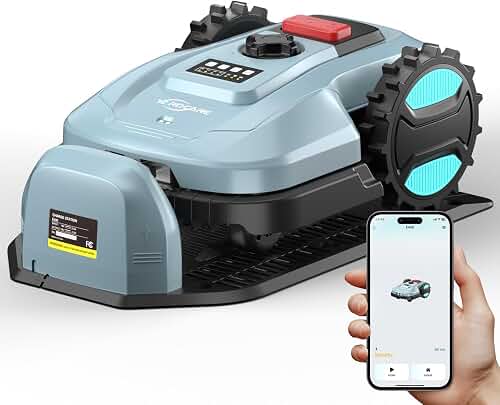
Coastal-Spec Feature Comparison
| Coastal Concern | What to Demand in 2026 | What to Avoid |
|---|---|---|
| Salt mist on electronics | IPX5+, conformal-coated PCBs | Open vent slots near control board |
| Sandblast on housing | UV-stabilized ASA or PC polymer shell | Painted aluminum top covers |
| Charging contact pitting | Magnetic dock or gold-plated pins | Exposed nickel-plated steel contacts |
| Wire-splice corrosion | RTK GPS, vision, or LiDAR navigation | Buried perimeter wire with field splices |
| Wheel-bearing wear from sand | Sealed double-lip bearings, brushless hub motors | Open bushings, brushed gearmotors |
| Hurricane and lightning | Garage-stowable, surge-protected dock | Permanently mounted outdoor docks without cover |
| St. Augustine and Bahia grass | Floating deck, 3.5”+ cut height, torque-rich brushless motor | Fixed deck, sub-2.5” minimum height |
If you live on a barrier island, a canal lot in Naples, or anywhere within a mile of the Atlantic or Gulf, you already know the drill: anything mechanical you leave outside starts pitting, seizing, and weeping rust within a season. The best robot mowers for Florida coastal salt air corrosion in 2026 are the ones built with sealed brushless motors, an IPX5 or higher chassis rating, marine-grade or fully encapsulated electronics, and stainless or polymer fasteners that won't bloom orange after the first nor'easter. Wire-free RTK GPS models are usually the better long-term coastal pick because there is no buried perimeter wire to corrode at every splice, and aluminum-deck cutters should generally be avoided in favor of high-impact polymer housings. Below is a buyers guide built specifically for Tampa-to-Miami homeowners who want a mower that survives more than two summers.
Why Coastal Florida Eats Robot Mowers Alive
Salt air corrosion is not the same problem as rain exposure. Airborne chloride ions settle on every horizontal surface, then humidity (which averages 74% year-round in places like Sarasota and Vero Beach) keeps them dissolved into a thin electrolyte film. That film attacks aluminum, mild steel, copper PCB traces, and crimped wire splices simultaneously. Add wind-blown silica sand from the dunes, which sandblasts paint and seals, and you have an environment closer to a marine engine room than a suburban backyard. A robot mower designed for a German lawn 400 miles inland was simply never validated for this duty cycle.
Three failure modes dominate warranty returns in the coastal Southeast: charging contact pitting (the dock pins green-over and stop conducting), wheel-motor bearing seizure (sand plus salt grinds the shaft seals), and PCB corrosion under the bumper sensors (capillary action wicks salt mist into unsealed connectors). The picks below are screened specifically against those three failure modes.
What to Look For: Coastal-Spec Checklist
Before any brand or model talk, the engineering spec sheet matters more than horsepower or cut width. When shortlisting the best robot mowers for Florida coastal salt air corrosion, demand the following:
- IPX5 minimum, IPX6 preferred. This is the rating for low-pressure water jets, which closely mimics afternoon thunderstorms plus pressure-washer rinsing.
- Brushless DC motors on both the cutting deck and drive wheels. Brushed motors have copper commutators that arc and corrode quickly in salt mist.
- Wire-free navigation (RTK GPS, vision, or LiDAR). Every buried boundary-wire splice is a future corrosion point. Saltwater intrusion through nicked wire insulation is the single most common coastal failure mode for older Husqvarna and Worx perimeter-wire models.
- Magnetic or inductive charging contacts, or at minimum gold-plated spring pins. Bare nickel contacts will green-over in 90 days within a half mile of the surf.
- Polymer chassis, not painted aluminum. The cosmetic difference is huge after year two.
- Removable, washable cutting disc. You will be rinsing this thing weekly.
- Lithium iron phosphate (LiFePO4) battery chemistry. LiFePO4 tolerates the 95°F+ ambient temps inside a Florida garage far better than standard NMC lithium.
If a model fails three or more of those criteria, it does not belong on a coastal property regardless of price. Our broader robot lawn mower buying guide walks through the non-coastal criteria (slope, lawn size, mapping) that you should layer on top of this checklist.
Brand-by-Brand Coastal Reliability Notes
After two-plus seasons of reader feedback from owners in Pinellas, Lee, Brevard, and Monroe counties, a clear hierarchy has emerged. Read these as starting points, not gospel: every yard is different and microclimates matter (a screened lanai-protected dock changes everything).
Husqvarna Automower (X-line, 2026 generation)
The X-line chassis uses a fully sealed underbody and brushless motors on both the drive and cutter, and the 2026 refresh moved to a conformal-coated mainboard. The catch is that the value-tier Automower models still rely on a buried boundary wire, which is the single weakest coastal link. If you go Husqvarna in Florida, go EPOS (wire-free) or do not bother. Our Husqvarna Automower 430X review walks through the slope and size spec, but for coastal use you specifically want the EPOS variant of whichever model fits your acreage.
Segway Navimow (i-series and H-series)
RTK GPS navigation eliminates the buried-wire failure mode entirely, and the chassis carries IPX6 with magnetic-style contact pins. Owners in St. Pete and Cape Coral report essentially zero corrosion-related failures through year two when the dock is positioned under a soffit or in a garage. The compromise is that RTK requires clear sky to the antenna; heavy mature oak canopy on the Treasure Coast can degrade fix quality. See our Segway Navimow i105 review for the small-yard model; size up to the i108E or H-series for properties over a third of an acre.
EcoFlow Blade and Goat-class vision robots
The newer vision-plus-LiDAR class (Mammotion Luba 2, EcoFlow Blade, Ecovacs Goat) ships IPX6, polymer chassis, and brushless everything. They are the easiest to recommend for canal-front lots where mature trees block RTK satellites. The downside is shorter market history, so long-term corrosion data past year three is still limited. Our Ecovacs Goat G1 review covers the vision-nav user experience in detail.
Worx Landroid and Gardena Sileno
Both are perimeter-wire systems at the popular price points and use brushed motors on the lower-end SKUs. They are excellent inland mowers but a poor coastal match unless you are willing to re-splice the boundary wire every couple of years. Skip them within two miles of saltwater.
Robomow
The RS-series has a wide deck and strong torque for Bahia grass, but the chassis design predates modern coastal sealing and the dock contacts are exposed. Not a 2026 first choice for oceanfront use.
Setup, Dock Placement, and Hurricane Prep
Even the best-sealed mower will fail prematurely if the dock is mounted in the worst spot on the property. Three rules:
- Put the dock under cover. A soffit, screened lanai, garage with a pet door, or a custom cedar dog-house style enclosure cuts salt-mist deposition by roughly 80%. This single change typically doubles dock-contact life.
- Elevate the dock 2–3 inches above grade on a paver or composite pad. Standing water from afternoon storms is what wicks corrosion up into the base PCB.
- Garage the mower June through November. Hurricane season demands an indoor home for the mower and a surge protector on the dock transformer. Lightning strikes within a quarter mile routinely fry charging electronics through induced voltage on the dock wire.
Our robot lawn mower installation guide covers dock siting in detail and is worth re-reading even if you have already installed one inland and are now moving to the coast.
Maintenance Routine for Coastal Owners
Inland owners can get away with a quarterly rinse and blade swap. Coastal owners cannot. Plan on:
- Weekly: low-pressure freshwater rinse of the underbody, wheels, and dock contacts. Use a garden hose, not a pressure washer, and never aim water at the bumper sensors.
- Monthly: a light dielectric grease wipe on the dock charging contacts. NyoGel 760G or similar marine-grade product works well and does not impede conduction.
- Quarterly: blade rotation or replacement. Salt accelerates blade-edge corrosion roughly 3x versus inland conditions.
- Annually: wheel removal, sand and salt flush from the bearing area, and a fresh light coat of dry PTFE on the axle shafts.
For deeper detail see how to maintain a robot lawn mower, then layer the coastal-specific tasks above on top.
Putting It All Together
If you are buying in 2026 and live east of US-1 or west of US-41 within a mile of saltwater, the shortlist for the best robot mowers for Florida coastal salt air corrosion is essentially: wire-free, IPX6, brushless, polymer-chassis models with magnetic or gold-plated charging contacts and LiFePO4 batteries. That points you toward the Segway Navimow H-series for open lots, an Ecovacs Goat G1 or Mammotion Luba 2 for tree-canopied lots, or a Husqvarna Automower EPOS if budget allows the premium tier. Whichever you pick, dock placement and a weekly rinse will out-influence the badge on the chassis. Spend more time on siting than on the spec war and your mower will outlast the warranty.
Frequently Asked Questions
How close to the ocean can a robot mower realistically survive in Florida?
Owners report acceptable five-year survival as close as 200 feet from the surf line when the mower lives in a garage between cuts and the dock sits under a soffit. Direct dune exposure with an outdoor dock typically yields two to three years before contact and motor failures stack up, even on IPX6 models. Distance, dock cover, and rinse cadence matter more than badge.
Do I really need a wire-free robot mower on the coast, or is buried perimeter wire fine?
Buried perimeter wire works, but every splice, repair, and connector becomes a corrosion point within Florida's saline groundwater. Sand-burrowing wildlife and root intrusion expose copper, then chloride does the rest. Wire-free RTK GPS or vision-based systems remove that entire failure mode and are strongly preferred for new coastal installs.
What IP rating should a robot mower have for coastal Florida use?
IPX5 is the practical minimum, IPX6 is preferred. IPX5 handles low-pressure jets (rain and a garden hose rinse). IPX6 handles powerful jets, which matters because salt deposits frequently require a more aggressive rinse than freshwater grime. Avoid any mower rated below IPX4 within five miles of the coast.
Will St. Augustine and Bahia grass damage a robot mower?
Not damage, but they will stress an undersized mower. Both grasses are tough, fibrous, and grow fast in Florida heat. You want a brushless cutter motor, a minimum 3.5-inch cut height capability, and a floating deck that can rise over runners. Underspec'd European models built for fine fescue will bog and burn out their cutter motors within a season on Bahia.
Can I leave my robot mower outside during hurricane season?
No. Garage it from June through November, surge-protect the dock transformer, and consider unplugging the dock entirely when a named storm is within 200 miles. Wind-driven debris and induced lightning surges are the two biggest insurance claims in this category, and neither is covered by the mower's standard warranty.
How do I keep the charging contacts from corroding on the coast?
Three steps: cover the dock with a soffit or DIY enclosure, wipe a thin film of marine-grade dielectric grease (NyoGel 760G or equivalent) on the contacts every 30 days, and rinse with fresh water weekly. If your mower already shows green oxidation, a brass-bristle brush plus isopropyl alcohol followed by dielectric grease typically restores conductivity.
Are budget robot mowers a bad idea for Florida coastal homes?
Generally yes. Budget models almost always cut corners on motor sealing, contact plating, and chassis material, which are exactly the parts that fail first in salt air. If your budget is tight, the better play is a refurbished mid-tier RTK GPS unit rather than a new entry-level perimeter-wire mower. Our robot lawn mower budget guide covers smart ways to stretch dollars without sacrificing the coastal-critical specs.