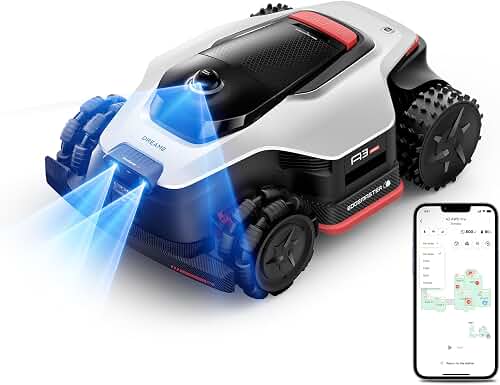
Finding the best robot lawn mowers for Bermuda grass Texas homeowners can rely on during prolonged drought means looking past marketing claims and focusing on three things: high cutting decks that respect Bermuda's heat-stress thresholds, GPS or boundary-wire systems that handle the irregular zones common to Hill Country and DFW-area lots, and battery platforms that can mow in early-morning or late-evening windows when surface temperatures are survivable. Bermuda grass thrives in Texas heat, but only if it is mowed at the right height, on the right frequency, and without scalping during water restrictions. The wrong robot mower will stress the turf, expose stolons to UV burn, and accelerate dormancy. The right one will keep your lawn dense, green, and drought-resilient even when your municipality imposes Stage 2 or Stage 3 watering rules.
This 2026 buyer's guide walks through what to look for in the best robot lawn mowers for Bermuda grass Texas lawns specifically, and why generic "best robot mower" lists from cooler climates often steer Texans wrong. We will cover deck height, cutting frequency, slope handling for caliche and clay soils, wire-free GPS versus boundary wire trade-offs, and the maintenance schedule that keeps a robotic mower running through a Texas summer.
Why Bermuda grass in Texas needs a different robot mower strategy
Bermuda grass (Cynodon dactylon) is the dominant warm-season turf across Texas for good reason: it tolerates heat above 100°F, recovers quickly from foot traffic, and goes dormant rather than dying when water is scarce. But that resilience comes with conditions. Bermuda needs to be cut at the correct height for its cultivar, and during drought, the rule flips from what most northern lawn guides assume.
Common Bermuda (the unimproved variety found in most older Texas yards) prefers a mowing height of 1.5 to 2.5 inches. Hybrid Bermudas like Tifway 419, TifTuf, and Celebration tolerate shorter cuts down to 0.5 to 1.5 inches — but during a drought, you want to mow at the top of that range, not the bottom. Taller blades shade the soil, reduce evaporation, encourage deeper root growth, and prevent the scalping that exposes stolons and rhizomes to the brutal Texas sun.
This is where most robot mowers struggle. Many European-designed models top out at 60mm (about 2.4 inches), which is fine for cool-season fescue but borderline for Bermuda during a Stage 3 watering ban. The best robot lawn mowers for Texas Bermuda lawns offer cutting heights of at least 2.5 inches, and ideally up to 3 inches, so you can raise the deck during the worst of summer and lower it again in spring and fall.
Key features to prioritize for Texas drought conditions
Maximum cutting height of 2.5 inches or higher
This is the single most important spec. If a mower cannot cut at 2.5 inches or above, skip it for Bermuda. Hybrid Bermuda owners doing a low-cut maintenance program in spring can still benefit, but the same machine needs to raise its deck for July and August. Look for stepped or continuous height adjustment, with a clear maximum number in millimeters or inches in the spec sheet.
Mulching with frequent micro-cuts
Robotic mowers mulch by design, returning fine clippings to the soil as a slow-release nitrogen source and a moisture-retaining mat. For Bermuda in drought, this is a major advantage over traditional weekly mowing with a bag. The micro-clippings break down quickly in Texas heat, feeding the lawn without thatch buildup, and the shade they cast on the soil surface lowers evapotranspiration noticeably. Choose a mower that runs daily or every other day so each pass removes only a fraction of an inch — never more than one-third of the blade height at a time.
GPS or RTK navigation for irregular Texas lots
Texas suburban lots often have curved beds, decomposed-granite paths, pool decks, and oak-shaded zones that make perimeter-wire installation tedious. Wire-free GPS-RTK mowers map your yard with centimeter-level accuracy and let you draw exclusion zones around flowerbeds, septic risers, and the dog's favorite digging spot from your phone. They are a strong fit for the irregular acre-plus lots common in Austin, Dripping Springs, Plano, and the Houston exurbs. For comparison of these approaches, see our guide to wire-free robot lawn mowers.
Heat-tolerant battery chemistry and shaded charging dock
Lithium-ion batteries degrade faster above 95°F. The charging dock is where the mower spends 60 to 70 percent of its life, and a dock baking in direct West Texas sun will cook a battery in two seasons. Plan to install the dock under the eaves on a north or east-facing wall, or build a small ventilated cover. Some 2026 models include thermal management with active fan cooling — worth the premium if your dock will see any afternoon sun. Schedule mowing for early morning (5–7 AM) or evening (after 8 PM) to keep the motor and electronics cooler.
Slope handling for clay, caliche, and St. Augustine transitions
Central Texas yards often have grade changes for drainage swales, and the transition from Bermuda in the sunny areas to St. Augustine in the shaded areas creates traction headaches. Look for at least 35 percent slope rating (about 19 degrees), all-wheel drive on anything steeper, and aggressive tread tires rather than the smooth scooter wheels found on entry-level European models. Our breakdown of robot lawn mowers for hills and slopes covers the AWD options in detail.
Cutting schedule for Bermuda during a Texas drought
Here is the schedule that keeps a Bermuda lawn alive through a Stage 2 or Stage 3 watering restriction in 2026:
- Spring (March–May): Cut at 1.5–2 inches every two days. Bermuda is greening up and recovering from dormancy; frequent low cuts encourage lateral spreading and density.
- Early summer (June): Raise the deck to 2.25–2.5 inches. Continue every-other-day mowing. Soil moisture is dropping but the grass is still actively growing.
- Peak drought (July–August): Raise the deck to its maximum, ideally 2.75–3 inches. Drop to mowing every third day. Restrict run times to before 8 AM and after 8 PM. If the lawn enters dormancy and stops growing, suspend mowing entirely — do not mow brown, brittle Bermuda.
- Fall (September–November): Return to 2.25 inches and every-other-day schedules. This is when Bermuda stores carbohydrates for winter.
- Winter (December–February): Bermuda goes dormant. Park the mower and use the off-season for blade replacement and a deep clean. See our robot mower winterization guide for the full checklist.
Sizing the mower to your Texas lot
Texas yards run the gamut from 4,000-square-foot Houston Heights lots to two-acre Hill Country spreads. Robot mowers are rated by maximum coverage area, but that rating assumes ideal conditions: flat terrain, simple rectangular boundaries, and moderate grass growth. For Bermuda in Texas heat, derate the manufacturer's coverage spec by about 25 percent to account for slower mowing speeds at higher deck heights and the time spent navigating irregular zones.
A mower rated for 0.5 acre will comfortably handle a typical 0.3-acre Bermuda lawn in San Antonio. A mower rated for 1.25 acres is the realistic floor for a true one-acre Texas lot with a pool deck and landscape beds. For lots over an acre, look at the high-capacity wire-free GPS models or plan to install multiple docking stations.
Wire-free GPS versus boundary wire in Texas soil
Texas clay expands and contracts dramatically with rainfall, and the perimeter wires that European robot mowers traditionally use can break when the soil heaves after a heavy storm following weeks of drought. Caliche layers in Central and West Texas make burying wire deeper than a couple of inches genuinely difficult without a trenching tool. For these reasons, wire-free GPS-RTK navigation has become the preferred approach for 2026 installations across Texas. The trade-off is that GPS mowers need a clear sky view, which can be challenging under mature live oaks. RTK base stations help, but heavy canopy can still cause signal loss. If your Bermuda areas are in full sun and your shaded zones are St. Augustine, this works in your favor — the GPS mower handles the Bermuda areas reliably, and you can hand-trim the shaded edges.
Installation and maintenance for Texas conditions
Installation in Texas requires a few extra steps beyond the standard manual. Anchor the charging dock on a level pad, ideally a small concrete or composite pad rather than directly on the lawn — fire ant mounds will appear under any structure left on soil. Run power to the dock through a GFCI outlet rated for outdoor use, and use UV-resistant conduit for any exposed wiring; standard PVC becomes brittle within two summers of Texas sun exposure.
Maintenance is mostly about heat and dust. Blades dull faster on the silica-rich soil of West Texas than they do on coastal soils, so plan to replace blades every six to eight weeks during the active mowing season rather than the every-three-months schedule the manual suggests. Clean the underside of the deck weekly during pollen-heavy spring weeks — cedar fever season coats everything in yellow dust that hardens into a crust when wet. Our detailed robot mower maintenance guide walks through blade replacement, deck cleaning, and sensor calibration.
Drought response and watering coordination
The best results come from coordinating the robot mower's schedule with your irrigation controller. Most Texas municipalities allow watering only one or two days per week during restrictions, typically before 10 AM or after 7 PM. Schedule the mower to run on non-watering days, and never within two hours of an irrigation cycle — wet Bermuda clumps, clogs the discharge, and leaves uneven cuts. Smart mowers with rain sensors will pause automatically, but they cannot detect that you watered yesterday, so manual scheduling matters.
During severe drought, when the lawn enters dormancy and turns straw-colored, suspend mowing entirely. The robot will happily shred dormant Bermuda crowns, and any damage done during dormancy will not heal until the next rain cycle. Park the mower at the dock, raise the deck to maximum, and resume only when you see new green growth.
Frequently Asked Questions
What height should a robot mower cut Bermuda grass at in Texas summer?
Set the deck to 2.5 to 3 inches during July and August. Taller blades shade the soil, reduce evaporation, and protect stolons from UV damage. Lower the deck back to 1.5 to 2 inches in spring and fall when the grass is actively growing and water is more available. Hybrid Bermuda cultivars like Tifway 419 can tolerate slightly lower cuts even in summer, but the principle holds: raise the deck during stress, lower it during growth.
Can a robot lawn mower handle Texas Bermuda grass during a Stage 3 watering ban?
Yes, provided you raise the cutting height to maximum and reduce mowing frequency to every third day or less. If the lawn enters full dormancy and stops growing, stop mowing entirely until rain returns. Robot mowers actually help drought-stressed Bermuda survive because mulched clippings retain soil moisture better than bagged cuttings, and the lighter, more frequent passes avoid the scalping shock of weekly mowing.
Will a robot mower damage Bermuda grass stolons?
Not under normal operation. Robot mower blades are small and light, designed to clip rather than tear, and the random or systematic patterns they follow prevent the rut formation that damages stolons under heavier traditional mowers. The risk comes from mowing too low during drought stress, which exposes stolons to sun, or from running the mower on dormant brown grass. Keep the deck high during stress periods and you will see denser stolon coverage over time.
Do I need a wire-free GPS robot mower for a Texas yard?
Wire-free GPS-RTK mowers are usually the better choice for Texas because clay soil heaves crack buried perimeter wires, and caliche makes trenching difficult. However, GPS mowers need an open sky view and struggle under mature oak canopy. If your Bermuda areas are in full sun, GPS is excellent. If your lawn is mostly shaded, a boundary-wire mower or a hybrid system may serve you better. Our guide to choosing a robot lawn mower walks through the decision in detail.
How do I keep a robot mower's battery from overheating in Texas heat?
Locate the charging dock in shade, ideally under the eaves on a north or east-facing wall. Schedule mowing for early morning before 8 AM or evening after 8 PM to avoid the hottest surface temperatures. If your dock must sit in afternoon sun, build a small ventilated cover or pergola structure over it. Choose a 2026 model with active thermal management if your yard has no shade options. Lithium-ion batteries lose roughly 20 percent of their lifespan for every 10°F above 95°F sustained ambient temperature, so shade is the single biggest factor in long-term battery health.
How often should a robot mower run on Bermuda grass during peak Texas summer?
Every third day is typical for hybrid Bermuda during July and August, with the deck raised to maximum. Daily mowing is fine in spring and fall when the grass is actively growing, but excessive mowing during heat stress wastes battery cycles and stresses the turf. If the lawn enters dormancy, suspend mowing entirely until new green growth appears after rainfall.
Can a robot mower handle the transition between Bermuda and St. Augustine in a Texas yard?
Yes, but you will need to compromise on cutting height. St. Augustine prefers 3.5 to 4 inches, while Bermuda peaks at 2.5 to 3 inches during summer. Set the deck somewhere in the middle (about 3 inches) or use a mower that supports multiple zones with different height settings — some 2026 GPS-RTK models offer this. Alternatively, accept that one grass type will be slightly off-spec and prioritize whichever covers more of your yard.