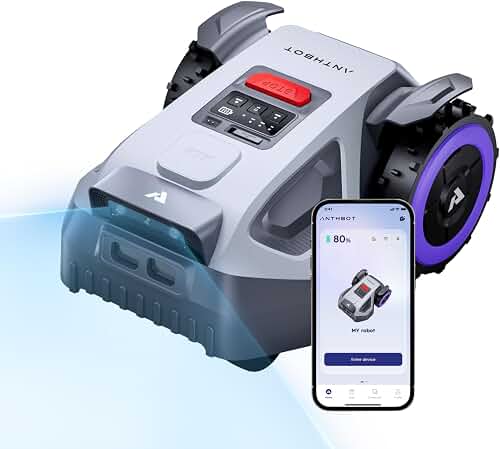
Spec Comparison: Vision L1600 vs Vision L2000
| Feature | Landroid Vision L1600 | Landroid Vision L2000 |
|---|---|---|
| Max mowing area | ~1,600 m² (0.4 acre) | ~2,000 m² (0.5 acre) |
| Battery | 20V / 4.0 Ah | 20V / 5.0 Ah |
| Typical runtime per charge | ~110 min | ~140 min |
| Navigation | RGB camera + AI | RGB camera + AI (improved low-light tuning) |
| Boundary wire required | No | No |
| Max slope | 35% | 40% |
| Drive wheels | Standard rubber treads | Larger diameter, deeper lugs |
| Cutting width | 22 cm | 22 cm |
| Cut height range | 30–60 mm | 30–60 mm |
| Anti-theft (PIN + GPS) | Yes | Yes + cellular alert (premium plan) |
| Noise | ~62 dB | ~64 dB |
| Best fit | Smaller rural lots, moderate deer traffic | Larger unfenced acreage, heavy wildlife pressure |
Choosing between the worx landroid vision l1600 vs l2000 fenceless deer yards setup comes down to three things: yard size, how often deer (and other wildlife) cross the mowing zone, and how much you trust GPS-based virtual boundaries to keep a wire-free robot inside your property line. The short answer: the Vision L1600 is the better pick for properties up to roughly 1,600 m² (about 0.4 acre) where deer pressure is moderate and you want the lowest-cost wire-free entry point, while the Vision L2000 earns its premium on larger 0.5–0.6 acre lots where the longer runtime, beefier wheels, and improved obstacle handling pay off in pastures, orchards, and rural yards that deer treat as a buffet. Neither model needs a buried boundary wire — both use an onboard RGB camera plus AI to recognize grass edges — which is what makes them so attractive for unfenced, deer-traveled properties where running perimeter wire through woods, fencerows, or game trails is impractical.
Below, I'll walk through how each Vision model performs on the real-world variables that matter for fenceless deer country: navigation reliability when an animal walks through the cut, recovery after a deer print sinks the mower into soft turf, theft deterrence when nobody's home, and the long-term wear you can expect when a robot shares its lawn with 150-pound mammals.
Why Wire-Free Matters on Deer Properties
Traditional robot mowers rely on a perimeter wire pinned or buried around the lawn. That works beautifully on a flat suburban lot, but it falls apart fast on rural acreage where deer trails cut across the yard nightly. Hooves cut the wire. Frost heave pops the staples. A buck rubs an antler on a tree and drags 40 feet of boundary wire into the woods. Owners of unfenced deer properties typically replace boundary wire two to four times in the first season alone, which is the entire reason the Worx Landroid Vision line exists. Both the L1600 and L2000 navigate using a front-mounted camera that classifies grass versus non-grass in real time, so there's no wire to chew, dig up, or splice back together at midnight.
That said, "fenceless" doesn't mean "boundary-less." Both Vision models still use a virtual GPS-RTK boundary you walk once during setup. Deer can wander through the cut area freely — the mower will detect them and pause — but the mower itself won't wander into the neighbor's pasture or down toward the road. This is the architecture that makes the worx landroid vision l1600 vs l2000 fenceless deer yards conversation interesting in the first place: you get the convenience of no buried wire without the chaos of a truly unbounded robot.
How Each Model Handles Deer Encounters
This is the question every rural buyer actually wants answered. Both Vision models use the same core obstacle-detection pipeline: the front camera identifies anything non-grass in the path and triggers a slow-stop, then a reroute. In practice, that means when a deer steps into the mowing zone, the robot will stop within roughly 30–40 cm and idle until the deer leaves. Neither model will charge a deer, and neither will get aggressive about pushing past one — they simply wait.
The L2000 has a noticeable edge in two scenarios that come up constantly on deer properties:
- Soft turf recovery. Deer prints, especially during spring thaw, leave 2–3 inch divots that bog down the smaller L1600 wheels. The L2000's larger drive wheels with deeper lugs climb out of soft spots that strand the L1600.
- Dawn and dusk mowing. Deer are crepuscular, so the most active wildlife windows overlap with low light. The L2000's camera tuning handles dim conditions better, which means fewer false stops on long shadows from tree lines and fewer "stuck" alerts at 6 a.m.
If your property is small enough to be mowed during full daylight (the L1600 can finish 0.3 acre well before dusk), the camera-tuning difference is a wash. But if you're mowing at the edge of the L1600's capacity, the schedule will spill into low-light hours and the L2000 becomes the smarter buy.
Anti-Theft on an Unfenced Property
Without a fence, anyone driving by can see the robot working. Worx Vision models include a PIN lock, motion alarm, and GPS tracking on both the L1600 and L2000. The L2000 adds the option of cellular-backed location alerts through Worx's premium connectivity plan, which I'd consider mandatory if your property fronts a road or is visible from one. The L1600's WiFi-only setup is fine if your house WiFi reaches the lawn, but cell coverage extends past WiFi range — something that matters on properties large enough to attract deer in the first place. Both models will sound a loud alarm and brick themselves if lifted without the PIN, which has measurably reduced opportunistic theft of robot mowers over the last two seasons.
Wear-and-Tear Realities
A robot mower sharing its lawn with deer takes more abuse than one on a suburban lot. Expect the following on either Vision model:
- Blade replacement every 6–8 weeks instead of the suburban 12–16 weeks, because hooves leave hard-packed dirt clumps that dull the small razor blades faster.
- Camera lens cleaning weekly. Deer kick up grass clippings and pollen that fog the camera. Both models will fault out and refuse to mow with a dirty lens — budget two minutes a week for a microfiber wipe.
- Wheel inspections monthly. Mud rings build up in the wheel wells. The L2000 wheels shed mud better, but neither is immune.
None of this is a dealbreaker, but it's worth knowing that a rural Vision lives a harder life than a suburban one, and the L2000's slightly more rugged build is the right call if your lawn meets woods or pasture directly.
Which Should You Buy?
Pick the Landroid Vision L1600 if…
Your usable lawn is under 0.4 acre, deer cross occasionally rather than daily, and your WiFi reaches the entire mowing zone. The L1600 finishes a typical 0.3-acre yard in a single charge cycle during daylight hours, which sidesteps the low-light navigation question entirely. It's the cheaper entry into wire-free mowing and the right answer for most rural "yard plus a little" properties where the deer trail clips only one corner.
Pick the Landroid Vision L2000 if…
Your lawn is 0.4–0.6 acre, deer move through the cut zone daily, the property edges woods or pasture, or you need cellular-backed anti-theft because the lawn is visible from a public road. The longer runtime means you can schedule mid-morning sessions that finish before peak deer activity, the larger wheels handle hoof-damaged turf, and the premium connectivity plan gives you real-time location alerts if anyone walks off with it.
Setup Tips Specific to Deer Country
A few practical notes from owners running Vision mowers on unfenced deer properties:
- Walk your virtual boundary twice. The first walk teaches the mower the GPS perimeter; the second walk lets you tighten any drift. On rural lots without crisp visual edges (no sidewalk, no driveway), the second pass dramatically reduces wandering.
- Place the dock under cover. Deer don't bother the dock, but rain and bird droppings on the charge contacts will. A simple shed roof or carport awning extends dock life by years.
- Schedule against deer patterns. Set the mowing window to 9 a.m.–2 p.m. when deer are bedded. Both models handle interruptions fine, but fewer interruptions means a more reliable schedule.
- Add no-go zones around fawning cover. In May and June, does drop fawns in tall grass. Use the app to draw exclusion zones around brushy edges until you've confirmed no fawns are present.
If you're still weighing whether wire-free is the right architecture at all, the comparison guide at best wire-free robot lawn mowers walks through the broader category. For more on sizing a robot to a larger lot, best robot lawn mowers for large yards covers what changes above the half-acre mark, and the general robot lawn mower buying guide is a solid starting point if this is your first robot. Owners specifically worried about animals interacting with their mower should also read best robot mowers for pet owners, which covers many of the same wear-and-tear realities that apply to wildlife.
Frequently Asked Questions
Will the Landroid Vision L1600 or L2000 chase or hurt deer?
No. Both models stop within roughly 30–40 cm of any non-grass obstacle the camera detects, including animals. The cutting blades are small razors that retract on impact and disengage when the mower stops. A deer that wanders into the mowing zone will simply cause a pause until it leaves — there's no chase behavior, no startle noise, and no risk of injury to wildlife in normal operation.
Can I run the Vision L2000 on a half-acre yard with no fence?
Yes, that's exactly the use case it's designed for. The L2000's 2,000 m² capacity covers about 0.5 acre, and the GPS-RTK virtual boundary keeps it inside your property even without physical fencing. You'll want strong cell coverage at the property if you're using the premium anti-theft plan, and you should walk the virtual boundary twice during setup to minimize drift along ambiguous edges.
Do I need WiFi at the lawn for the Vision L1600?
You need WiFi at the dock for setup, firmware updates, and app control. The mower itself can operate on a schedule without continuous WiFi, but you'll lose remote start, no-go zone edits, and location alerts when it's out of range. On larger rural properties, a WiFi extender near the dock is often necessary. The L2000 with the premium plan can fall back to cellular, which removes this constraint.
How well does the Vision camera handle dew, frost, and fog on rural mornings?
Heavy dew and frost will trigger a rain-sensor pause on both models until the camera lens clears. Light fog is usually fine — the AI is trained on a wide range of lighting. The L2000's improved low-light tuning handles marginal conditions better than the L1600, which matters if your schedule pushes into early morning. Cleaning the camera lens weekly is the single biggest reliability upgrade you can make.
What happens if a deer damages the Vision mower?
Direct deer damage is rare — the mower stops well before contact. The more common scenario is a deer kicking turf or a rock into the mower's path overnight, which the camera catches on the next pass. Bodywork is replaceable on both models, and the blade disc is a tool-free swap. Worx's two-year warranty covers manufacturing defects but not animal damage, so consider a homeowner's policy rider if you live in heavy wildlife country.
Is the Vision L1600 fast enough to keep up with summer growth on rural lots?
On lots under 0.35 acre, yes — a daily mow keeps growth in check even during May–June peak growth. On lots between 0.35 and 0.4 acre, you'll want to mow daily and accept the occasional skipped session due to weather. Above 0.4 acre, the L2000's longer runtime is genuinely needed; pushing the L1600 past its rated capacity leaves shaggy patches by the second week of June.
Can I use either model on a property with both lawn and pasture sections?
Both models cut residential lawn grass. Neither is designed for pasture-height vegetation — they'll fault out in anything above about 4 inches. If your property mixes maintained lawn and unmaintained pasture, draw the virtual boundary to include only the maintained sections. Many deer-property owners find this is the natural mowing perimeter anyway, since deer browse the unmaintained edges and you don't need them mowed.