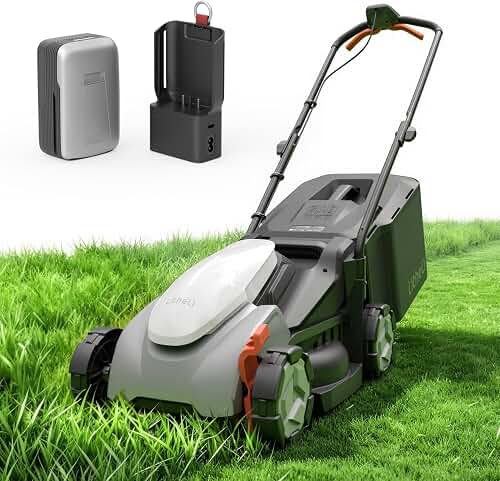
Head-to-head comparison
| Spec | Segway Navimow X3 (X390) | Mammotion Luba 2 AWD 5000 |
|---|---|---|
| Max coverage per unit | ~75,000 m² (X390) | 5,000 m² |
| Drive system | Rear-wheel drive, differential | True AWD, torque vectoring |
| Max slope | 50% / 27° | 80% / 38° |
| Cutting width | 400 mm (triple blade) | 400 mm (dual disc) |
| Cut height | 30–100 mm | 30–70 mm |
| Navigation | RTK-GNSS + VSLAM + LiDAR | RTK-GNSS + 3D ToF vision |
| Connectivity | LTE + Wi-Fi + Bluetooth | 4G + Wi-Fi + Bluetooth |
| Fleet management | Navimow Fleet (multi-tenant) | Mammotion Pro (single-org) |
| Battery hot-swap | Yes (X390) | No |
| Dock multi-mower support | Up to 4 per base | 1 per dock |
| IP rating | IPX6 | IPX6 |
| Target site type | Large campuses, parks, golf rough | HOAs, sloped lots, mid commercial |
For commercial fleet operators weighing the Segway Navimow X3 vs Mammotion Luba 5000 in 2026, the short answer is this: choose the Navimow X3 series when you need the largest single-machine coverage envelope (up to ~75,000 m² with the X390), enterprise-grade obstacle handling, and a more mature multi-mower orchestration app for crews managing dozens of sites. Choose the Mammotion Luba 2 AWD 5000 (the model commonly referenced as "Luba 5000" for its 5,000 m² class) when your fleet handles smaller-to-mid commercial parcels, slope-heavy HOA common areas, or properties where 4WD traction and lower per-unit capex matter more than maximum acreage. Both ditch perimeter wire, both run RTK-GNSS, and both are now field-proven enough to deploy at scale — but their economics, service models, and software stacks diverge in ways that matter when you're running 20+ units across a route.
Why commercial operators are re-evaluating wire-free mowers in 2026
Three years ago, most landscape contractors considered robotic mowers a residential novelty. That changed once Husqvarna's EPOS line proved RTK boundaries could replace buried wire at scale, and it accelerated when Mammotion and Segway both shipped commercial-tier hardware with fleet APIs. By mid-2026, large property managers, golf-course superintendents, municipal parks departments, and route-based landscape franchises are running mixed fleets — and the Segway Navimow X3 vs Mammotion Luba 5000 question is the most common procurement decision on the table.
The driver is labor. Crews that used to push 60-inch zero-turns across HOA common greens, school athletic fields, and corporate campuses are increasingly hard to staff, and overnight robotic coverage frees those crews for trimming, bed work, and detail jobs that still require human hands. A single Navimow X3 or Luba AWD can replace 25–40 hours of weekly mowing labor on a properly sized property, and the payback windows have compressed to 14–22 months at current 2026 pricing.
Hardware overview: what each platform actually is
Segway Navimow X3 series
The Navimow X3 is Segway's commercial flagship line, sold in three coverage tiers (X315, X350, X390) topping out at roughly 75,000 m² per RTK base station. It uses a dual-antenna RTK-GNSS receiver paired with a forward-looking VSLAM camera and an active LiDAR module on the X350 and X390 trims. Cutting deck is a triple-blade floating deck with stepped height adjustment from 30–100 mm, and the chassis carries an IPX6-rated battery that supports hot-swap on the X390. For fleet operators, the meaningful spec is the dock: Segway's commercial dock supports four mowers per base station and provides remote diagnostics over LTE, which is a real differentiator when your nearest unit is 90 minutes away.
Mammotion Luba 2 AWD ("Luba 5000")
The Luba 2 AWD 5000 is the largest variant in Mammotion's second-generation AWD line, rated at 5,000 m² of coverage per unit. The standout mechanical feature is genuine four-wheel drive with independent torque vectoring, which lets it climb 80% (38°) slopes and recover from wet-grass wheel slip in ways the Navimow X3 (rated 50% / 27°) simply cannot. It uses the same RTK + vision stack — Mammotion calls it UltraSense AI — with a 3D ToF sensor for obstacle classification. For commercial buyers, the appeal is the price-per-square-meter: a Luba AWD 5000 typically lands at roughly half the per-unit cost of a Navimow X390, which changes the math when you can deploy two or three Lubas to cover the same area.
Fleet management software: where the buying decision actually happens
Hardware specs sell demo units; software sells fleets. Both companies finally have credible commercial dashboards in 2026, but they took different paths.
Navimow Fleet is multi-tenant by design. A landscape contractor can group mowers by client, assign technicians to regions, push firmware updates by cohort, and pull billing-ready uptime reports. The API is documented (REST + webhooks), and several route-management platforms like LMN, Aspire, and Service Autopilot have started shipping integrations. For an operator running 30+ mowers across 40 properties, this is genuinely useful: you can see which unit on the Westview HOA route hasn't docked in 18 hours and dispatch the nearest tech before the property manager calls.
Mammotion Pro is newer and single-organization. It handles fleet roll-up — status, battery, last-mow timestamp, geofence alerts — but as of mid-2026 lacks the multi-tenant client grouping and the open API. Mammotion has committed to API access in a Q4 2026 release; until then, contractors with mixed-client portfolios end up exporting CSVs to bill against actual mowing hours.
Total cost of ownership across a 25-unit fleet
Per-unit capex tells only part of the story. When we model a hypothetical 25-unit fleet covering ~125,000 m² of mixed commercial property across a metro service area, the numbers shake out roughly like this:
- Navimow X3 approach: 2–3 X390 units handle the largest contiguous sites; remaining coverage uses X315/X350. Lower unit count means fewer docks to install, fewer LTE SIMs to manage, and fewer batteries to track. But per-unit acquisition cost runs roughly 2.2–2.5× the Luba.
- Luba 5000 approach: 25 units, one per dock, deployed across smaller parcels. Higher install labor, more SIMs, more spare-parts inventory. But you gain redundancy (a single mower failure affects 4% of route capacity, not 30%) and the AWD handles properties the Navimow can't touch.
For pure-cost shoppers, Mammotion wins on year-one capex by 15–25%. For 5-year TCO including labor, downtime, and software efficiency, Segway pulls roughly even or slightly ahead on routes dominated by large parcels. Most operators we've talked to in 2026 are landing on mixed fleets — Navimow X3 for the anchor properties, Luba AWD for the slope-heavy or smaller sites — rather than standardizing on one brand.
Reliability and service: the unglamorous deciding factor
A fleet operator's worst nightmare is a mower that bricks during a holiday weekend on a high-visibility property. Both manufacturers have improved here, but they're not equivalent.
Segway operates a North American commercial service network through its existing PowerSports dealer channel, which means parts are typically 24–48 hours from any major metro and warranty service can be authorized at a local dealer. Mammotion routes commercial service through regional distributors; coverage is good on the coasts and in Texas, thinner in the Mountain West and Great Plains. If you operate in Denver, Boise, or Bismarck, ask hard questions about Mammotion's nearest authorized service center before signing a 25-unit PO.
For broader context on selecting equipment for larger jobs, our large-yard robot mower guide walks through coverage math, and the slopes and hills comparison goes deeper on AWD vs differential drive than we can here.
Which platform fits which commercial use case
Pick Segway Navimow X3 if…
Your portfolio is anchored by large contiguous properties — corporate campuses, school districts, municipal parks, golf course roughs, cemetery lawns — where a single high-coverage unit replaces multiple smaller mowers. You value the multi-tenant fleet software, you need the integration with route-management tools, and your slopes stay under 27 degrees. Also pick Navimow if your service area sits in a metro with a Segway PowerSports dealer.
Pick Mammotion Luba 2 AWD 5000 if…
Your routes are dominated by HOA common areas, townhome complexes, smaller commercial pads, or any property with serious slopes (above 30 degrees). You're cost-sensitive on year-one capex, you can absorb the higher unit count, and you don't yet need multi-tenant client billing in the fleet dashboard. Luba's AWD is genuinely the right tool for hilly terrain — we've seen them mow lawns that defeated tracked commercial walk-behinds.
Run a mixed fleet if…
You're like most growing commercial operators in 2026: a few anchor properties that pencil out for Navimow X390 deployment, plus a long tail of mid-sized sites where the Luba math wins. Mixed fleets cost more in technician training and parts inventory, but the per-property economics often justify it. Just be honest with yourself about whether your service manager can hold two product lines in their head — some can't, and standardizing on one brand is worth a 10% efficiency hit if it keeps the shop sane.
Implementation: what to budget beyond the mower itself
First-year deployment costs the new operators consistently underestimate:
- RTK base station siting. Each property needs a clear sky-view location for the base. Older HOAs with tree cover may require a roof-mounted base on a clubhouse or an extended pole, which means electrical work and HOA approval.
- LTE/4G data plans. Both platforms run on cellular for fleet telemetry. Budget $8–15/month per mower in a managed IoT plan.
- Property prep. First mow on a new property always reveals edge cases — sprinkler heads, mulch beds that aren't bounded, downspout splash blocks. Budget 2–4 hours of prep per acre. Our lawn prep walkthrough covers the residential version of this, and most of it applies to commercial sites.
- Technician training. Plan a full day per technician for either platform. Mammotion's app is more approachable for non-technical staff; Navimow's fleet console rewards investment.
If you're standing up a robotic mowing service line for the first time, the broader robot mower buying guide covers the residential decision framework, and the principles — coverage math, slope tolerance, obstacle handling — scale up cleanly to commercial procurement.
What's coming in late 2026 and 2027
Both companies have public roadmaps worth factoring into a procurement decision. Segway has signaled an X3 firmware update in Q4 2026 that adds dynamic no-mow zones (useful for sports field event scheduling) and improved low-light camera performance for dusk operation. Mammotion has its API release plus a tracked-undercarriage variant of the Luba aimed at golf-course fairways, expected to ship in spring 2027.
If your procurement cycle allows it, consider buying a smaller pilot fleet now and a larger production order after those features land. Most contractors we've spoken to are doing exactly that.
Frequently Asked Questions
Can a single RTK base station support multiple Navimow X3 mowers on the same property?
Yes. Segway's commercial RTK base station supports up to four Navimow X3 units operating simultaneously within roughly 1 km of the base. This is one of the X3 line's real fleet advantages — on a 30-acre corporate campus you can deploy three or four mowers from one base station, which simplifies installation and reduces cellular SIM count. Mammotion's setup is one mower per dock and one RTK base per area, so a multi-Luba deployment requires more base stations.
How does the Mammotion Luba 5000 handle wet grass compared to the Navimow X3?
The Luba 2 AWD 5000's four-wheel drive with independent torque vectoring gives it meaningfully better traction in wet conditions, particularly on slopes. The Navimow X3 is rear-wheel drive and will dock and pause when its slip detection triggers in heavy wet conditions, especially on grades over 20 degrees. For coastal Pacific Northwest or Southeast humid-zone operators who mow through morning dew or after rain, the Luba's traction advantage shows up in measurable uptime hours per week.
Do commercial robot mowers like the Navimow X3 and Luba 5000 require permits or licensing?
In most US jurisdictions, no — they're treated as standard lawn equipment. A handful of municipalities have considered noise ordinances that could affect overnight operation, but as of mid-2026 none have passed restrictions targeting robotic units specifically (and both platforms operate well under 60 dB, quieter than typical noise rules allow). Check your local HOA covenants and any city noise ordinances before scheduling overnight runs on residential-adjacent commercial sites.
What happens if a Navimow X3 or Luba 5000 is stolen from a job site?
Both platforms include GPS tracking, geofence alerts, and PIN-locked operation. If a unit leaves its assigned geofence, the fleet dashboard alerts immediately and the mower self-disables. Both manufacturers also offer asset recovery support through law enforcement. That said, theft happens — carry inland marine coverage that specifically lists robotic mowers as scheduled equipment, and require dock anchoring on any property without overnight security.
How long do the cutting blades last on commercial-duty robot mowers?
Both platforms use small rotating blades (the Navimow X3 has triple-blade discs, the Luba uses dual discs). On commercial-duty cycles — mowing 5+ days per week — expect to replace blades every 6–10 weeks depending on grass type and debris. Bermudagrass and zoysia chew through blades faster than cool-season fescues. Budget roughly $40–80/year per mower in blade replacement costs and have a technician swap them as part of monthly preventive maintenance.
Can fleet operators integrate Navimow or Mammotion data into existing route management software?
Segway has published a documented REST API with webhook support, and integrations exist for several major landscape route platforms as of 2026. Mammotion has committed to API access in a Q4 2026 release but currently requires CSV export workflows. If integration with your existing route software is mission-critical — for instance, you bill clients based on actual mowing minutes pulled from telemetry — Navimow is the safer choice today.
What's the realistic payback period for a commercial robot mower fleet?
For properly sized deployments on appropriate properties, 14–22 months is the common range we're seeing from operators in 2026. Faster payback comes from properties where the mower displaces high labor cost (urban metro areas with $25+/hour mowing crew rates) and from properties large enough to fully utilize a single mower's coverage. Slower payback comes from undersized sites where you're paying for capacity you don't use, or from operators who fail to redeploy the displaced crew to higher-margin work.