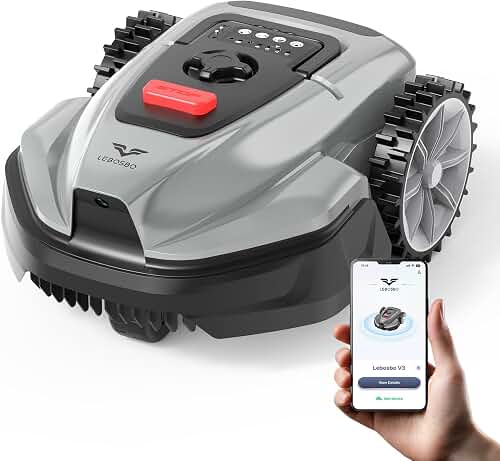
Husqvarna Automower 320 NERA vs 410XE NERA: spec comparison
| Feature | Automower 320 NERA | Automower 410XE NERA |
|---|---|---|
| Max working area | 2,200 sq m (~0.54 acre) | 2,500 sq m (~0.62 acre) |
| Max incline | 45% (24°) | 45% (24°) |
| Cutting width | 22 cm | 22 cm |
| Cutting height | 20-60 mm | 20-60 mm |
| Typical mowing time per charge | ~70 min | ~70 min |
| Charging time | ~60 min | ~60 min |
| Navigation | Boundary wire + EPOS-ready | Boundary wire + EPOS-ready |
| Ultrasonic obstacle sensor | No | Yes |
| Front LED light ring | No | Yes |
| Frame / weather seals | Standard | X-line reinforced |
| Noise level | 60 dB(A) | 60 dB(A) |
| Weight | ~13.2 kg | ~13.9 kg |
| Approx. street price (2026) | $2,300-$2,600 | $2,900-$3,300 |
For a sloped third-acre lawn (roughly 14,500 sq ft / 1,350 sq m), the Husqvarna Automower 320 NERA vs 410XE NERA debate usually comes down to one question: do you need the extra capacity and pro-grade frame of the 410XE, or is the 320 NERA's lighter, cheaper package enough? Short answer for 2026: the 320 NERA is the right tool for most third-acre yards with slopes up to 45%, but if your terrain is genuinely steep (north of 35% on long runs), heavily obstacle-rich, or you want X-line extras like spotlights, LED status ring, and the rugged frame for rocky paddocks, the 410XE NERA earns its premium. Both are EPOS-ready, both robot mow on a schedule with Husqvarna Connect, and both are leagues ahead of older 315X-class models on hills.
Below we break down the Husqvarna Automower 320 NERA vs 410XE NERA on slope performance, runtime, navigation, durability and total installed cost for a typical sloped third-acre property.
Quick verdict for a sloped third-acre yard
If your third-acre has rolling slopes that peak around 30-35%, choose the Automower 320 NERA. It is rated for 2,200 sq m (about half an acre) of working area, which leaves comfortable headroom for a third-acre with complex passages, and it handles inclines up to 45%. You will save several hundred dollars versus the 410XE without giving up the things that matter most on a sloped lawn: torque, traction wheels with deep lugs, and the new NERA-generation collision and lift sensors.
Step up to the Automower 410XE NERA if any of the following apply: your slope sections are long and consistently above 35%, your yard has lots of narrow passages or islands that benefit from a heavier, more stable chassis, or you want the X-line cosmetic and functional upgrades (front LED light ring, frosted body, rubber bumper, ultrasonic sensor). The 410XE is rated for 2,500 sq m and the same 45% incline, but its build is closer to professional Automower territory.
Slope handling: where the NERA series shines
Both mowers carry the same headline figure: 45% maximum slope (about 24 degrees). That number tells only part of the story. In real third-acre yards, what matters is sustained slope under wet grass, transitions between flat and steep sections, and how the wheels recover when the chassis pitches forward at the crest of a hill.
The 320 NERA uses deep-lugged drive wheels that are unchanged from the larger Automowers, and its lower weight actually helps on dry grass because there is less inertia to manage when the unit changes direction across a slope. Most owners with a sloped third-acre report no slip issues up to about 35-40% as long as the grass is kept under 3 inches.
The 410XE NERA adds a touch of weight, a slightly more rigid frame, and the X-line ultrasonic sensor that slows the mower before bumping into obstacles. On steep, wooded yards where the mower is dodging tree trunks while climbing, that pre-emptive slowdown reduces wheel spin in tight quarters. If your sloped third-acre is dotted with raised beds, retaining walls, or hardscape edges, the 410XE's smoother obstacle behavior is genuinely useful.
For broader context on which Husqvarna and competing models actually deliver on hillside marketing claims, see our roundup of the best robot lawn mowers for hills and slopes.
Coverage and runtime on a third-acre
A third-acre is comfortably inside both mowers' working area ratings, so neither will be working at the edge of its envelope. The practical implication is that you can run a relaxed schedule (5-6 days a week, daytime only) and still keep grass at a consistent height.
Expect the 320 NERA to cover a third-acre in roughly 4-5 hours of total daily mowing, broken into two or three charge cycles. The 410XE NERA shaves a little off that thanks to slightly better path-planning under EPOS, but in pure boundary-wire mode the difference is negligible.
If you are weighing whether a smaller model could squeak by, don't. The 315X and 305 class mowers struggle on slopes above 25% and run out of capacity headroom on a third-acre with any complexity. Stick with NERA-generation hardware. For homeowners with bigger yards, our guide to the best robot lawn mowers for large yards covers options that scale to a full acre and beyond.
Navigation: boundary wire today, EPOS tomorrow
The NERA designation means both mowers are EPOS-ready. EPOS (Exact Positioning Operating System) is Husqvarna's RTK-GPS solution that replaces the boundary wire with a centimeter-accurate satellite fence. You install a reference station, connect it to Wi-Fi or cellular, and define your zones in the Husqvarna app.
Out of the box, both mowers operate with a traditional buried boundary wire. To unlock EPOS, you buy the EPOS Plug-in Kit and a reference station separately. Total EPOS upgrade cost in 2026 runs about $900-$1,200, which is non-trivial but transformative for complex yards. On a sloped third-acre with multiple zones, terraces, or odd-shaped beds, EPOS lets you run systematic parallel passes instead of the random pattern that boundary-wire Automowers use.
One important caveat: EPOS requires a clear sky view to the reference station. Yards heavily shaded by mature trees or with tall buildings nearby may need supplemental boundary wire in problem zones, which both NERA models support as a hybrid setup.
Installation effort on a sloped lawn
Boundary-wire installation on a sloped third-acre is the same workload for either mower: plan on 6-10 hours for a DIY install, including pinning or burying about 700-900 feet of perimeter wire plus guide wires for the charging station route. Slopes complicate burial because you typically need to bury deeper to prevent erosion exposure.
Our step-by-step robot lawn mower install guide walks through wire routing, charging station placement, and how to handle slope-related drainage. For a sloped yard, place the charging station on the flattest reasonable spot near the perimeter to avoid forcing the mower to climb immediately on undocking.
Build quality, weather sealing, and noise
Both models are weather-sealed for full outdoor operation and can mow in rain (though most owners schedule around it to reduce clipping clumps). The 410XE NERA's X-line chassis adds:
- Rubber front bumper for impact tolerance against tree roots and stone borders
- Frosted body finish that hides scratches
- Front LED light ring useful for visibility at dawn/dusk and as a soft theft deterrent
- Ultrasonic forward sensor for smoother obstacle response
At 60 dB(A), both mowers are quiet enough to run during the day without bothering neighbors or interrupting a backyard conversation. That is roughly the noise level of a normal conversation and significantly quieter than any gas mower.
Security and theft deterrence
Both NERA mowers include PIN code lockout, GPS tracking via Husqvarna Connect, and a loud alarm if lifted without proper unlock. The 410XE's LED ring adds a visible "smart device" cue that helps deter casual theft. If your yard is unfenced and street-facing, that subtle deterrent is worth something, but neither mower replaces a locked garage or shed for overnight storage.
Total cost of ownership over 5 years
Beyond the initial purchase, expect to spend roughly $40-$80 a year on replacement razor blades (every 6-10 weeks during the season), one wheel motor service around year 4-5, and battery replacement around year 5-6 (~$200). The 320 NERA's lower entry price compounds favorably: over five years on a third-acre, the 320 NERA total cost lands around $3,000-$3,400, versus $3,700-$4,200 for the 410XE NERA.
For perspective on how Husqvarna stacks up against newer wire-free competitors, see our complete robot lawn mower buying guide for 2026.
Which one should you actually buy?
Pick the Automower 320 NERA if: you want the best price-to-capability ratio for a sloped third-acre, your steepest sections are under 40%, and you don't need X-line cosmetic or sensor upgrades. This is the smart-money choice for most readers.
Pick the Automower 410XE NERA if: your yard has long, sustained slopes above 35%, lots of obstacles, or you want the ruggedized frame and ultrasonic sensor for peace of mind. It is also the better long-term pick if you plan to upgrade to EPOS and want every advantage in path planning and obstacle avoidance.
If you are torn between this NERA pair and the older but still excellent X-line generation, our Husqvarna Automower 430X review covers what you give up (and gain) by going with a non-NERA model.
Frequently Asked Questions
Can the Husqvarna Automower 320 NERA actually handle a third-acre with slopes?
Yes. The 320 NERA is rated for 2,200 sq m (about 0.54 acre) and 45% maximum incline, so a third-acre at roughly 0.33 acre sits well within both envelopes. Real-world owners with slopes peaking in the 30-40% range report reliable performance as long as grass height stays under 3 inches and the boundary wire is correctly placed away from steep drop-offs.
Is the 410XE NERA worth the extra $500-$700 over the 320 NERA?
Only if you genuinely need its strengths: ultrasonic obstacle sensing, the reinforced X-line chassis, sustained operation on steep grades, or the cosmetic LED upgrades. For a flat or gently sloped third-acre with few obstacles, the upgrade is hard to justify. For a complex, terraced, or wooded sloped third-acre, the 410XE's smoother behavior around obstacles and slightly tougher build are worth the premium.
Do I have to use the EPOS satellite system with NERA mowers?
No. Both mowers ship with full boundary-wire support and work perfectly without EPOS. The NERA designation just means they are EPOS-ready when you decide to add the plug-in kit and reference station later. Many owners run boundary wire for the first season and then upgrade to EPOS once they understand their yard's traffic patterns.
How loud are these mowers when running on slopes?
Both are rated at 60 dB(A), measured at a standard distance. Slope operation does not meaningfully increase that figure because the motors are already well within their torque envelope at 45%. You can run them during early morning or evening hours in most neighborhoods without disturbing anyone.
Will either mower work in rain on a sloped yard?
Yes, both are sealed for wet operation. However, traction on steep, wet grass drops noticeably, and clippings clump more, which can leave visible streaks. Most owners use the Husqvarna Connect app's weather timer to pause mowing during and shortly after heavy rain. Drier ground gives a cleaner cut and less wheel rutting on hillsides.
What's the slope difference between NERA and older Husqvarna Automowers like the 315X?
The 315X is rated for only 25% incline, while both the 320 NERA and 410XE NERA jump to 45%. That is a substantial real-world difference: a 30% slope that defeats a 315X is handled comfortably by either NERA model. If your sloped third-acre defeated a previous-generation Automower, upgrading to NERA hardware solves it.
How long does the boundary wire installation take on a third-acre with slopes?
Plan on a full weekend for a DIY install: 6-10 hours of actual work, including planning the perimeter, pinning or burying 700-900 feet of wire, routing guide wires, and positioning the charging station. Slopes add time because you typically want the wire buried 2-4 inches deep to survive freeze-thaw and erosion. Pros typically charge $600-$1,200 for installation on a sloped third-acre.