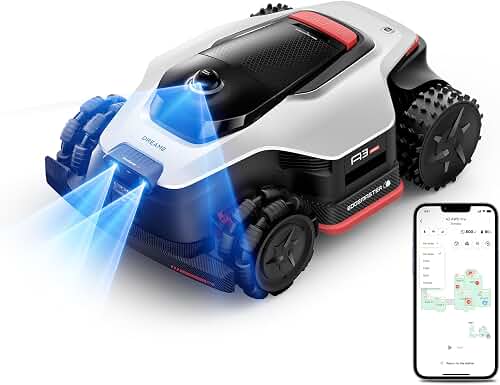
Husqvarna Automower 305 vs Gardena Sileno Minimo: side-by-side specs
| Feature | Husqvarna Automower 305 | Gardena Sileno Minimo |
|---|---|---|
| Best for lawn size | Up to 600 m² | Up to 250 m² (500 m² variant also) |
| Cutting width | 22 cm | 16 cm |
| Cutting height | 20–50 mm | 20–50 mm |
| Max slope | ~25% | ~25% |
| Noise level | ~60 dB(A) | ~57 dB(A) |
| Weight | ~6.7 kg | ~7.0 kg |
| Chassis length | ~55 cm | ~45 cm |
| App control | Automower Connect (Bluetooth) | Gardena Bluetooth app |
| Cellular / Wi-Fi | No on base trim | No |
| Theft protection | PIN lock, alarm | PIN lock, alarm |
| Boundary wire required | Yes | Yes |
| Typical 2026 price | $1,200–$1,500 | $700–$900 |
If you're shopping the husqvarna automower 305 vs gardena sileno minimo tiny lawns matchup, the short answer is this: the Gardena Sileno Minimo is the better fit for genuine postage-stamp lawns under 250 m² because it's purpose-built for small, awkward, walled-in plots, while the Husqvarna Automower 305 is an entry-level Husqvarna with capacity up to 600 m² that becomes overkill the smaller your yard gets. For a true 100–250 m² courtyard, terrace lawn, or front strip in 2026, the Minimo's compact chassis, narrower cutting width, and quieter motor pull ahead of the heavier, longer-runtime 305.
That said, "tiny" is a sliding scale. A 350–500 m² rectangular yard with a slope and a tree well is a very different animal from a 90 m² L-shaped front lawn squeezed between a driveway and a hedge. Below we break down how each mower handles real postage-stamp plots, what their cut quality looks like, how their boundary systems differ, what the realistic install effort is, and which one wins on noise — because if your lawn is small, your neighbors are close.
Why postage-stamp lawns need a different robot mower
The robot mower industry was built around 500–2,000 m² suburban lawns. Small urban yards break a lot of the assumptions those mowers were designed around: tight corners are harder to clean up, charging stations eat scarce square footage, longer chassis can't reverse out of narrow channels, and a wide cutting deck wastes pass after pass. On a 150 m² lawn, a robot that takes 35 minutes to cycle and runs four hours a day is doing the same patch six times — that's not gardening, that's pacing.
Both the Husqvarna Automower 305 and the Gardena Sileno Minimo are guided-wire robots — you install a perimeter boundary cable around the lawn, and the mower navigates within it using random or pseudo-random patterns. Neither uses GPS-RTK, vision, or LiDAR. That keeps them affordable and reliable on small plots where complex navigation systems struggle to lock in. But it also means installation effort is roughly proportional to perimeter length, not lawn area, so a small lawn with a complex shape can be more work to set up than a big square one.
The Husqvarna Automower 305 on a tiny lawn
The Automower 305 is the smallest mower in Husqvarna's classic lineup, and it's a genuinely good machine — quiet for its class, reliable, and backed by Husqvarna's parts and dealer network. On a 400–600 m² lawn it's near the sweet spot. On a true postage-stamp lawn, though, three things start to grate.
First, the 22 cm cutting width is wider than the Minimo's 16 cm, which sounds like an advantage until you watch it try to navigate a 1.2 m grass channel between a path and a fence. The 305 will clear it, but it can't U-turn cleanly in such tight space, so its random-pattern coverage gets lumpy. Second, the chassis is roughly 10 cm longer, which matters when you're parking a charging station inside a 6 m² corner of grass. Third, the 305 is built to run long sessions to amortise its capacity — on a small lawn that translates into more passes per blade-day, faster wear, and noise during hours your neighbors notice.
Where the 305 earns its keep on a smaller lawn: heavier wet conditions (its drive wheels are noticeably more aggressive), steeper grade transitions, and lawns with thicker grass species. If you're in a wet maritime climate with kikuyu, rye, or thick fescue, the 305's extra torque is real.
The Gardena Sileno Minimo on a tiny lawn
The Sileno Minimo was designed from the start for the kind of lawns the rest of the robot mower industry treats as edge cases. Gardena's SensorCut system uses three small razor blades on a swivelling disc — exactly the cutting concept that suits postage-stamp lawns, because frequent light tipping on small grass volumes is what the system was tuned for. The 16 cm cutting width finds its way into corners the 305 has to skip.
The Minimo's signature feature is its noise floor. At around 57 dB(A) at the wheel, it's quieter than a normal conversation a meter away, and on small lawns close to bedrooms, patios, or open windows that difference is the whole user experience. You can run it at 7 a.m. on a Saturday without anyone complaining. Try that with a petrol mower, or even a noisier robot, and you'll learn what an HOA-flag looks like.
The trade-off is power. On thick wet grass, on transitions onto wet pavers, and on slopes near the 25% spec ceiling, the Minimo is more willing to call it a day and return to base than the 305 is. For a manicured English-style lawn that gets cut three times a week, that's a feature. For a rough back garden that gets ignored for two weeks then asked to recover, it's a limitation.
Cut quality on small lawns: where the difference shows up
Both mowers cut continuously rather than collecting clippings, returning fine fragments to the lawn as mulch. On small plots that mulching effect is more pronounced because the grass volume is small relative to mowing frequency — lawns under a robot mower tend to develop a denser, finer sward over a season.
The Minimo's narrower deck and smaller blades produce a slightly cleaner tip cut at low heights (20–30 mm), which is the range most small-lawn owners actually want. The 305's wider deck is more forgiving if you mow at 35–50 mm, more typical of larger suburban plots. If your tiny lawn is a fescue or bent showpiece, the Minimo edges ahead. If it's a rye or Bermuda blend kept tall, the 305 doesn't disappoint.
Installation: the part nobody warns you about
Both mowers require a perimeter boundary wire pinned or buried around the lawn. On a postage-stamp lawn this can paradoxically be more fiddly than on a bigger one, because every shape change, flower bed, tree well, and stepping-stone path needs wire routing. Budget 2–3 hours for a typical small plot.
Gardena ships the Minimo with a small-lawn-friendly install kit: shorter wire (150 m), fewer pegs, simpler charging base, and a quick-start guide that assumes a single zone. Husqvarna's 305 kit is similar but more substantial — more wire, more pegs, a bigger base — reflecting its larger target size. If your yard is genuinely tiny you'll have leftover wire either way; the Minimo just throws away less of it. For a full walkthrough, see our robot lawn mower installation guide, which covers boundary cable depth, signal interference traps, and charging station placement for small plots.
App, scheduling, and smart features
The base Automower 305 in 2026 ships with Bluetooth-only app control through Automower Connect — meaning you have to be within ~10 m of the mower to change schedule or settings. If you need cellular or Wi-Fi, you're stepping up to the 310 Mark II or higher, which pushes the price further from the Minimo's. The Minimo similarly uses Bluetooth only, so on connectivity the two are tied.
Scheduling on both is straightforward. The Gardena app feels marginally more polished and is geared toward set-and-forget use — you set lawn size, mowing days, and forbidden hours, and it does the rest. Husqvarna's app gives you more visibility into faults and battery health, which matters more on bigger lawns. For the husqvarna automower 305 vs gardena sileno minimo tiny lawns use case, both are sufficient and neither is class-leading.
Noise: the small-lawn deal breaker
This is where the comparison most clearly favors the Minimo. On a 200 m² yard, the mower is rarely more than 10 meters from you, the neighbors, or an open window. A 3 dB noise difference is large at that distance. The Minimo can run during early morning or late evening hours most lawns assume are off-limits to motorised tools. The 305 can do this too, but it's noticeably more present. If your tiny lawn shares a wall with a neighbor, this single factor may decide the purchase.
Slopes, edges, and obstacles
Both are rated to around 25% slopes inside the working area. In practice the 305 holds traction better on damp slopes thanks to more aggressive tread and slightly higher drive torque. For small lawns with a strong front-to-back grade — common on terraced city lots — the 305 is the safer pick.
Edge cutting is a recurring weakness in this category. Neither mower has a true side-cutting deck; both stop their blades a few centimeters short of the boundary wire. On a postage-stamp lawn that's visible — you'll need to string-trim along walls, beds, and stepping stones every couple of weeks. The 305's wider deck makes this slightly worse in tight corners; the Minimo's narrow chassis tucks closer to obstacles.
Price and long-term value
In 2026 the Sileno Minimo retails $300–$500 below the Automower 305. For a small lawn that price gap rarely translates into less value — both mowers will run for years, both use widely available razor blades, and both can be serviced by the same independent garden specialists. If you're set on Husqvarna for resale, ecosystem, or dealer reasons, the 305 is defensible; otherwise, the Minimo is the rational pick.
For a wider field of options see our best robot lawn mowers for small yards roundup, which includes both wire-required and wire-free models. If you've already decided Gardena is your brand, our Gardena Sileno City review covers the next size up.
The verdict: which mower wins on a tiny lawn?
For 90% of true postage-stamp lawns — 250 m² or under, residential, close neighbors, manicured turf — the Gardena Sileno Minimo wins the husqvarna automower 305 vs gardena sileno minimo tiny lawns question. It's quieter, cheaper, easier to install, and built around the use case rather than scaled down to fit it. Pick the Automower 305 if you have thicker grass, real slopes, or you're already locked into the Husqvarna parts ecosystem. Both are good mowers; the difference is fit.
Still weighing your options? Our broader robot lawn mower buying guide compares wire vs wire-free systems, navigation types, and total-cost-of-ownership across brands.
Frequently Asked Questions
What size lawn is the Gardena Sileno Minimo actually best for?
Gardena rates the base Minimo for lawns up to 250 m² (the larger trim handles 500 m²). In practice the sweet spot is 80–200 m² — small enough that the 16 cm cutting deck doesn't feel constraining, and small enough that the mower's daily runtime isn't stretched. Above 250 m² you'll see longer cycles and noticeable wear; below 60 m² you're paying for capacity you don't use.
Is the Husqvarna Automower 305 worth the extra money on a small lawn?
Only if you have thick grass species (Bermuda, kikuyu, dense rye), strong slopes near the 25% spec, or wet maritime weather where extra drive torque pays off. For a typical 150–250 m² fescue or bluegrass lawn, the 305 is over-engineered and you're paying for capacity and torque the lawn never asks for.
Do either mower work without a boundary wire?
No. Both the Automower 305 and the Sileno Minimo require a perimeter boundary cable. If you want a wire-free option, look at GPS-RTK or vision-based mowers — these cost more and need clear sky for the antenna, but eliminate the install effort that drives many small-lawn buyers away. They make most sense above 300 m² where the wire job becomes onerous.
How loud is the Sileno Minimo compared to a petrol push mower?
A typical petrol push mower runs 90–98 dB(A); the Minimo is around 57 dB(A) at the wheel and quieter at conversational distance. That's roughly a thousandth the acoustic energy — closer to a fridge than a mower. You can realistically run it before 8 a.m. without complaints in most residential settings.
Can I install a robot mower on a lawn with a stone path or flower beds?
Yes, but the boundary wire needs to route around each non-grass obstacle, returning to itself with a tight loop the mower reads as outside the working area. Stepping stones flush with the grass can be mowed over if the mower's blades clear them (~3 cm undercarriage), but raised stones need a loop. Plan on extra setup time for tiny lawns with complex shapes.
Which mower handles slopes better on a tight courtyard lawn?
The Automower 305. Both are spec'd to 25%, but the 305's heavier drive train holds traction better on damp grass and paver transitions. If your courtyard has a real grade — say a front lawn that drops a meter from the house to the sidewalk — the 305 is the safer bet. On flat or near-flat plots the Minimo's lower noise wins.
How often will I need to replace the blades?
On both mowers, the small razor-style blades wear every 2–3 months under continuous use on a typical small lawn. They cost $1–$2 each and you replace three at a time. Set a calendar reminder; running on dull blades shreds grass tips and invites disease, especially on the dense, finer-textured sward that develops under a robot mower's daily cut.