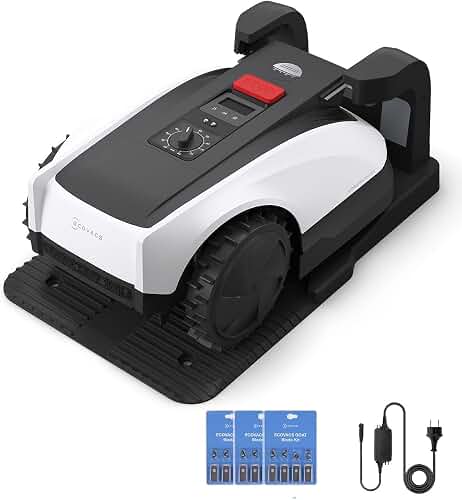
To charge a robot mower with solar panels at an off-grid cabin, you need a properly sized solar array (typically 200-400W), a 12V or 24V deep-cycle battery bank with 100-200Ah of usable capacity, an MPPT charge controller, and a pure sine wave inverter that matches the voltage and wattage of your mower's stock charging brick. A robot mower solar panel off grid charging system is entirely practical in 2026 because most consumer robotic mowers draw only 0.5-1.5 kWh of energy per week, well within the daily output of even a modest cabin solar rig. In the sections below we walk through panel sizing, battery selection, wiring topology, dock mounting strategy, and the specific mower features that play nicely with intermittent shoulder-season sun.
Why solar is the obvious power source at an off-grid cabin
Cabins without grid power historically meant gas trimmers, push reels, or letting the meadow take over. Robotic mowers changed that equation because they sip energy instead of gulping it. A 1500 m² lawn cut by an Automower-class machine typically consumes the same weekly energy as running a 100W lightbulb for ten hours. Once you have any kind of solar setup at the cabin for lights, a fridge, or a Starlink terminal, adding a robot mower is a marginal load rather than a new build-out.
The trickier piece is matching the mower's expected always-on charging dock to a power source that disappears every night. Solar plus a battery bank decouples sunshine from charging cycles, letting the mower behave as if it were plugged into a normal AC outlet at the cabin. The dock just sees a clean 120V or 230V sine wave whenever it needs to top the mower up.
How much power does a robot mower actually pull?
Power draw splits into two phases: charging the onboard lithium pack and idling on the dock. Charging power for residential models ranges from 30W to 120W, with charging cycles lasting 45 to 90 minutes. Dock-idle draw is the silent killer — most docks pull 2 to 8W continuously to keep the boundary signal alive on wired models, or to run a small radio link on wire-free models. Over a week, idle draw can account for more total energy than the actual mowing.
A realistic energy budget for a quarter-acre cabin lawn:
- Active charging: 60W × 5 hours/week = 300 Wh
- Dock idle: 5W × 168 hours = 840 Wh
- Inverter overhead: roughly 15% on top = 170 Wh
- Weekly total: approximately 1.3 kWh
That weekly number is the design target your solar and battery system needs to meet through the worst stretch of cloudy weather you expect to mow through.
Sizing the solar array for robot mower solar panel off grid charging
Rule of thumb for North American cabin latitudes (40-50°N): assume 3 to 4 peak sun hours per day in shoulder months. To net 1.3 kWh per week — roughly 185 Wh per day — after charge controller losses and battery round-trip inefficiency, you want about 250 Wh of panel-generated energy daily. That works out to a 75-100W panel in ideal conditions, but you should oversize by 2-3x to handle a string of cloudy days. A 200-300W rigid panel, or two 100W flexible panels in parallel, hits the sweet spot for most cabin sites.
If your cabin already has a solar setup powering interior loads, the robot mower dock is usually a sub-100W addition to whatever inverter is already running. Check that your existing inverter has enough surge headroom; some mower docks pull a brief inrush spike when the mower seats and starts charging.
Panel orientation matters more for the mower than for, say, lighting. The mower expects a charged dock during daylight hours since most models mow on solar-friendly midday schedules. Face panels true south, tilt them at latitude plus 10-15° for shoulder-season optimization, and clear surrounding tree shade aggressively — even partial shade on one cell can knock a panel's output to a fraction of its rating.
Battery bank: lithium iron phosphate is the right answer in 2026
LiFePO4 (lithium iron phosphate) batteries have come down enough in price that they are now the default for cabin solar storage. For a robot mower setup, you want at least 100Ah at 12V (1.2 kWh nominal), which gives you roughly four days of full mower operation with zero solar input. If your cabin runs other loads from the same bank, scale accordingly.
LiFePO4 advantages that matter for cabin use:
- Tolerates partial state of charge indefinitely (unlike lead-acid, which sulfates)
- Operates from -20°C to 60°C with charging cutoff below freezing on quality BMS units
- 10+ year lifespan with 3000-5000 deep cycles
- Flat voltage curve means the inverter sees consistent voltage until the bank is nearly empty
Avoid lead-acid for any cabin you do not visit weekly. Self-discharge and sulfation will eat a flooded or AGM bank that sits at partial charge for months between visits.
Charge controller and inverter selection
Use an MPPT (maximum power point tracking) charge controller, not the cheaper PWM type. MPPT extracts 20-30% more energy from the same panel and tolerates the voltage swings that come with shaded or cool conditions. Size the controller for your panel array wattage plus 25% headroom.
For the inverter, a pure sine wave unit is non-negotiable. Robot mower dock electronics often glitch or refuse to charge on modified sine wave. A 300-600W pure sine inverter handles a mower dock comfortably; if you are also running cabin loads, size the inverter for the combined peak draw. Look for an inverter with low idle consumption (under 10W) because it will be on continuously to keep the dock powered.
Step-by-step: wiring the mower dock into a solar system
- Mount the panels on the cabin's south-facing roof or a ground rack with clear sky exposure. Use marine-grade UV-resistant wire from panel to controller.
- Wire the charge controller between panels and battery, with appropriately sized fuses on both legs. Most cabin installs use 8-10 AWG between panel and controller, and 4-6 AWG between controller and battery.
- Connect the inverter directly to the battery bank with short, fat cables and an inline fuse rated to the inverter's max input current.
- Plug the mower dock into the inverter's AC outlet. Use the stock charging brick the manufacturer provides — do not try to feed DC directly into the dock unless the manufacturer publishes a 12V or 24V DC input spec.
- Weatherproof the dock with a small roofed enclosure. Most docks are rated for outdoor use, but a shelter reduces UV degradation and keeps snow off in shoulder seasons.
If you are setting up the lawn boundary for the first time, our robot mower installation walkthrough covers boundary wire layout, dock siting, and signal testing — all of which apply identically whether power comes from the grid or solar.
Mower features that pair well with solar power
Not every robot mower is happy with intermittent or limited power. The features worth filtering for in 2026:
Wire-free GPS / RTK boundary systems
These eliminate the always-on boundary wire signal that wired docks broadcast, cutting idle draw roughly in half. They also free you from burying a perimeter wire around a rough cabin lawn. See our wire-free robot mower picks for current models that fit this use case.
Programmable charging schedules
Some mowers let you specify charging windows. Setting the mower to only charge from 10 a.m. to 4 p.m. matches the solar generation curve perfectly and lets your battery bank coast at full charge overnight.
Lithium-ion onboard batteries with low-temperature cutoffs
Critical for shoulder-season cabins where overnight temps drop below freezing. A mower that refuses to charge cold actually protects its own pack — exactly what you want when the cabin owner is hundreds of miles away.
Cellular or satellite connectivity
Several 2026 models include LTE-M or LoRa connectivity so you can check mower status and trigger updates from anywhere. Critical for an unattended cabin install.
Mounting the dock at an off-grid cabin
Pick a flat spot near the cabin wall where the panels' DC run and the inverter's AC run can both reach the dock. Run AC out through a weatherproof junction box and a short whip of outdoor extension cord rated for the climate. Keep the inverter and battery inside the cabin or in an insulated shed — LiFePO4 tolerates cold but the inverter electronics will appreciate above-freezing operation.
If the cabin sees harsh winters, plan for a complete pack-up. Our winterization guide covers proper storage temperatures, charge levels for long-term battery health, and dock disconnection so you do not return in spring to a brick.
Common pitfalls with cabin solar mower setups
- Undersized inverter idle budget. A 50W inverter idle draw on top of a 5W dock idle quadruples your real energy budget. Spec inverters by idle draw, not peak rating.
- Charge controller in the cabin attic. MPPT controllers throttle in heat. Mount them somewhere ventilated.
- Trying to skip the inverter. Some hobbyists wire a 12V DC supply directly to the dock and fry the dock electronics. Use the stock brick.
- Ignoring panel shade analysis. Cabins are usually in trees. Use a shade analysis app before committing to a panel location.
- Tiny battery banks. Anything under 50Ah will leave you without lawn care after two cloudy days.
Selecting a mower for cabin use
If you are buying the mower as part of the project, prioritize models with low standby draw, GPS or RTK boundaries (so a downed boundary wire from animals does not strand you), and connectivity for remote diagnostics. Our broader buyer's guide covers feature trade-offs in depth and is worth a read before pulling the trigger on a specific model.
Frequently Asked Questions
Can a single 100W solar panel run a robot mower full-time?
In summer, with a 100Ah LiFePO4 battery and a low-idle inverter, yes — most quarter-acre lawns can be maintained with a 100W panel. In shoulder seasons, especially north of 45° latitude, you will want 200W or more to stay ahead of cloudy stretches. Sizing for the worst week of the mowing season is the right design philosophy.
What size battery bank do I need for a robot mower at an off-grid cabin?
Plan for at least three to four days of mower operation without solar input. For a typical residential mower drawing 1.3 kWh per week, that means a 100Ah 12V LiFePO4 bank as a minimum. If the same battery runs cabin lights, double it.
Will my robot mower's dock work with a modified sine wave inverter?
Sometimes, but unreliably. Mower charging electronics frequently glitch on modified sine wave, refusing to charge or charging slowly. Spend the extra $50-100 for a pure sine wave inverter — the dock will thank you with full charging cycles and a longer service life.
Do I need a separate dedicated solar setup or can I share with the cabin's existing system?
Sharing is fine and usually cheaper. The mower dock is a sub-100W load that disappears into any properly sized cabin solar system. Just confirm the inverter has enough headroom and a low enough idle draw to make sense for an always-on dock.
How do I handle winter when the cabin is closed?
Bring the mower indoors to a frost-free space at 50-70% state of charge. Disconnect the dock from the inverter so you are not running idle draw all winter. Keep the battery bank at 50% state of charge if leaving it through winter, with the charge controller still connected so the panels trickle-maintain it.
Can the mower charge directly from DC without an inverter?
A few mowers offer 12V or 24V DC charging accessories aimed at RV and off-grid use, but the majority of consumer models in 2026 still expect AC input through their stock brick. Check manufacturer documentation before attempting any DC bypass — getting it wrong typically voids the warranty and destroys the dock.
What is the cheapest viable solar setup for a robot mower at a cabin?
A 200W rigid panel, a 30A MPPT controller, a 100Ah LiFePO4 battery, and a 500W pure sine inverter will run a robot mower comfortably at most cabin lawns and runs $600-900 in 2026 prices for quality components. Cutting corners on the inverter or battery quality is where projects fail — those are the components doing real work every day of the season.