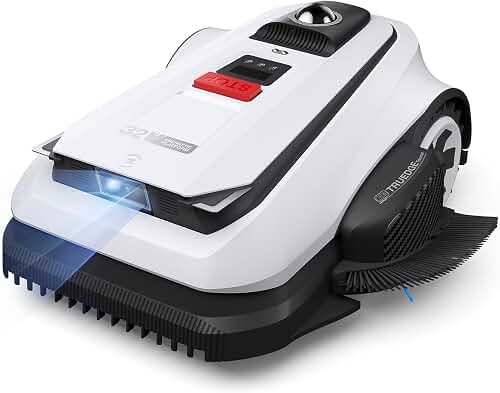
Finding the best robot mower for Zoysia grass Georgia homeowners can trust means balancing three things at once: a low, precise cut that suits dense Zoysia varieties, an IPX5-or-better chassis that shrugs off afternoon thunderstorms, and a mowing schedule aggressive enough to stay ahead of explosive summer growth. Zoysia spreads laterally through rhizomes and stolons, builds a tight thatch layer, and accelerates when soil temperatures climb above 80°F — exactly the conditions you get from Macon to Atlanta from May through September. Pick a robot with a sub-1-inch cut height, rear-wheel torque, sealed electronics, and rain-tolerant operation, and the dew-soaked Georgia mornings stop being a problem.
Why Zoysia and Georgia humidity demand a different robot mower
Northern fescue lawns are forgiving. You can mow them at 3 inches, let them creep to 4, and a midrange robot can keep up. Zoysia is the opposite. Empire, Zeon, JaMur, Meyer, and Emerald — the cultivars you will find on most Georgia lawns in 2026 — are warm-season grasses that prefer to be cut at 1 to 2 inches. Cut higher and Zoysia goes leggy, builds excess thatch, and looks pale. Cut at the right height and it carpets like a putting green.
That is the first constraint. The second is humidity. The metro Atlanta dewpoint sits in the 70s for weeks at a stretch every summer, which means the grass is wet from 11 PM to nearly 10 AM most days. Add the routine 4 PM thunderstorm and a robot needs to either tolerate damp blades or be smart enough to delay until the lawn dries. Cheap robots with exposed motor housings or unsealed charge contacts corrode within a single season in this climate.
The third issue is growth rate. Healthy Zoysia in Georgia summer can push half an inch of vertical growth in a single 48-hour window after a thunderstorm. The one-third rule of mowing says you should never remove more than a third of the blade in one pass. A weekly walk-behind violates that rule constantly between June and August. A robot mowing four to six times a week, taking off a sixteenth of an inch each pass, leaves clippings small enough to disappear into the canopy as free fertilizer — exactly what Zoysia wants.
What to look for in the best robot mower for Zoysia grass Georgia lawns
Cutting height that actually reaches 1 inch
Read the spec sheet carefully. A surprising number of robot mowers advertise themselves as adjustable from 20 to 60 mm — that is 0.79 to 2.36 inches — but the lower end is the absolute floor. Other models bottom out at 30 mm (1.18 inches) or even 40 mm. For Empire Zoysia, the most common Georgia cultivar, you want to mow between 1 and 1.5 inches. For Zeon and Emerald, you want even shorter — 0.5 to 1 inch. Verify the minimum height before you buy. A robot that physically cannot drop below 1.5 inches is a non-starter for short-cut Zoysia varieties.
Pivoting razor blades vs. fixed bar blades
Most modern robot mowers use small pivoting razor blades on a spinning disc rather than a heavy steel bar. For Zoysia, pivoting blades are actually an advantage. Zoysia stems are notoriously tough and wiry — they will dull traditional rotary blades in a single season. Pivoting razors are cheap to replace (often less than a dollar each, swapped quarterly) and they tip back instead of breaking when they hit a pinecone, a magnolia seed pod, or a hidden sprinkler head. The major brands like Husqvarna, Worx, Gardena, and Segway all use this design.
IPX5 weather rating and rain sensors
Georgia robots get rained on. A lot. Look for an IPX5 rating at minimum — resistance to low-pressure water jets from any direction — which covers monsoon thunderstorms but also the lawn-irrigation overspray and the high-pressure hose-down the robot itself will need every few weeks. Better robots include a rain sensor that pauses operation when droplets hit and returns to the dock automatically. The catch: some owners disable rain sensors in Zoysia country because the mower would never run otherwise during the wet season. If you go that route, make sure the chassis is genuinely sealed, not just water-resistant.
Slope handling for red-clay yards
Georgia red clay drains slowly and many lawns slope toward the street or a creek. Standard robots handle 25% (14-degree) grades; premium models step up to 45% (24-degree) grades. If you are in the foothills around Dahlonega or the rolling neighborhoods of Cobb County, this matters. Wet clay is also slippery — a robot rated for 35% slope on dry grass may struggle on the same hill after a thunderstorm. Add roughly 10 percentage points of headroom to whatever the spec sheet says, and check our breakdown of the best robot mowers for hills and slopes if you are pushing the limits.
Coverage area vs. yard size
Georgia lots tend to be larger than the national median. A robot rated for 0.4 acres may be working 18 hours a day to maintain that area, which means more dock cycles, more wear, and more chances for a stuck-in-mulch error during a wet week. Buy a robot rated for at least 25% more area than you actually have. For a half-acre Zoysia lawn, that means looking at models rated for 0.6 to 0.8 acres or larger.
Wired boundary vs. RTK-GPS wire-free
Until 2024 the answer was almost always wired boundary. A buried perimeter loop is bulletproof, does not care about tree canopy or atmospheric noise, and is invisible after a few weeks of growth. In 2026 the calculus has shifted. RTK-GPS robots from Segway, EcoFlow, Mammotion, and Worx now work reliably on most yards — but Georgia's mature oak and pine canopy can degrade GPS accuracy in older neighborhoods around Athens, Druid Hills, or downtown Savannah. If your front yard is shaded by a 70-foot live oak, a wired boundary may still be the more reliable choice. Check our wire-free robot mower comparison before assuming GPS is the answer.
Installation tip: install boundary wire in spring, not summer. Cool-season ground in March is easier to slit-trench than rock-hard July clay, and the wire vanishes into new Zoysia growth before the heavy use season begins. Our lawn prep guide walks through the boundary planning step by step.
Mowing schedule for Georgia Zoysia by month
Robots are at their best when they run a custom schedule that mirrors the grass's growth curve. For Georgia Zoysia, here is a schedule that produces a country-club finish without overworking the machine.
March: Zoysia is still greening up. Run twice a week at a slightly higher cut (1.5 inches) to avoid scalping any winter-dormant patches. April–May: Drop to 1.25 inches and run four times a week as growth accelerates. June–August: Peak growth. Run five to six times a week at 1 inch. Allow rain delays — the lawn will catch up in 24 hours. September–October: Pull back to four times a week as nights cool. November–February: Zoysia goes dormant and turns straw-colored. Stop mowing entirely, winterize the robot, and store it indoors. Our winterization checklist covers blade care, battery storage, and dock weatherproofing.
What the best robot mower for Zoysia grass Georgia owners should NOT do
Do not run the robot when soil is saturated. A 35-pound robot driving the same arcs across waterlogged turf will leave wheel ruts that take weeks to recover. Set a 6-hour delay after any rainfall over half an inch.
Do not mow during army worm season without checking the lawn first. Late summer army worm outbreaks can strip a Zoysia lawn to bare ground in 48 hours. If your robot is happily mowing while caterpillars are eating, you will end up with a perfectly cut dead lawn. Walk the yard once a week in August and September.
Do not ignore the dock location. Place the charging station in shade if possible. Direct Georgia sun on a black plastic dock pushes internal battery contacts to 140°F or higher in July, which shortens battery life. A simple plywood awning over the dock adds years of service.
How a robot affects Zoysia health long-term
Beyond the labor savings, robotic mowing genuinely improves Zoysia density. Three mechanisms are at work. First, the high mowing frequency keeps individual blade tips young and photosynthetically active — old leaf tips are mostly dead tissue. Second, the tiny clippings act as mulch, recycling nitrogen and trace minerals directly into the rhizosphere; university extension data suggests 25–30% reduced fertilizer demand on robot-mowed warm-season lawns. Third, the mower's repetitive light pressure on the soil encourages lateral stolon growth — Zoysia responds by filling in bare spots faster than under a heavy walk-behind regime.
The result, after a full season, is the dense, springy carpet Zoysia is famous for. Owners in Atlanta, Augusta, and Savannah who switch from weekly contract mowing to a daily robot routinely report cutting their annual lawn care budget while improving turf quality. The math works because Zoysia rewards exactly the input pattern a robot delivers: little, often, and consistent. For a broader look at the category, see our overall best robot mowers guide.
Frequently Asked Questions
What is the minimum cutting height I need for Empire Zoysia in Georgia?
Empire Zoysia performs best between 1 and 1.5 inches. Pick a robot whose minimum height spec is at or below 25 mm (about 1 inch). Models that bottom out at 30 mm or higher will leave Empire too tall, which leads to thatching and a coarse appearance over the course of a Georgia summer.
Will Georgia humidity damage a robot mower's electronics?
Not if the robot carries an IPX4 or IPX5 rating and you keep the charging dock contacts clean. The most common failure is not humidity itself but pollen, clay dust, and grass residue building up around charge pins. Wipe both the dock contacts and the robot's underside contacts monthly during pollen season — late March through early May in most of Georgia.
Can a robot mower handle Bermuda and Zoysia transition zones?
Yes. The robot does not care which grass species it is cutting, but you will need to compromise on height. Set the cut to the lower of the two species' preferred ranges (Bermuda likes 0.75–1.5 inches, Zoysia likes 1–1.5 inches), then live with slightly stressed Bermuda or slightly tall Zoysia. Many Georgia lawns settle at 1.25 inches as a reasonable average.
How often should a robot mow a Zoysia lawn in July?
Five to six days per week during peak summer growth. The goal is to remove no more than one-sixteenth of an inch per cycle. That sounds extreme, but the robot is quiet and slow — you will rarely see it work — and the lawn responds by densifying. Skipping days during heavy rain is fine; the mower will catch up within 48 hours without violating the one-third rule.
Do I need a wire-free RTK-GPS robot for a Georgia yard?
Not necessarily. Wire-free robots work brilliantly on open suburban lots in Lawrenceville, Newnan, or Macon, but mature tree canopies common in older Atlanta neighborhoods can disrupt GPS accuracy. If your lot has heavy oak or pine cover, a traditional boundary-wire robot is more reliable. If your lot is open to the sky, RTK is a cleaner install with no annual wire repairs.
Will a robot mower help with my Zoysia thatch problem?
Indirectly, yes. Frequent light mowing reduces the leaf material that turns into thatch, so the thatch layer grows more slowly. The robot does not replace mechanical dethatching every two or three years, but Georgia owners typically report needing to dethatch less often after switching to robotic maintenance.
How do I keep a robot mower from getting stuck in wet Georgia clay?
Three steps. First, configure a rain delay of at least 6 hours after any rainfall. Second, identify the low spots in your yard that pond after storms and exclude them from the mowing zone (use no-go wires on a wired model or virtual zones on a GPS model). Third, regrade or topdress chronically wet areas with sand — robots and standing water never mix.