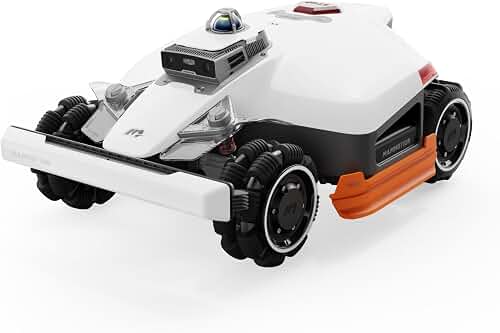
The best robot lawn mowers for wooded yards with poor GPS signal are models that do not depend on RTK satellite positioning. Dense tree canopy, leaf-out conditions, and tall hardwoods scatter the L1/L5 signals that RTK rovers need for centimeter accuracy, so a satellite-first mower will spin in circles, refuse to leave the dock, or carve into your hostas the moment a cloud of oak leaves blocks the sky. Under shade you want one of three navigation systems instead: a buried perimeter wire, vision/LiDAR SLAM, or a hybrid mower that falls back to wheel-odometry and bump sensors when satellites drop out. This 2026 guide walks through which technology survives a wooded lot, what to check before you buy, and how to install the system so the mower actually finishes the job.
Why GPS-only robot mowers fail under tree cover
RTK (real-time kinematic) GNSS is the headline feature on most 2024-2026 wire-free mowers. It works beautifully on an open suburban lot because the rover antenna can see eight or more satellites plus a base-station correction stream. Tree canopy breaks that chain in two ways. First, leaves and branches attenuate the L-band signal by 10-25 dB, which is often enough to drop the receiver out of “FIX” mode into “FLOAT” or “DGPS,” where accuracy degrades from 2 cm to 2 m. Second, trunks and wet foliage create multipath reflections — the antenna sees the same satellite from two paths and the solver throws the fix entirely.
Manufacturers publish optimistic “canopy tolerance” numbers based on light deciduous shade in winter. A mature wooded yard in July, with oaks, maples, or pines at 60-80% canopy closure, is a fundamentally different environment. If your lot has more than a few mature trees clustered together, plan around the assumption that satellite positioning will be unreliable for at least part of every mowing session.
Three navigation systems that work in the shade
1. Buried perimeter wire (the proven option)
A boundary-wire mower does not care about the sky. You staple or trench a thin copper wire around the mow zone, the charging base sends a low-voltage signal through it, and the mower detects the magnetic field to know where its world ends. Husqvarna Automower, Worx Landroid, Robomow, and Gardena Sileno all use this approach. It is the most reliable navigation system ever shipped for residential mowing, and it is the default recommendation for anyone with significant tree cover. The trade-off is install labor: you will spend a Saturday laying wire, and you will need to repair breaks if a vole, an aerator, or a frost heave snaps the conductor.
2. Vision and LiDAR SLAM
A newer class of mowers — Mammotion Yuka, Ecovacs Goat, Dreame Roboticmower A1 — uses cameras and/or solid-state LiDAR to build a map of physical landmarks (trees, beds, fences) and localize against them. Vision systems still benefit from some daylight but they are not dependent on satellite signals, so heavy canopy does not break them the way it breaks RTK. The catch is that pure-vision mowers struggle in deep dusk, in heavy rain, and on lawns where seasonal change (leaf drop, snow cover, mulch refresh) alters the visual landmarks they trained on. LiDAR is more robust but still pricier and newer to the residential market.
3. Hybrid systems with dead-reckoning fallback
The most flexible option is a mower that uses RTK when available but falls back to wheel encoders, IMU dead-reckoning, and bump/lift sensors under canopy. Segway Navimow’s newer X-series and Mammotion Luba 2 AWD both publish canopy-handling modes that keep mowing when GPS drops, then re-localize once the rover regains a clear sky window. These are workable in mixed yards with both open and shaded sections, but read the fine print: dead-reckoning drift is real, and most hybrids will still pause or return to base after extended GPS loss.
What to check before you buy a mower for a shaded lot
Before you commit to any model, walk your yard with a simple GNSS test app on your phone (GPS Test or GPSTest on Android, GPS Diagnostic on iOS). Stand under the worst canopy and check satellite count and horizontal accuracy. Fewer than 7 satellites or horizontal accuracy worse than 5 m means an RTK mower will struggle there. If most of your mowable area falls into that category, default to wire-based or LiDAR-based navigation and skip the RTK marketing entirely.
Other shaded-yard checklist items:
- Slope tolerance. Wooded yards in the Northeast and Pacific Northwest often have grade variation around trunks and roots. Look for at least 35% slope capability.
- Wheel design. Knobby or studded wheels handle damp leaf litter and exposed roots much better than the smooth turf wheels on open-yard models.
- Cutting height range. Shade lawns are usually fine fescue or shade-tolerant tall fescue, which prefer a 3.5-4 inch cut. Confirm the mower reaches that height.
- Object detection. Fallen branches, pinecones, and squirrels-with-acorns are routine obstacles. Front bumper + lift sensor is the minimum; AI vision obstacle avoidance is a nice upgrade.
- Rain handling. Canopy slows evaporation so wooded lawns stay damp longer. A mower with a rain sensor that resumes promptly (rather than skipping the day) keeps the schedule on track.
Categories to focus on
Boundary-wire models for heavy canopy
If your lot is more than 50% under mature trees, a wire-based Husqvarna Automower or Worx Landroid is still the safest bet in 2026. Husqvarna in particular has two decades of firmware refinement around irregular boundaries, narrow passages, and steep terrain — conditions that often coincide with wooded lots. The install is real work but pays off for years. For deeper comparison, see our main best robot lawn mowers ranking, which breaks down the leading wire-based and wire-free systems side by side.
LiDAR / vision models for partial shade
If your yard has scattered mature trees but you still get sky access across most of the lawn, a vision-first or LiDAR-equipped mower can give you the wire-free install without the RTK fragility. Mammotion Yuka, Ecovacs Goat G1, and the newer Dreame models are worth a look. Just budget time for the mapping run — these mowers learn your yard by driving it once with you, and shaded yards require extra patience during that calibration.
Hybrid RTK + dead-reckoning
For yards that are roughly half open and half wooded, a hybrid mower like the Segway Navimow X3 or Mammotion Luba 2 AWD gives you RTK precision in the open sections and graceful degradation under canopy. Confirm the model’s documented canopy-loss behavior before buying — some pause and wait for re-acquisition, others continue on dead-reckoning for a bounded distance.
Not sure which family fits your lot best? Our how to choose a robot lawn mower walkthrough has a decision tree that starts from yard size, slope, and tree cover.
Installation tips specific to wooded yards
The install of a boundary-wire mower in a shaded lot has some quirks worth planning around. Lay the wire at least 12 inches away from exposed surface roots so the staples bite into soil rather than wood. Use a stake-and-staple pattern every 18-24 inches on root-heavy ground; the wire wants to lift as the ground freezes and thaws around roots. Where the wire crosses a root, run it over the top with two staples on each side rather than trying to bury it underneath — you will be back fixing it within a season otherwise.
For the charging base, pick a flat spot at the canopy edge if possible. The base itself does not need sky, but you will appreciate the extra signal margin when the mower returns home and re-orients. Wire crossings of leaf-collection paths should be marked with small flags during the first autumn so you do not slice them with a rake or leaf-blower nozzle.
Our step-by-step install guide covers wire routing, base placement, and signal testing in detail.
Maintaining a robot mower under tree cover
Shaded lots throw two extra maintenance items at you. First, leaf litter: even a thin layer wraps around the cutting disc and bogs the motor. Run a leaf blower across the lawn before each scheduled mow during October-November, or schedule the mower for the windless early morning when leaves are damp and settled. Second, moss and thatch: shade lawns build thatch faster, and a thatch layer over 3/4 inch will lift the mower’s wheels enough that it scalps the high spots. Dethatch in early spring before the first mow of the season.
Sap and pollen also coat the underside of the deck more aggressively under trees — plan on a deck rinse every two weeks during pollen season rather than the monthly cadence most manuals suggest.
When a robot mower is the wrong answer
Be honest about your lot. If you have more than about 30 mature trees per acre, a creek or seasonal swale running through the mow zone, or a steep ravine, a robot mower of any kind is going to spend more time stuck than mowing. In that case a battery-electric push or self-propelled mower remains the better tool, and you can let the wooded edges grow into a no-mow naturalized strip that the mower never has to enter.
Frequently Asked Questions
Do any robot lawn mowers work without GPS at all?
Yes. Every boundary-wire mower — Husqvarna Automower, Worx Landroid, Robomow, Gardena Sileno, and most older Bosch Indego models — navigates without GPS. They use the magnetic field from the perimeter wire plus wheel encoders and bump sensors. These are the most reliable choice for fully shaded yards because canopy density is irrelevant to their navigation.
How much tree canopy is too much for an RTK robot mower?
As a rule of thumb, if a free GNSS app on your phone shows fewer than 7 visible satellites or horizontal accuracy worse than 5 meters in your worst mowing spot, an RTK mower will struggle there. Manufacturers vary in how gracefully they handle canopy, but most lose RTK FIX at roughly 50% canopy closure with mature broadleaf trees in full leaf.
Can I install a second RTK antenna higher up to fix the canopy problem?
Some manufacturers (Segway, Mammotion) sell extended antenna mounts or repeater modules. They help in marginal cases — say, one corner of an otherwise open yard that catches a single tree shadow — but they cannot recover usable RTK under a closed canopy. If your yard is genuinely wooded, spending money on antenna accessories is usually wasted versus switching to a wire-based or LiDAR mower.
Will a LiDAR robot mower work in a shaded yard?
LiDAR works in any lighting condition because it generates its own infrared illumination, so dense shade does not blind it the way it can confuse pure camera systems. The remaining limitation is that LiDAR mowers still need consistent physical landmarks to localize against; if your wooded yard changes dramatically with seasonal leaf litter, you may need to re-map once or twice a year.
How do I prepare a shaded lawn before installing a robot mower?
Dethatch in early spring, mark and remove any surface roots that protrude more than 1 inch above grade, fill low spots with sandy loam, and overseed bare patches with a shade-tolerant fescue mix at least 6 weeks before installing the mower. Our lawn prep guide walks through the full checklist with timing for each climate zone.
Are wire-free robot mowers ever a good idea for wooded lots?
Only if they use LiDAR or vision-SLAM rather than RTK. A pure RTK mower marketed as “wire-free” will likely disappoint in heavy shade. If you want the wire-free convenience and your yard is partially shaded, look at the LiDAR-equipped models or hybrid RTK mowers with documented dead-reckoning fallback. Our wire-free robot mowers roundup calls out which models handle canopy and which assume open sky.
What about robot mowers for large wooded properties over an acre?
Large wooded lots compound both problems — long boundary-wire runs and unreliable GPS. The practical answer is a high-end wire-based mower (Husqvarna Automower 450X or 535 AWD) that ships with the capacity, slope rating, and battery life to handle a full acre on a single charge. See our guide to robot mowers for large yards for the models that actually scale to acreage rather than just claiming to.
Will tree sap or falling acorns damage a robot mower?
Sap will gum up the cutting disc and the deck underside but rarely damages the motor itself — a monthly degreaser wipe handles it. Acorns and pinecones are tougher: a hardened acorn the size of a marble can chip the polymer pivot blades used on Husqvarna and Worx models. If you have a heavy oak year, raise the cutting height and rake or blow the lawn before the mower runs to keep blade replacement costs down.