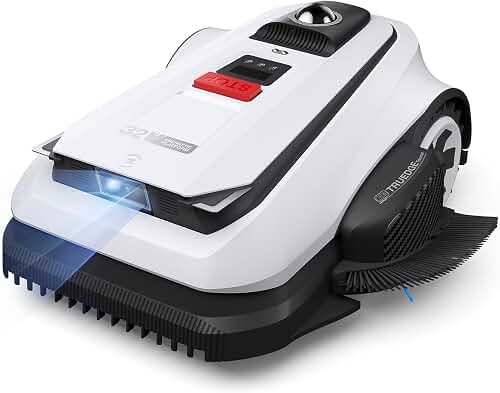
Best Robot Mower Flag Lot Narrow Driveway Picks for 2026
No single mower is “the” flag-lot mower, but a handful consistently outperform on this geometry. Here is how to think about the categories.
Premium Wire-Free RTK: Segway Navimow i-Series and EcoFlow Blade
If your driveway has reasonable sky exposure, RTK systems are the cleanest fit. You drive the mower around the perimeter once, designate the driveway corridor as a passage, and the mower handles the rest. Navimow’s i105 covers up to 500 m², the i108 handles larger flags, and both support passages as narrow as 3 feet. EcoFlow Blade adds AI obstacle detection — useful if delivery boxes or trash bins routinely sit in the corridor. Our best wire-free robot lawn mowers roundup compares the full RTK class side by side.
Vision-Based: Ecovacs Goat G1
Goat uses onboard cameras and a pair of beacons instead of RTK satellites, which makes it the better pick when your corridor passes under a heavy tree canopy that blocks GPS. The trade-off is shorter overall range and a smaller maximum lawn area, so it best suits flag lots where the main yard is under 1/4 acre.
Premium Wire-Guided: Husqvarna Automower X-Line
The Automower 430X and 450X still handle flag lots beautifully if you’re willing to bury wire. Husqvarna’s passage logic is the most mature in the industry — it can navigate a 2-foot-wide passage, and the EPOS variants offer wire-free operation on top. Battery life and slope handling are class-leading, which matters if your driveway has any grade.
Budget-Friendly Wire-Guided: Worx Landroid M / L
Landroid models support a Cut to Edge feature and an optional Off Limits module that lets you carve out the driveway centerline as a no-cut zone while keeping it as a travel passage. They’re a sensible pick if your flag area is under 1/4 acre and you want passage handling without spending Husqvarna money.
Comparison Table: Key Specs for Flag-Lot Suitability
| Mower Class | Boundary System | Min Passage Width | Max Lawn Area | Best For |
|---|---|---|---|---|
| Segway Navimow i105 | RTK + vision | ~3 ft (1 m) | 500 m² | Small flag, open sky corridor |
| EcoFlow Blade | RTK + AI vision | ~3 ft (1 m) | 3000 m² | Larger flag, obstacle-heavy corridor |
| Ecovacs Goat G1 | Vision + beacons | ~3 ft | ~3000 m² | Tree-canopied driveways |
| Husqvarna 430X / 450X | Perimeter wire (EPOS opt.) | ~2 ft | 3200-5000 m² | Sloped or hilly flag lots |
| Worx Landroid M/L | Perimeter wire | ~3 ft | 700-2000 m² | Budget builds, modular needs |
If you own a flag-shaped property, you already know standard mower recommendations miss the mark. The best robot mower flag lot narrow driveway setup has to do two jobs at once: efficiently navigate a long, skinny access corridor (often only 12-20 feet wide and 100+ feet long) and then handle the wider rear lawn — the “flag” — without getting lost, hitting fences, or burning half its battery on the commute. In 2026, that means looking for mowers with explicit passage mode, multi-zone scheduling, GPS-RTK or vision-based boundary mapping, and a charge dock you can place strategically. Below we break down the exact features that matter, which models actually handle this geometry, and the installation tricks that keep your mower out of trouble.
Why Flag Lots Confuse Most Robot Mowers
A flag lot is a property where the buildable area sits behind another lot and is accessed by a long, narrow driveway easement. From the road, you see the “pole” (the driveway corridor) leading back to the “flag” (the main yard behind the front-row houses). Geometrically, it is one of the hardest shapes for a robot mower to handle. The corridor is too narrow for normal coverage patterns, the transition zone often has tight turns, and once the mower reaches the back, it needs to recognize it has entered a totally different zone with different obstacles.
Random-pattern mowers — the kind that simply bounce off boundaries — will waste hours in the corridor and may never make it to the back yard before the battery dies. Older wire-guided systems treat the whole property as one continuous zone, which means the mower keeps re-mowing the driveway strip every time it cycles. Modern GPS, RTK, and LiDAR mowers solve this with passage and zone logic, but only if the model actually supports those features. Picking the wrong system is the single most common mistake flag-lot owners make when shopping in 2026.
The Features That Actually Matter
Passage or Corridor Mode
This is non-negotiable. Passage mode tells the mower to travel through a narrow strip rather than try to mow it in serpentine passes. Without it, the robot will treat your 15-foot-wide driveway median as a tiny lawn and waste 30 minutes there before reaching the main area. Husqvarna calls this a “Passage,” Worx Landroid uses “Narrow Passage” with its Off Limits module, and Segway Navimow and EcoFlow Blade let you draw passages directly in the app. The minimum corridor width supported varies: most premium mowers handle 3 feet (1 meter), but some require 5 feet of clearance plus signal buffer on each side.
Multi-Zone Mapping with Independent Schedules
You want to schedule the driveway strip to mow once or twice a week, while the main flag area might need three or four cuts. Multi-zone scheduling lets you assign cut frequencies, cut heights, and even mowing directions per zone. Cheap mowers offer only one schedule for the whole property, which means either over-cutting the corridor or under-cutting the flag.
GPS-RTK or Vision-Based Boundary Detection
Burying a perimeter wire down a 150-foot driveway, around a flag-shaped main lawn, and back is brutal — and if a contractor ever trenches the driveway for utilities, the loop is destroyed. Wire-free mowers using RTK satellite positioning (Navimow, Mammotion Luba, EcoFlow Blade) or onboard cameras (Ecovacs Goat) eliminate that risk. The trade-off: RTK needs reasonably open sky overhead. If your access corridor is heavily tree-canopied, look for models with onboard vision backup or dead-reckoning fallback.
Battery Capacity and Travel Efficiency
A long driveway eats battery before the mower even starts cutting. Look for at least 90-120 minutes of runtime, ideally with a fast charge (60-90 minute recharge). If your flag is more than 1/4 acre, prioritize lithium packs in the 5 Ah+ range. For more on the underlying tradeoffs, our robot lawn mower buying guide walks through how to match battery to total mow area plus travel distance.
Anti-Theft and Locator Features
Flag-lot driveways are visible from the street and often shared with neighbors. PIN locks, GPS tracking, and audible alarms are not luxuries here. Most premium models in 2026 include all three, but verify the GPS tracker doesn’t require a paid subscription after year one.
Wire vs. Wire-Free for Flag Lots Specifically
The flag-lot geometry pushes most owners toward wire-free systems, but not always. Wire-guided mowers offer rock-solid passage navigation because the signal physically defines the corridor — there is no GPS drift to worry about under dense trees. The cost is the install: laying 500+ feet of perimeter wire down a driveway and around a back lot is a half-day job, and every future utility trench is a hazard. Wire-free RTK and vision systems install in an afternoon with no digging, but they need clear sky or unobstructed sightlines to perform consistently. A practical rule for the best robot mower flag lot narrow driveway decision: if your corridor is open and your municipality doesn’t plan utility work, go wire-free. If it is canopied or shared with other underground utilities, wire-guided is still the safer long-term bet.
Installation Tips for Flag-Lot Geometry
Place the Dock at the Junction
The smartest charging-station location on a flag lot is usually at the junction between the driveway corridor and the main lawn — not at the back of the property and not at the street. A junction placement minimizes total travel distance, lets the mower return for charging without burning unnecessary battery, and keeps the dock visually shielded by the corridor sides. Make sure you have a weather-protected outlet within reach.
Account for the Driveway Surface
Many flag-lot owners assume the mower will roll across pavement to get from front to back. Most robot mowers are not designed to drive on hard surfaces for long distances — wheel wear is significant, and many models will refuse to operate off-grass. Instead, route the mower along a continuous strip of grass alongside the driveway. If no continuous strip exists, you may need to install a narrow turf channel or accept that you need two separate mowers (one per zone).
Plan for Signal Buffers and Sight Lines
RTK antennas need clear sky. Vision mowers need landmark variety. If your driveway is bordered by tall hedges on both sides, vision-based systems can struggle because every frame looks identical. Plant or place a few distinct markers (planters, low solar lights) every 20-30 feet to give vision mowers something to triangulate against. For step-by-step setup guidance once your model arrives, see our walkthrough on how to install a robot lawn mower.
Set Conservative Cut Schedules in the Corridor
Driveways often get less foot traffic and less fertilizer than the main lawn, so the grass grows slower there. Schedule the corridor for half the cutting frequency of the flag area to extend blade life and reduce mower wear.
Frequently Asked Questions
What is the minimum driveway width a robot mower can navigate?
Most premium robot mowers can handle a passage as narrow as 3 feet (1 meter) of mowable grass. Husqvarna’s wire-guided models can squeeze through 2 feet. Below that, you typically need to either skip the corridor entirely and run two mowers, or install stepping-stone bridges that the mower navigates as a hard obstacle.
Can a robot mower cross a paved driveway between two lawn areas?
Some can, but it’s not their strong suit. Hard surfaces accelerate wheel wear, and most wire-guided systems treat the pavement break as a boundary stop. Wire-free RTK mowers handle short pavement crossings of a few feet better, but a 100-foot driveway is asking too much. A continuous turf strip alongside the pavement is the reliable solution.
Do I need RTK GPS for a flag lot, or will random-pattern work?
Random-pattern mowers are a poor choice for flag lots because they waste enormous battery in the corridor. You don’t strictly need RTK — wire-guided systems with passage support work fine — but you do need some form of intelligent zone navigation. Pure bounce-and-mow models will frustrate you within a week.
How long should the battery last for a flag-lot property?
Aim for 90 minutes of runtime minimum, and ideally 120 minutes. The corridor commute can consume 15-20% of battery on each cycle before any cutting happens, so cushioning your runtime is important. Fast-charge models (60-90 minute recharge) let the mower complete multiple cycles per scheduling window.
Is anti-theft really a concern on a private driveway?
Flag-lot driveways are usually visible from the street and sometimes shared with other properties, so yes. PIN-lock-on-lift, audible alarms, and built-in GPS tracking are baseline features in 2026 premium models. Verify that GPS tracking doesn’t require an ongoing subscription, or budget for it.
Can two robot mowers share one flag lot if the corridor is too narrow?
Yes, and it’s often the cleanest solution when your access strip is under 3 feet wide or paved end-to-end. Use a smaller, budget mower (Gardena Sileno Minimo, Worx Landroid S) for the front strip and a larger model for the main flag area. Each mower gets its own boundary loop or RTK zone and its own dock.
Will tall fences along the driveway interfere with RTK signal?
Vertical fences usually don’t — RTK satellites are overhead, not at horizon angle. The real risks are tree canopy, building overhangs, and metal arbors that block sky view. If your corridor is tunnel-like, prioritize vision-based or wire-guided mowers over pure RTK models.