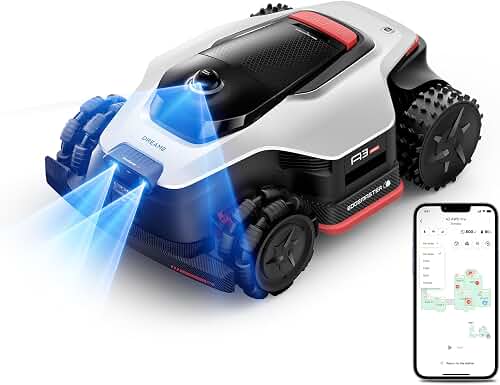
Comparison: top picks for clay and uneven wet lawns
| Model | Drive | Max slope (dry) | Navigation | Weather rating | Best for |
|---|---|---|---|---|---|
| Husqvarna Automower 435X AWD | 4WD | 70% | Boundary wire + GPS | IPX5, rain sensor | Steepest, roughest yards up to 0.9 acre |
| Mammotion Luba 2 AWD 5000 | 4WD | 80% | Wire-free RTK-GPS + vision | IPX6 | Large, uneven, wet yards up to 1.25 acres |
| Worx Landroid Vision L1600 | 2WD (high torque) | 35% | Wire-free camera AI | IPX5 | Moderate clay yards under 0.4 acre |
| Ambrogio L60 Deluxe | 2WD with traction-control | 50% | Random-pattern, no wire needed | IPX4 | Small, bumpy, fenced yards under 0.05 acre |
| Segway Navimow i110N | 2WD | 45% | Wire-free RTK-GPS | IPX6 | Mid-size yards with mild clay and gentle bumps |
If your yard combines heavy clay soil, lumpy terrain, and a climate that dumps rain for half the year, you need a very specific kind of robot mower. The best robot lawn mowers for clay soil uneven terrain share three traits: aggressive multi-wheel drive (often AWD), high ground clearance with deep-tread tires, and weatherproof electronics rated to keep cutting in light rain or resume quickly after a downpour. Lightweight perimeter-wire models that struggle on soggy lawns are the wrong tool here. Instead, look toward heavier four-wheel-drive machines from Husqvarna, Mammotion, Worx, and Ambrogio that were engineered for difficult ground rather than flat suburban turf.
This guide walks through what to prioritize when shopping, which models hold up best in waterlogged clay conditions, and how to prepare a lumpy yard so the mower can actually do its job. We focus on real-world performance in regions like the Pacific Northwest, the UK, coastal British Columbia, and the U.S. Southeast — places where lawns rarely fully dry out between mowings.
Why clay soil and wet climates are uniquely hard on robot mowers
Clay holds water. After rain, the top inch of soil turns to a slick, sticky paste that grabs at wheels and refuses to drain. On uneven terrain, low spots stay saturated for days. A standard two-wheel-drive robot mower with smooth tires will spin, dig ruts, and trigger a "wheel stuck" error within minutes. Worse, repeated passes over saturated clay compact the soil further, killing grass roots and creating the bare patches that make the terrain even more uneven over time.
Wet climates also stress the cutting system. Damp grass clumps under the deck, dulls floating razor blades faster, and increases the load on the drive motors. The best robot lawn mowers for clay soil uneven terrain compensate with higher-torque motors, self-cleaning deck geometry, and rain sensors that pause mowing until conditions improve — then resume the schedule automatically without you touching the app.
Key features to prioritize
All-wheel drive or four-wheel drive
AWD is the single most important feature for clay and uneven ground. Models like the Husqvarna Automower 435X AWD and the Mammotion Luba 2 AWD series drive all four wheels independently, so when one wheel loses traction in a soft spot the others keep pulling. Two-wheel-drive mowers with the cutting deck at the back simply cannot climb out of a wet clay depression.
Tire tread and ground clearance
Look for deep, knobby treads — almost mountain-bike-like — and at least 60 mm of ground clearance. Smooth or shallow-grooved tires that work fine on a flat Kentucky bluegrass lawn will glaze over the moment they hit slick clay. Some owners add aftermarket spiked tire covers for extreme conditions, but a properly specified mower shouldn't need them.
IPX rating and rain sensors
An IPX5 rating or higher means the mower can handle rain and being hosed down. Combine that with a built-in rain sensor (or a smart weather-API integration that pauses mowing when rain is forecast within the hour) and you avoid the worst soil damage. Mowers without rain sensing will keep grinding through a downpour, leaving tire ruts behind.
Slope handling
Uneven terrain almost always includes localized slopes. Manufacturer slope ratings assume dry conditions, so derate by roughly 30% for wet clay. A mower rated for 45% slopes will realistically handle 30% reliably when the ground is saturated. If your yard exceeds that, you need an AWD model with active hill-climb logic.
Wire-free GPS/RTK navigation
Boundary wires get cut by aerating tools, frost-heaved in winter, and snapped by tree roots that shift in wet soil. For uneven ground, a wire-free RTK-GPS mower is far more practical because you can redraw zones in the app instead of digging up cable. See our best wire-free robot lawn mowers roundup for an overview of the category.
Top robot mower picks for clay soil and uneven terrain
Husqvarna Automower 435X AWD — the proven workhorse
The 435X AWD is still the benchmark for difficult ground. Its articulated chassis lets the front and rear sections move independently, so the mower climbs over root humps and dips into low spots without losing traction. All four wheels are powered, and the deep-tread tires bite into wet clay where other mowers spin. It uses a perimeter wire, which is less convenient than RTK-GPS, but the wire-based positioning is rock-solid even when satellite signals are blocked by tall trees — common in the damp wooded yards where this model excels. With an IPX5 rating and an integrated rain sensor, the 435X simply pauses, returns to its dock, and resumes the schedule once conditions allow. Expect a 0.9-acre realistic capacity on rough ground.
Mammotion Luba 2 AWD 5000 — the wire-free heavyweight
If you want serious AWD capability without burying a perimeter wire across a soggy, uneven lawn, the Luba 2 AWD is the standout choice in 2026. Independent drive on all four wheels, an 80% rated slope capability (translate that to roughly 55% in wet clay), and an RTK-GPS plus computer-vision navigation system let it handle complex multi-zone yards. The IPX6 rating means it shrugs off heavy rain, and the app's weather-aware scheduling pauses operation when needed. The Luba 2 is one of the few wire-free mowers we trust on truly lumpy terrain — its suspension travel and torque make it feel more like a small ATV than a typical robot mower. For a head-to-head against the Husqvarna flagship, our Mammotion Luba 2 AWD vs Husqvarna Automower 430X Nera comparison goes deeper on the trade-offs.
Worx Landroid Vision L1600 — value pick for smaller clay yards
The Vision L1600 is two-wheel-drive, but Worx puts surprisingly aggressive treads on it and the camera-based AI navigation lets it identify and avoid the muddiest patches rather than plowing through them. It's not the right choice for steep, severely uneven ground, but for a small or mid-size yard with moderate clay and mild lumps, it offers most of the wet-climate benefit at a fraction of the price of the Husqvarna or Mammotion options. The IPX5 rating handles persistent drizzle. If budget matters more than terrain capability, also see our best budget robot lawn mowers roundup.
Segway Navimow i110N — wire-free option for mild conditions
The Navimow series isn't built for the worst clay scenarios, but the i110N's IPX6 rating, wire-free RTK navigation, and tidy software make it a strong pick for mid-sized yards where clay is present but not severe and the terrain is mostly gentle waves rather than ankle-twisting bumps. The included Exclusion Detection Sensor module helps it avoid soft spots after rain. Read our full Segway Navimow i105 review for hands-on impressions of the platform.
How to prepare a clay, uneven yard before installation
Even the best AWD mower benefits from a few lawn-prep steps. First, core-aerate in early spring or fall to reduce compaction — that single action can transform how dry your yard feels three days after rain. Second, top-dress low spots with a sand-compost blend (50/50) to gradually level the worst dips. Don't try to fill more than a half-inch in one season or you'll smother the grass. Third, overseed with a fescue blend bred for heavy soils; deeper roots improve drainage and structure over time.
Once the mower is installed, schedule cuts during the driest part of the day. Most apps let you blackout early morning hours when dew is heaviest. Our how to prepare lawn for robot mower walkthrough covers the full prep checklist in more detail.
Maintenance notes for wet-climate owners
Clay and water are hard on blade pivots, wheel bearings, and chassis seams. Rinse the underside of the mower weekly during the rainy season — most IPX5-and-higher models tolerate a gentle hose spray. Replace blades every six to eight weeks instead of the standard three months; wet grass dulls them faster. Inspect tire treads monthly and remove caked-on clay from between the lugs. Finally, before winter, follow a proper shutdown procedure — see our how to winterize robot lawn mower guide for the full process.
Frequently Asked Questions
Can a robot lawn mower work on heavy clay soil that stays wet for days?
Yes, but only AWD or 4WD models with deep-tread tires and high ground clearance. Two-wheel-drive mowers will rut the lawn and trigger stuck errors. The Husqvarna 435X AWD and Mammotion Luba 2 AWD are the most reliable picks for chronic wet clay. Pair the mower with annual core aeration to keep the soil from compacting further under repeated passes.
What is the best robot mower for a bumpy yard with shallow dips and root humps?
Articulated chassis designs like the Husqvarna 435X AWD handle root humps best because the front and rear sections flex independently. For wire-free convenience on similar terrain, the Mammotion Luba 2 AWD's long-travel suspension is the next best thing. Avoid low-clearance models like the Gardena Sileno City — they're built for tidy, level European lawns.
Will rain damage a robot lawn mower if I leave it outside?
Modern mowers rated IPX5 and higher are designed to live outdoors year-round in their charging stations. Most include rain sensors that send the mower home automatically. A simple garage-style cover over the dock extends the life of the charging contacts and reduces algae buildup on the chassis, but the mower itself doesn't need to be brought indoors after every shower.
Do robot mowers leave tire tracks on wet clay lawns?
They can if you let them mow during or right after heavy rain. Use the app's rain sensor or weather-API scheduling to delay cuts until the surface has firmed up — typically four to twelve hours after rain stops. The lightweight AWD models distribute load across four wheels and leave far less of a track than heavier 2WD machines.
How steep a slope can a robot mower handle in wet conditions?
Derate the manufacturer's dry-condition slope rating by about 30% for wet clay. A 70% rated AWD model like the Husqvarna 435X will reliably handle around 45–50% in saturated conditions. For dedicated slope guidance, see our best robot lawn mowers for hills and slopes guide.
Is a wire-free RTK-GPS mower better than a boundary-wire mower for uneven yards?
Usually yes. Boundary wires get cut by aerators, shifted by frost heave, and broken by tree roots in saturated soil. RTK-GPS lets you redraw zones in the app and avoid the headaches. The only exception is heavily wooded yards where satellite signals are blocked — there, a wired mower like the Husqvarna 435X still wins.
How long do robot mowers last in wet climates?
With proper maintenance — weekly rinsing, regular blade changes, and seasonal winterization — eight to ten years is realistic for premium models. Budget mowers in wet climates typically last four to six years. Our how to maintain robot lawn mower guide covers the routine that maximizes lifespan in damp conditions.