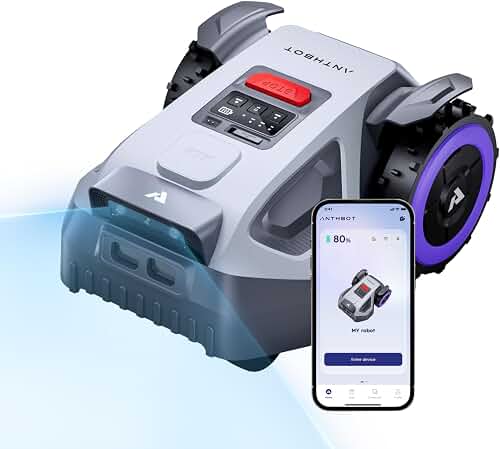
Installing your Bosch Indego M 700 around vegetable garden beds takes careful planning of the boundary wire so the mower trims grass cleanly without nibbling tomato vines or trampling raised beds. A successful Bosch Indego M 700 vegetable garden install requires you to route the perimeter wire 30 cm (12 inches) from any non-grass obstacle, create island loops around freestanding beds, and keep a 1 cm gap between the outbound and return wires when looping islands. This 2026 guide walks through every step, from mapping the garden to first-cut testing, so the M 700 mows safely around vegetables, herbs, and fruit bushes without damaging your harvest or its own blades.
Why the Bosch Indego M 700 needs special planning around vegetable beds
The Indego M 700 uses a buried or surface-pinned boundary wire to define where it can and cannot mow. Unlike a robot vacuum that bumps off objects, the M 700 stops only when its onboard sensor detects the magnetic field from that wire. Vegetable beds present three problems the wire must solve: tall plants that drape over the lawn edge, raised beds with overhangs the mower could clip, and seasonal changes where a bed expands or contracts as you plant new rows. If the wire is laid too close, vines like squash and cucumber will be sliced by the blade disc as they grow outward. If laid too far away, you will be left hand-trimming a 15 cm fringe every week, defeating the point of automation.
The M 700 also uses Bosch's LogiCut navigation, which mows in parallel stripes rather than random patterns. Parallel mowing is more efficient but less forgiving of poor boundary placement — the mower will repeatedly graze the same edge, so any obstacle inside the cutting zone will be hit on every pass until you fix the wire.
What you need before starting
Gather everything before you start unspooling wire. The boxed M 700 kit includes the boundary wire, pegs, docking station, low-voltage transformer, and wire connectors. For a yard with multiple vegetable beds you will almost certainly need extras, especially if your garden is larger than the kit's bundled 150 m of wire.
- Bosch-compatible boundary wire (buy a 50 m or 100 m extension reel if you have more than three island beds)
- Extra pegs — plan on one every 50–80 cm for surface installs, more for slopes and curves
- Waterproof wire connectors (gel-filled, never electrical tape)
- A 30 cm spacer stick cut from scrap wood — this guarantees consistent offset from obstacles
- Garden edger or half-moon spade if you intend to bury the wire
- Smartphone with the Bosch Indego app installed and the mower paired
- Sketch of your yard with bed positions, gates, and the planned dock location
For background on general install logic before you start cutting wire, the step-by-step robot lawn mower installation guide walks through the universal principles that apply to any model, including the M 700.
Step-by-step Bosch Indego M 700 vegetable garden install
Step 1: Map the garden on paper first
Sketch the mowing area to scale, marking each vegetable bed, fruit bush, compost bin, water butt, and pathway. Identify which beds touch the lawn edge (these become part of the perimeter loop) and which sit out in the lawn as islands (these need their own loop wire returning to the perimeter). Mark gates and gaps narrower than 90 cm — the M 700 needs a corridor at least 1 m wide to pass through reliably.
Step 2: Position the docking station
The dock needs 2 m of straight wire approaching from one side and 2 m exiting the other, both perpendicular to the dock face. Choose a flat, shaded spot at least 1 m from any vegetable bed so plant overgrowth never blocks the mower's approach. Avoid placing the dock under a low fruit cane or tomato cage — falling fruit will sit on the charging contacts and corrode them.
Step 3: Lay the perimeter boundary wire
Walk the lawn edge with your 30 cm spacer stick. For grass that borders a hard wall, fence, or paving, the wire goes 10 cm from the edge. For grass that borders soil, mulch, or a vegetable bed, push the spacer to 30 cm. This larger offset stops the spinning blade from flicking soil and slicing low foliage. Pin the wire as you go, keeping it taut but not stretched.
Step 4: Create island loops around freestanding vegetable beds
This is the critical step that most owners get wrong on their first Bosch Indego M 700 vegetable garden install. For each bed sitting out in the lawn — a corner herb spiral, a freestanding raised bed, a tomato cage — you must run the perimeter wire toward the bed, loop it tightly around the bed with a 30 cm offset, and return it back to the perimeter along the same path. The outbound and return wires must lie within 1 cm of each other on the return run, because the M 700 only registers the wire as a boundary when the two signals cancel out. If the gap widens to 5 cm or more, the mower treats the corridor as mowable lawn and will drive straight over your bed.
Step 5: Pin or bury the wire
Surface installation with pegs is faster and lets you adjust easily as your garden evolves through the season. Push pegs flush to soil level so the wire disappears into the grass within two mowings. For a permanent install, bury the wire 3–5 cm deep with a garden edger — but never deeper than 10 cm or the M 700's signal sensor will struggle to detect it through wet soil.
Step 6: Connect to the docking station
Strip both wire ends, fit them into the dock's terminals with the supplied gel connectors, and snap the dock cover shut. Plug in the transformer indoors and verify the dock's green LED is solid. A flashing LED means a break or short — most often caused by the outbound and return island wires not being close enough together.
Step 7: Calibrate and run the first test cut
Open the Bosch Indego app, pair the M 700, and run the automated perimeter mapping. The mower will follow the wire all the way around the lawn including every island loop, building its internal map. Watch every island closely — if the mower hesitates or tries to cross a loop, the return wire gap is too wide. Pause it, tighten the loop, and re-run mapping.
Handling raised beds versus in-ground vegetable patches
Raised beds with a hard wood or stone frame are the easiest. The frame itself acts as a bumper guide, and you can run the boundary wire 15 cm from the frame because the M 700's wheel base will keep the blade well clear. In-ground vegetable patches with no physical edge are harder — the soil-to-grass transition is fuzzy, plants spread outward as they grow, and a 30 cm wire offset will leave an ugly uncut strip. The fix is to install a 10 cm tall lawn edging strip (steel or composite) along the bed border, then run the wire 15 cm from that edge. The edging gives the mower a visual edge for your eye and a hard backstop for any wayward wheel tracking.
Pathways and access corridors between beds
If your vegetable garden has grass paths between beds, those paths must be at least 1 m wide for the M 700 to mow them automatically. Narrower paths should be excluded by running the boundary wire across the entrance and back. Wider paths between two island beds need careful wire routing — run the perimeter through the path on one side, loop around the first bed and back, continue the perimeter, then loop the second bed. Never try to share return wires between two adjacent islands; the signal interference will confuse the navigation.
Common mistakes during a Bosch Indego M 700 vegetable garden install
The most frequent installation errors come from rushing the island loops. A 5 cm gap between outbound and return wires will let the mower cross the boundary. Pinning the wire under a sprinkler head guarantees you will sever it within the first season. Running the wire over an irrigation line and then re-burying both together leaves you unable to repair either without digging up the whole run. Most importantly, do not assume your spring layout will work in August — squash, courgette, and tomato plants spread 60–90 cm beyond their stem base. Plan the wire offset for the plant's mature size, not the seedling size you see on planting day.
If your first cut goes wrong, the general troubleshooting guide covers boundary wire faults, signal loss, and dock connection errors that apply across all wire-guided mowers including the Indego range.
After the install: keeping vegetables safe long term
A finished Bosch Indego M 700 vegetable garden install is not the end of the work. Check the perimeter loop monthly during growing season, walking the wire path to spot any pegs lifted by frost heave or a curious dog. Trim back any vegetable foliage that overhangs the wire — if a vine grows on top of the wire it will be cut, and the leaf will then mask the boundary signal for the rest of the season. Before laying any new mulch in spring, mark the wire path with garden canes so you do not slice it with a spade.
For ongoing care beyond the vegetable garden, the robot lawn mower maintenance guide covers blade replacement, sensor cleaning, and winter storage that will keep your M 700 running for the eight-to-ten year service life Bosch quotes.
Frequently Asked Questions
How far should the boundary wire be from a vegetable bed for the Bosch Indego M 700?
Keep the wire 30 cm from the edge of any soft-edged vegetable bed, or 15 cm from a hard-edged raised bed with a solid timber or stone frame. The 30 cm offset accounts for plant overgrowth during the season and stops the blade from clipping low-hanging vines or flicking soil onto the lawn.
Can the Bosch Indego M 700 mow between narrow rows of vegetables?
No. The M 700 needs a minimum 1 m wide corridor to navigate reliably. Narrow paths between raised beds should be excluded from mowing by running the boundary wire across the entrance and back. Mulch or gravel those paths instead — the mower will skirt the edge, and you avoid hand-trimming.
Do I need to move the boundary wire when I rotate vegetable beds each season?
Only if the new beds occupy a different footprint than the old ones. If your bed positions stay the same and you just rotate the crops inside them, the wire never moves. If you expand a bed by 30 cm or more in any direction, lift and reposition the affected wire section before the M 700's next scheduled mow.
Will the Bosch Indego M 700 damage a plastic vegetable bed edging?
The mower body will not contact plastic edging if the wire is set 15 cm back, but flicked grass clippings and small stones can scuff thin edging over time. Use 5 mm or thicker composite edging rather than the flexible 2 mm plastic strips sold in garden centres for a longer-lasting border that the M 700 can mow right up to.
How do I install the Bosch Indego M 700 around a fruit tree in the middle of the lawn?
Treat a fruit tree exactly like a vegetable island bed. Run the perimeter wire toward the tree, loop it around the trunk with a 30 cm offset (more if the tree drops fruit that could jam the blade), and return the wire alongside the outbound run with a 1 cm gap. For mature trees with surface roots, increase the offset to 50 cm so the mower never bumps over the roots.
Can I bury the boundary wire under a vegetable bed to avoid going around it?
No. The M 700 detects the wire's magnetic field through grass, not through 30 cm of compost and root mass. Burying the wire under a bed means the mower loses the boundary signal and will either stop mid-cut or drive across the bed entirely. Always route the wire around vegetable beds at surface or shallow grass depth.
What happens if my dog digs up part of the boundary wire near the vegetable garden?
A severed wire will trigger a dock error LED and the M 700 will refuse to leave the dock. Find the break, strip both ends, and join them with a gel-filled waterproof connector — never electrical tape, which fails within one winter. Re-pin the repaired section deeper and consider a low decorative border to discourage further digging.