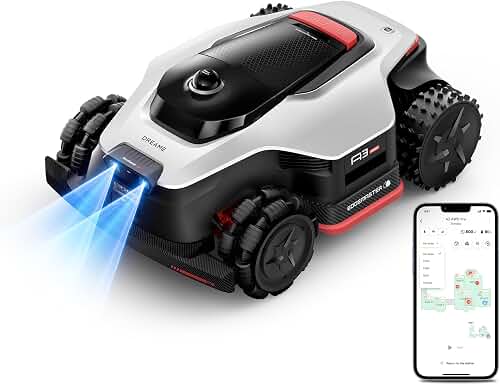
Adding a Hidden Aftermarket Tracker
Even if your mower has factory GPS, smart owners add a second, concealed tracker. Thieves who have stolen a mower before know exactly where the OEM module lives and will rip it out within minutes. A second tracker hidden under battery covers, inside a wheel well, or behind a sensor housing dramatically improves recovery odds.
Three categories of aftermarket trackers work well for robot mowers:
- Bluetooth crowd-sourced tags (Apple AirTag for iPhone households, Tile Pro for mixed households, Samsung Galaxy SmartTag2 for Android-only households). No monthly fee. Battery lasts ~1 year.
- Compact LTE GPS trackers (Tracki, LandAirSea 54, Spytec GL300, Invoxia Mini). Require a monthly SIM plan of roughly $5-$20. Live location updates every 1-5 minutes.
- Hardwired vehicle-style trackers intended for fleet use. Overkill for most homeowners but bulletproof if you've already lost a mower once.
Quick Comparison of Tracker Types
| Tracker Type | Monthly Fee | Update Frequency | Battery Life | Best For |
|---|---|---|---|---|
| Bluetooth (AirTag / Tile / SmartTag2) | None | Whenever a phone passes nearby | ~12 months | Suburban front yards |
| LTE GPS tag (Tracki, Invoxia Mini) | $5-$15 | 1-5 minutes (live mode) | 1-4 weeks per charge | Rural/exposed yards |
| Hardwired LTE tracker | $10-$20 | Continuous | Powered by mower battery | Repeat-theft neighborhoods |
| Manufacturer cellular GPS | Often included | 1-15 minutes | Powered by mower | Primary line of defense |
GPS-tracking robot mower theft prevention in front yards combines built-in cellular GPS, hidden add-on trackers, geofencing alerts, PIN locks, and physical anchors to both deter thieves and recover stolen units. For 2026, the best approach for an exposed front lawn is layered: choose a mower with factory GPS and cellular connectivity, conceal a third-party tracker (AirTag, Tile, or LTE tag) inside the chassis, enable geofence push alerts in the manufacturer app, set a startup PIN and motion alarm, and bolt the charging dock to a ground anchor. Robot mower GPS theft prevention only works when hardware, software, and physical layers stack together.
Why Front Yards Are Higher-Risk Than Back Yards
Front-yard installs are visible from the street, accessible without crossing fences, and rarely covered by motion lighting or cameras pointed outward. A thief can spot a $1,500-$4,000 robot mower from a passing car, come back at 2 a.m., lift it into a trunk in under thirty seconds, and post it on a classifieds site by breakfast. Most owners do not notice the mower is missing for two to four days because the lawn just looks a bit shaggy. That delay is precisely why passive deterrents (decals, warning labels) are not enough — you need active GPS reporting that pings you the moment the mower leaves its assigned zone.
The good news is that front-yard theft is largely opportunistic. Layered prevention works because most thieves abandon the attempt as soon as an alarm sounds, a PIN screen appears, or the mower refuses to operate outside its boundary. Your job is to make your unit look harder to fence than the next one over.
Built-In GPS: What Manufacturers Offer in 2026
Premium robot mowers now ship with factory GPS modules and bundled cellular data, typically over 4G LTE-M or NB-IoT. Models from Husqvarna (Automower Nera series), Segway (Navimow i and H lines), EcoFlow Blade, Mammotion Luba 2 AWD, and Worx Landroid Vision use a combination of RTK GNSS for navigation and a separate cellular GPS chip for anti-theft reporting. When the mower leaves its programmed work area without first being unlocked, the app sends a push alert with live coordinates and, on most models, a recovery code you can give to police.
If you are shopping specifically for a front-yard installation, prioritize three feature checkboxes: (1) factory cellular SIM with a multi-year prepaid plan, (2) geofence with adjustable radius, and (3) PIN-required startup. Our guide to the best smart robot lawn mowers breaks down which 2026 models include all three at no monthly subscription cost.
How Cellular GPS Beats Bluetooth for Outdoor Theft Recovery
There is an important distinction between Bluetooth tracker tags (AirTag, Tile, Galaxy SmartTag) and true cellular GPS. Bluetooth tags piggyback on nearby smartphones — they only report a location when an enrolled phone walks within roughly 30 feet of the mower. In a crowded suburb that is often enough; in a rural area, on a country road, or inside a thief's metal-walled van, a Bluetooth tag can go silent for hours or days. A cellular GPS chip pings cell towers directly and reports every 1-15 minutes regardless of who is nearby. For front-yard mowers, the layered answer is: built-in cellular GPS as your primary signal, plus a hidden Bluetooth tag as a redundant backup the thief is unlikely to find.
Geofencing: Your First Real Alert
A geofence is a virtual boundary around your property that triggers an alarm if the mower crosses it without owner authorization. On Husqvarna, Segway, and Worx apps you can draw the fence directly on a satellite map. Set the radius tight — just a few feet beyond your normal cutting zone — so that the moment a thief lifts the mower over the curb, your phone buzzes.
Pair the geofence with two settings most owners forget to enable:
- Tilt / lift alarm: A 105 dB siren triggers if the mower is picked up off the ground.
- Out-of-zone disable: The mower will not motor or charge until the correct PIN is entered, making it useless to resell.
PIN Locks, Alarms, and "Anti-Resale" Features
Robot mower GPS theft prevention is dramatically more effective when paired with a PIN lock that survives a factory reset. Look for mowers that bind the PIN to a serial number registered with the manufacturer — even if the thief opens the case, swaps the battery, or reflashes the firmware, the unit phones home on next boot and refuses to operate. Husqvarna's Automower line and Segway's Navimow i Series are two examples; for setup walkthroughs see our Husqvarna Automower 430X review and Segway Navimow i105 review.
Physical Deterrents That Make GPS Tracking Easier
The single best physical upgrade is a ground-anchored charging dock. Most docks ship with four short plastic pegs. Replace them with 12-inch galvanized ground spikes or, on hard surfaces, masonry-screw the dock to a concrete pad. A dock that cannot be lifted in seconds buys you the extra minutes your GPS alert needs to bring you (or police) to the scene.
Additional cheap-but-effective layers:
- A small motion-activated floodlight aimed at the dock zone.
- A weatherproof outdoor camera (Reolink Argus, Blink Outdoor, Ring Stick Up) with a clear shot of the dock.
- A 2-inch-tall low hedge or decorative border around the work zone — thieves prefer a clean lift-and-go.
- A visible "GPS tracked, PIN locked" decal on the chassis. Cheesy, but it does push opportunists toward easier targets.
For tips on positioning the dock so that GPS, cellular, and Wi-Fi all reach it cleanly, see our walkthrough on how to install a robot lawn mower.
Setting Up Your First Anti-Theft Stack: A 30-Minute Workflow
- Register the mower with the manufacturer using its serial number. This is what police will check first.
- Activate the cellular SIM through the brand's app and confirm a GPS fix within five minutes of going outside.
- Draw a geofence tightly around the cutting area. Enable push, email, and (if available) SMS alerts.
- Set a 4-digit PIN required for startup and at every charge cycle.
- Conceal an aftermarket tracker deep inside the chassis. Use removable adhesive so battery swaps remain possible.
- Anchor the dock with 12-inch spikes or masonry screws.
- Photograph the mower, dock, and serial-number plate. Store the photos in cloud backup — police reports go faster with imagery.
- Run a test: pick the mower up, walk it to the curb, and confirm you receive a geofence alert within two minutes.
If Your Mower Is Stolen: The First 4 Hours Matter
The recovery window is short. Move in this order:
- Open the manufacturer app and screenshot the last known GPS coordinates.
- File a police report by phone — insist on a report number for insurance.
- Share live tracker links (Tracki, Apple Find My, Tile) with police.
- Notify the manufacturer; they can flag the serial number so the unit cannot be re-registered for app pairing.
- Check local marketplaces (Facebook Marketplace, OfferUp, Craigslist) twice a day for the next week for matching listings.
Owners who follow this checklist recover stolen mowers roughly 40-60% of the time when a cellular GPS module is active; recovery without GPS sits in the single digits.
Insurance: A Quick Reality Check
Most homeowner policies cover lawn equipment under "personal property" with a sub-limit between $1,000 and $2,500. If your robot mower cost more than that, ask your agent about a scheduled-personal-property endorsement — usually a few dollars per year. Keep your serial number, receipt, and GPS-tracker subscription paperwork in the same cloud folder so a claim takes minutes, not days.
Frequently Asked Questions
Does a robot mower GPS theft prevention setup require a monthly fee?
Not necessarily. Many 2026 mowers from Husqvarna, Segway, and Mammotion include several years of cellular GPS service in the purchase price, with affordable renewal plans afterward. Bluetooth-only tags (AirTag, Tile, SmartTag2) have no monthly fee at all. Monthly fees only apply if you choose a dedicated LTE tracker like Tracki or Spytec, which typically run $5-$15 per month.
Will GPS work if a thief puts the mower in a metal trunk or van?
Cellular GPS struggles inside metal enclosures because both the satellite signal and the cell signal are attenuated. That is why layering matters: the mower will broadcast its last known coordinates the moment before it enters the vehicle, and again the moment it is unloaded. Bluetooth crowd-sourced tags also re-ping every time the thief opens the trunk near a smartphone, which is often.
Can I hide an AirTag inside my robot mower without voiding the warranty?
Most manufacturers consider non-invasive additions (adhesive-mounted under a removable cover, inside a wheel well, behind a bumper sensor) acceptable. Avoid drilling into the chassis or interrupting wiring — that can void coverage. Choose a location that doesn't touch the battery, motor, or PCB, and use weatherproof adhesive rated to 120°F.
How accurate is robot mower GPS theft prevention compared to car GPS?
Standalone robot mower GPS chips typically report to within 3-10 meters — close enough to identify a house or vehicle. RTK-equipped models (used for navigation) can be centimeter-accurate, but for anti-theft purposes the cellular module's 5-meter resolution is plenty to direct police to a specific address.
What if my front yard has poor cellular reception?
Test before you buy. Most manufacturers let you check signal strength inside their app during the first install. If reception is borderline, raise the dock and antenna slightly, choose a carrier the unit supports best in your region, or add a tracker that uses a different carrier than the OEM module. A dual-carrier setup (one OEM, one aftermarket) closes most reception gaps.
Are there robot mowers I should avoid if theft is my main concern?
Avoid budget mowers without app-bound serial locking, without a geofence feature, or with removable batteries that can be reset with a paperclip. These units have strong resale value on classifieds and almost no anti-theft enforcement. Stick to brands that bind PIN+serial+app together at the cloud level.
Does putting the mower in the back yard eliminate the need for GPS?
It reduces opportunistic theft but doesn't eliminate it — targeted thieves still hop fences in residential neighborhoods. The cost of cellular GPS (often $0/month with modern mowers) is small enough that there's no real reason to skip it, regardless of front- or back-yard placement.
Can I retrofit GPS onto an older robot mower without it?
Yes. A weatherproof LTE tracker (Tracki, Spytec GL300, Invoxia Mini) plus a hidden Bluetooth tag will give an older Worx, Robomow, or Husqvarna unit a respectable anti-theft stack for under $100 in hardware. You will lose the PIN-lock advantage, so add a sticker, a camera, and an anchored dock to compensate.